

A friend recently forwarded me an article that was sure to get my attention: “The Death of Spotify: Why Streaming is Minutes Away From Being Obsolete” by Joel Gouveia. The jumping-off point for Gouveia is comments made by music industry titan Jimmy Iovine—co-founder of Interscope Records and Beats by Dre, among other accomplishments—in an interview with David Senra. Both Iovine and Gouveia raise concerns about the streaming service-oriented music industry business model and its impact on artists. They argue that the music streaming service business is not sustainable as presently configured, in part because it provides too little benefit to most artists.
Of course, artists could benefit from a more favorable allocation of streaming revenue. But what is the arrangement that ensures the success of streaming services as well as artists? And is there enough revenue to go around, or does more need to be brought in? These are questions I’ll leave for another day.
As a market research analyst and brand strategist, as well as a music fan, I’m highly interested in another aspect of this story: the relationship between the artist and the audience.
Iovine feels that streaming services have not been helpful enough on this front: “It’s one-dimensional. It’s an ATM machine. You put your money in, you get your music. They don’t do anything for the artist. See, the artists want to communicate with their fans, period. That’s what they want. They want to communicate. They want to market themselves.”
Building off that point, Gouveia recommends that artists develop more direct and deeper relationships with their fans: “The artists who will survive the next five years are the ones who are quietly shifting their focus away from the ‘ATM machine.’ They are building their own cultural hangars . . . through high-margin merch, vinyl, and hard tickets . . . We are witnessing the death of the ‘Mass Audience’ and the birth of the ‘Micro-Community.’”
I see such community-building from some of my favorite artists. From global superstars to indie favorites, they excel in cultivating connection; and in turn, their fans are happy to invest back into the relationship. For example:
Pearl Jam in concert feels like a gathering of friends and family. In addition to long sets of great music, there’s storytelling, audience interaction, familiar rituals, and surprise guests. The band’s longtime fan club, the Ten Club, is not free. But for $35 a year, it’s loaded with valuable benefits for avid fans, such as seniority-based access to hard-to-get concert tickets at face-value rates.
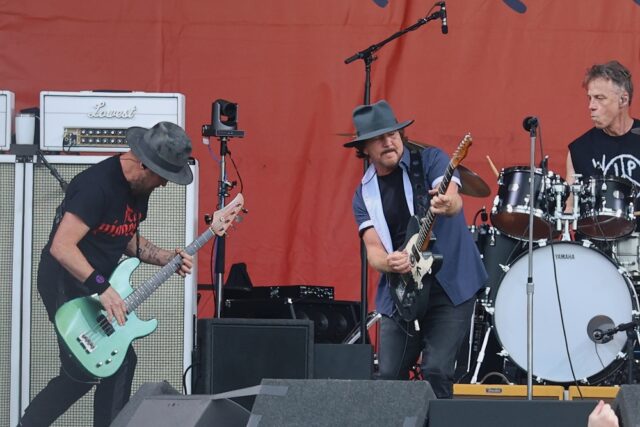
Pearl Jam concerts feel like a gathering of friends and family (Photo credit: L Paul Mann / Shutterstock.com)
Sturgill Simpson has so endeared himself to fans that his latest album Mutiny After Midnight debuted last month at #3 on the Billboard 200 albums chart, despite (a) being released under the alias Johnny Blue Skies and (b) being only available via vinyl, cassette, or CD purchase. As of this writing, a month after its release, the album is not yet available on streaming services, though it can be purchased for $9.99 on iTunes. And the artist-to-audience feedback loop will continue as Johnny Blue Skies & The Dark Clouds promise to leave it all on the field with each stop of their upcoming tour, recently posting: “Touring behind Mutiny is something we greatly look forward to. Something we will cherish . . . We’re going out to play arenas and theaters with a vengeance. No opening act. We’re going to take every minute the venue gives us. We’re gonna rock this Mutiny as hard as humanly possible. It is our privilege and our honor because our fans deserve it.”

Sturgill Simpson purposely pushes the boundaries of the artist-to-audience relationship (Photo credit: Geoffrey Clowes / Shutterstock.com)
American Aquarium frontman BJ Barham has put in the work for 20 years, cranking out great albums, touring relentlessly, and working through multiple evolutions of the band’s lineup. His connection with fans is cemented by his openness and authenticity. His lyrics share stories of love, loss, and the occasional bit of bad behavior. He personally interacts with fans before and after shows. And his band’s social media presence is active, engaging, and informative. Barham is also refreshingly transparent about the business of music, such as recently explaining the economics of merch sales versus streaming (“Merch is the lifeblood of any touring band, including us. A $30 t-shirt is the equivalent of 10,000 streams on Spotify.”) and encouraging word-of-mouth promotion (“We are not a band that you’re gonna hear on the radio. We are not a band that you’re gonna see go viral on TikTok.”). When I saw American Aquarium play a hometown show in Raleigh a couple of months ago, next to me was a superfan from England who built a vacation—yes, a vacation from London, England to Raleigh, North Carolina—around the occasion.
In a way, these are essentially stories of brand strength. These are artists who are not only extremely talented in their art, but who are also invested in cultivating community with and among those who appreciate that art. Such mutually rewarding relationships, in music and beyond, are what we should all be trying to achieve.
