
Apple announced this past week that it will introduce advanced video capabilities in its Apple Podcasts app this spring, including seamless switching between watching and listening and dynamic video ad support, and that is indeed a very big deal. But video podcasting isn’t new for Apple.
Apple brought podcasts into iTunes in 2005 and supported video podcasts via RSS from the very beginning, offering both audio and video shows side by side. While there were technical limitations in that early RSS-based video implementation, including playback and monetization challenges, Apple effectively led the way in mainstream audio and video podcasting. Apple never stopped supporting video via RSS; it effectively stopped highlighting it. Those video feeds were siloed, the UI de-emphasized them, and search behavior generally pushed you to audio unless you specifically searched for terms like ‘video.’
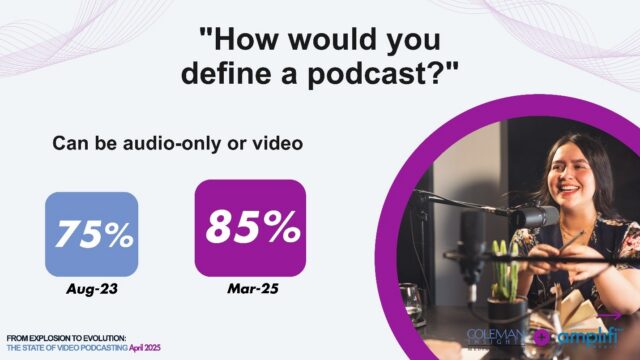
Meanwhile, a behavioral sea change took hold of the podcasting world, with a grip that isn’t going away any time soon. Amplifi Media’s Steve Goldstein and I, in our first video podcasting research study of U.S. podcast consumers 15-64 in July 2023, noted that consumers were reporting YouTube as their #1 podcasting platform. Even more interesting to us was something bubbling under the surface — the way consumers described podcasts was changing. In that study, 75% of podcast consumers defined podcasts as audio or video, while only 22% described podcasts as audio-only, despite the industry anecdotally seeing itself as an audio medium. The results of our March 2025 follow-up, “The State of Video Podcasting,” were striking in how fast this was moving. It showed that 85% defined podcasts as audio or video, compared to just 13% that said audio-only.
Reported podcast usage shifted in tandem with this shift in usage and definition, with a massive 77% of podcast consumers reporting they alternate between audio and video in the 2025 study.
YouTube was (and is) the biggest beneficiary of this, as it increased its lead in reported platform usage. To say this consumer shift has been a disrupter would be selling it short. Spotify pushed its chips in on video. Netflix recently announced its new initiative. The New York Times embraced video. Networks, creators, and agencies are all attempting to navigate the new world order.
A deeper look at Apple reveals bigger issues.
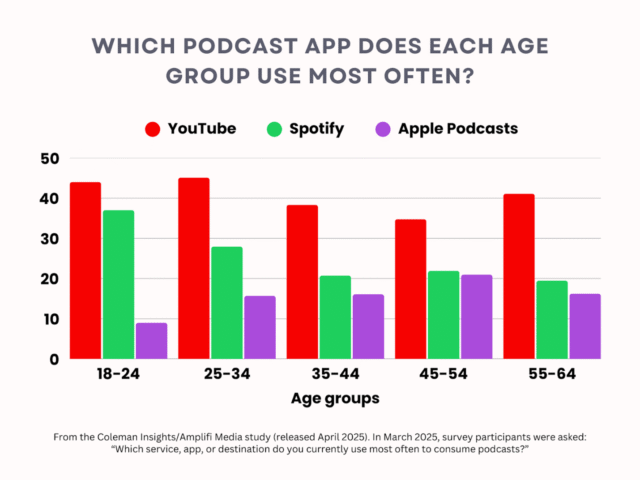
Transistor’s Justin Jackson, looking at our 2025 data, pointed out that Apple Podcasts has an aging problem: among younger listeners, especially 18–24, Apple’s usage drops into single digits while YouTube and Spotify enjoy dominant leads.
That’s not a problem video alone is going to fix.
Most pieces on Apple’s news seem to focus on the technical side of things. Instead of leaning on the old RSS‑based video feeds, Apple will now ingest video via its HLS streaming tech, enabling adaptive quality and seamless audio/video switching for users. On the monetization side, HLS also allows dynamic insertion of video ads. The industry does (and should) care about Apple’s move.
But this all begs a very (I would argue most) important question…
Will consumers care?
This isn’t to say this isn’t the right move by Apple. It absolutely is. As Tom Webster pointed out last week in referencing Sounds Profitable research, “About 42% of Apple’s video podcast consumers are spending more than half their podcast time watching video. These aren’t reluctant video viewers. They aren’t people who need convincing. They already want video — they’ve just been going somewhere else to get it.”
Although plenty of Apple engineers would surely disagree with me, the technical build was the easy part. The hard part is connecting the brand perceptual dots and tracking progress.
Consumers use YouTube for video because they think of it for video. Their satisfaction with the platform keeps them there. That massive image presents the biggest challenge for any other podcast platform to effectively compete in video, and that includes Spotify and Netflix, despite all their resources.
The long-term success of video on Apple Podcasts will be determined by Apple’s ability to first build awareness of the native app on the iPhone, particularly with younger consumers who may have no idea it’s there. In conjunction with and after this, the experience must not only be perceptually strong but should offer at least one important point of differentiation. In other words, if I’m already using YouTube to watch videos and Spotify to stream my music, why shouldn’t I stay there for my podcasts? What’s special about Apple that pushes me to open the Apple Podcasts app?
Kudos to Apple for getting (back) in the game. The focus they put on technical capabilities now needs to be matched by an equal focus on perception and positioning, because that’s ultimately how this move will be judged.
