Tag Archives: callout

Why Does My Radio Station Need Callout Research?

Today’s Tuesdays With Coleman blog first appeared in The Sands Report, the Alternative music newsletter written and published by Richard Sands.

At Coleman Insights, we think of callout research and streaming consumption data as valuable, and complementary, tools for those making decisions about which songs to add, drop, or change in rotation. Our goal is to provide a little primer on callout research and help explain why many successful programmers consider it an essential resource.

What is callout research?

For those unfamiliar with it, callout is a form of consumer research that routinely measures your target audience’s opinions on the new, current, and recurrent titles you are playing or are considering playing on your station. Typically conducted on a weekly or biweekly basis, each survey measures the familiarity and popularity of 30 to 40 songs. We want to learn if the listener is familiar with the song, and if they are, we then want to learn how much they like or dislike it. We can look at different segments of the audience, and we can track and trend these data over time. Additionally, metrics such as Hitcyle®, Burn, and Fit may be used to gain deeper insights on the titles being tested. Though this form of research is still commonly called “callout,” at firms such as ours, there is no longer any calling being done; instead, the surveys are conducted online.

Understanding the “whys” of behavior

As mentioned earlier, callout research data and streaming consumption data complement one another. In general, think of consumer research, such as callout, as a tool that helps you understand the motivations that drive consumption. I like to say that consumer research helps us understand the “whys” of behavior.

For example, Nielsen data may show that a radio station’s audience is smaller than desired, but why is that? Is the station off the radar screens of potential listeners? Is the format lane too limited in its appeal? Is the music recipe off in some way? Consumer research can answer these questions.

Photo credit: Shutterstock/fizkes

Along these lines, streaming consumption data may indicate that a song does not have much traction, but why is that? Do people not know the song? Do people know the song, but feel kind of “meh” about it? Do people know the song, but completely dislike it? Callout research can provide clarity.

Callout research is designed to generate success in radio

Of course, it is valuable to know which songs are being heavily consumed in streaming, just as it was once valuable to know which songs were being heavily purchased in physical, and then digital, form. That said, it is important to keep in mind that the songs that are most successful in streaming, like the songs that were most successful in sales, are not necessarily the songs that will be most successful for your radio station. It’s not that one system has it “right” and another has it “wrong”—they’re just different.

With the on-demand streaming chart, we’re essentially looking at the positive votes of those who have chosen to hear a song. Evident at the top, for example, may be the enthusiastic streaming of a popular artist’s new release.

But in radio, the full range of opinion matters because everyone listening to your station gets a vote. They vote by turning on and sticking with your station, or they vote by turning off or changing away from your station. And it’s impossible to give everyone exactly what they want. Thus, successful programmers are skilled in the art of coalition-building, creating an appealing shared experience for a large community of listeners.

In this radio paradigm, one can see how tremendously helpful callout research can be. When curating a radio station’s recipe, it is essential to understand both the positive and negative values that each song brings to the table. If, for example, you have two songs with equally passionate fan bases, but the first is disliked by 5% of listeners while the second is disliked by 25% of listeners, the latter would be a riskier choice that you would want to handle more carefully.

Photo credit: Shutterstock/Roman Samborskyi

Callout also helps you identify up-and-coming songs with low familiarity, but high evaluations among those who know them, giving you the confidence to get behind them and help build their familiarity. And on the other side of the lifecycle, some callout services have measurements such as Hitcycle or Burn that help you determine when it’s time to slow down the rotation of a song.

Additionally, a key benefit of local callout research is that it can be precisely focused on the audience you choose to target. Your market, your demographic criteria, your listeners, your competitors’ listeners—whatever parameters best align with your strategic needs. (While local callout research may be the gold standard, I should note that we also provide a national callout service, Integr8 USA, as a more budget-friendly option for high-quality callout data.)

In closing…

While callout has been the topic of the day here, I don’t want to leave you with the impression that callout is the only tool that matters when it comes to making decisions related to new music—but it’s certainly one that I’d want to have in my toolbox.


What Spotify Can Teach Your Radio Station about Christmas Music

At Integr8 Research, we routinely examine streaming data alongside our own callout for local clients and national subscribers for a full picture what music is most relevant right now. Generally, relevant music means contemporary music.

However, there’s a special time of year when the most relevant hits are decades—even centuries—old music.

While analyzing the Top 200 weekly streams in the U.S. on Spotify’s charts, we noticed that at the height of the holiday season in 2022:

  • 80 of the Top 200 songs on Spotify were Christmas songs.
  • Nine of the Top 10 songs on Spotify were holiday hits.
  • 50% of all streams among the Top 200 songs were Christmas songs.

Considering that Millennials and Gen Zers remain overrepresented among Spotify users, we can learn a lot about how Christmas music is changing by examining their Spotify usage.

Here are five insights your station should know about Christmas music from Spotify’s user data.

#1. YOUNG LISTENERS PREFER OLD CHRISTMAS TUNES

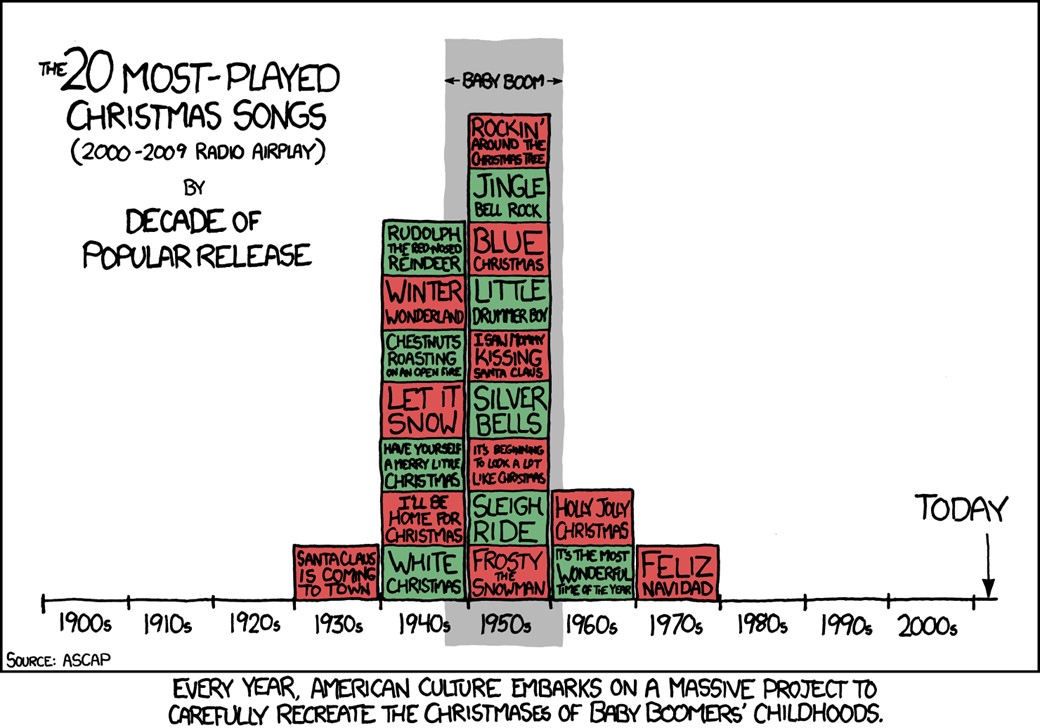
A decade ago, a popular meme highlighted how the 20 most-played Christmas songs on the radio were primarily a snapshot of the songs Baby Boomers heard on the radio when they were grade-schoolers:

The most played songs on radio are from the timeframe when Boomers were kids

Music nerds pontificated that those Boomer childhood chestnuts would eventually fade away as younger generations sought to recreate their own childhood Christmas soundtracks. The thinking went that, by the 2020s, songs from the 1990s and 2000s would dominate holiday favorites as younger generations sought to recreate their own childhoods, not their parents’ childhoods.

So now that the future is here, what are those 90s babies playing on Spotify to get them in the holiday spirit?

Perry Como.

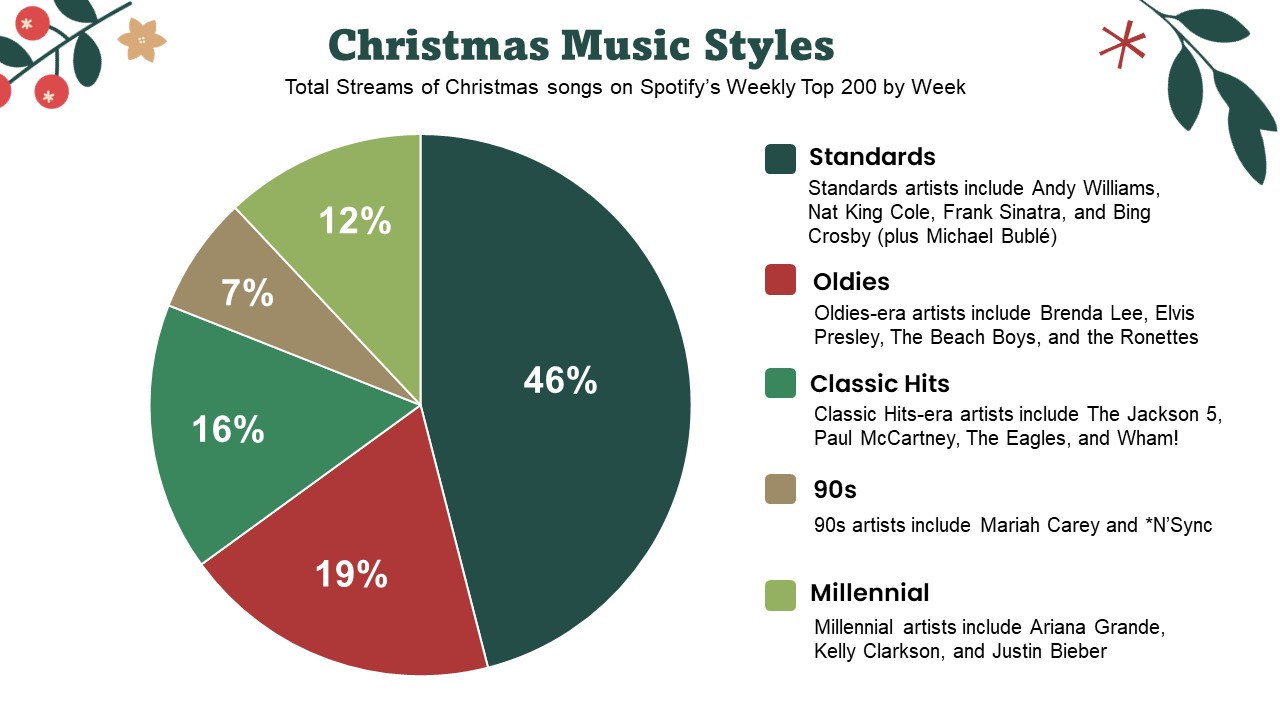
Christmas music on Spotify by genre

Almost half (46%) of the Christmas music that made Spotify’s Top 200 last year were songs from pre-rock era Standards artists. Bing Crosby, Nat King Cole, Frank Sinatra, and Andy Williams are the most-streamed Christmas crooners on Spotify, along with new Standards artist Michael Bublé.

The second most popular style, representing 19% of all Christmas music plays, are from pre-Beatles Rock ‘n’ Roll Oldies artists, namely Brenda Lee, Bobby Helms, The Ronettes, and Elvis Presley,

In aggregate, almost two-thirds of the most-played Christmas songs on Spotify are from styles and eras of music that radio abandoned decades ago the rest of the year.

What happened?

As Boomer parents played those songs for their own families, their kids grew to think of Bing Crosby and Brenda Lee as Christmas music artists, not one-time Pop superstars who also recorded Christmas songs.

As Chris Molanphy details in the Christmas music episode of his Hit Parade podcast, younger listeners often have no idea that one-time pop icons from Nat King Cole to Brenda Lee had dozens of massive hits in their day; They know these icons exclusively for their enduring Christmas hits. Ask a Gen Zer what genre Andy Williams performs, they’ll likely tell you Christmas music.

Today, Christmas music isn’t simply Boomers’ memories of their childhood Christmas: It’s everyone’s childhood Christmas memory.

#2. SECULAR SONGS DOMINATE ON SPOTIFY

There is a striking difference between the songs many associate with Christmas and the Christmas songs Spotify users play most: Little Drummer Boy, O’ Little Town of Bethlehem, The First Noel, and Silent Night will all be on your radio this year. However, no versions of these classic carols are among the 80 holiday titles that made the Spotify Top 200 last year.

In fact, only three (3) of the 81 Christmas songs that made Spotify’s Top 200 last year reference the nativity; Bing Crosby’s renditions of “Do You Hear What I Hear,” and “God Rest Ye Merry Gentlemen” and “Joy To The World” from Nat King Cole.

Religious affiliation and church attendance is declining in the United States. Are religious Christmas songs losing their relevance as Americans become less religious?

We’ll stay in our new music lane and let Barma Research tackle Christianity’s weekly cume erosion.

#3 FOR SOME, CHRISTMAS STARTS NOVEMBER 1ST.

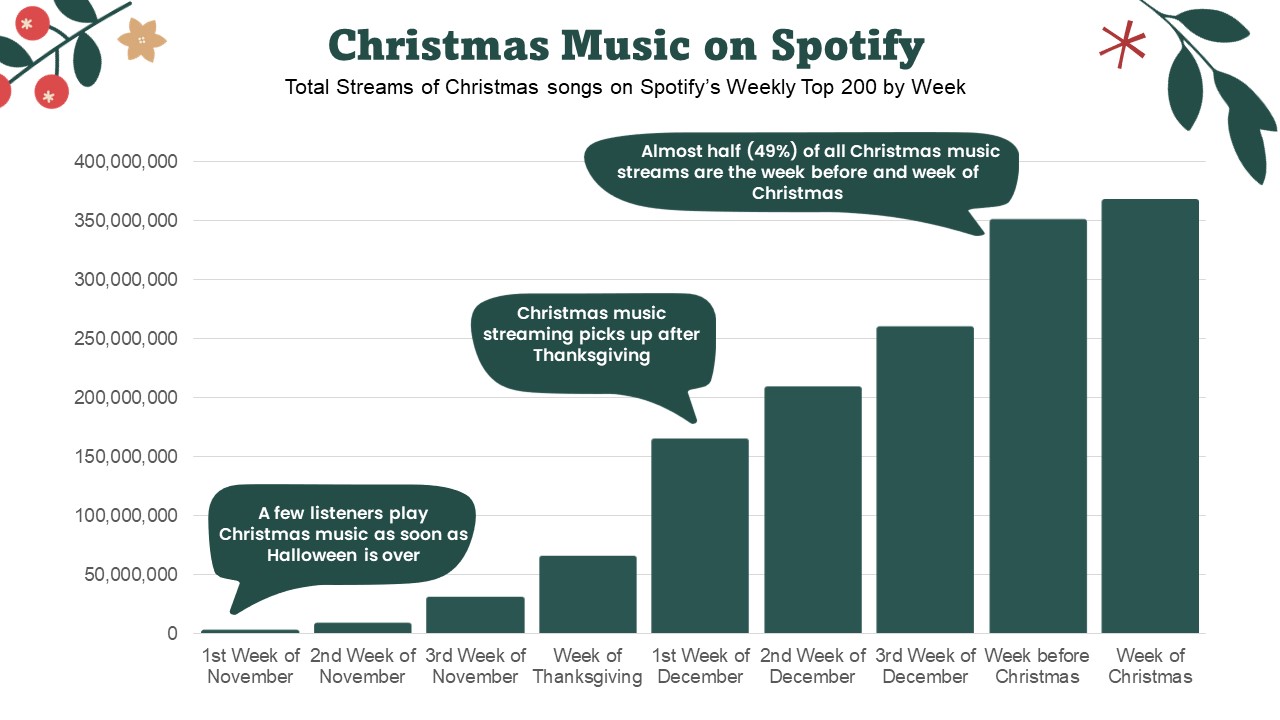
In the week immediately after Halloween, while decent people are still sucking down Pumpkin Spice stuff, there are Americans among us who collectively play Mariah Carey’s “All I Want for Christmas” almost 2 million times on Spotify.

It’s only the 149th most-played song for that first week in November.  But still…

Thaw Mariah Carey for the Christmas season

Christmas music continues growing throughout November, but truly takes off after Thanksgiving, just as the good Lord intended: Plays of Christmas songs on Spotify jump 2 ½ times during the week immediately after Thanksgiving.

Ultimately, almost half of the plays of holiday titles on Spotify occur during the week before and the week of Christmas.

Once Christmas is over, however, Americans’ appetite for yuletide cheer goes away faster than your mom cleaning up giftwrap. During the week of New Year’s Day, not a single Christmas song remains among Spotify’s Top 200 songs.

Christmas music on Spotify: Total streams by week

#4: CHRISTMAS HITS REMAIN SOLIDLY STABLE YEAR TO YEAR

Here are the Top 5 Christmas songs on Spotify for the entire 2022 holiday season:

  1. Brenda Lee – Rockin’ Around The Christmas Tree
  2. Mariah Carey – All I Want for Christmas Is You
  3. Bobby Helms – Jingle Bell Rock
  4. Wham! – Last Christmas
  5. Andy Williams – It’s the Most Wonderful Time of the Year

What songs are gaining or losing appeal this year? So far, none:

The Top 5 Christmas songs on Spotify for the week of Thanksgiving 2023

  1. Brenda Lee – Rockin’ Around The Christmas Tree
  2. Mariah Carey – All I Want for Christmas Is You
  3. Bobby Helms – Jingle Bell Rock
  4. Wham! – Last Christmas
  5. Andy Williams – It’s the Most Wonderful Time of the Year

For Christmas music fans, the classics abide.

WHAT THESE FINDINGS MEAN FOR YOUR RADIO STATION

1) If your station targets a young audience, know that they like old Christmas songs. Even among Spotify users who are younger than the general music audience, the appetite for Andy Williams is much stronger than for Ariana Grande. If your station simply sprinkles in holiday hits, you may wish to limit your Christmas selections to those songs from contemporary core artists to align with listeners’ expectations of your music. If your strategy is to be the Christmas station in your market, however, you’d better bring the Bing.

2) Focus on snow and Santa. The songs that enjoy the broadest appeal among the younger user base for Spotify are songs evoking the spirit of the season, not the religious significance of the holiday. Unless you’re a religious station (obvi) or you’re in a market where listeners are far more likely to, “remember the reason for the season,” focusing on secular titles ensures your Christmas selections appeal to the widest possible audience.

3) The appetite for Christmas music steadily grows throughout the season. A few listeners are ready for Christmas right after Halloween. Others get into the spirit after Thanksgiving. However, half of all Christmas music streaming occurs during the two weeks leading up to the big day. This observation of Spotify usage confirms what many programmers have known for decades: Steadily increasing the percentage of songs of the season in rotation throughout December is a solid strategy.

4) Understand if your audience wants your station to play Christmas music. Younger listeners love Christmas music. Even at the height of the holidays, however, the majority of Spotify’s 200 most-streamed songs are regular songs. If your market has a dominant Christmas music station, you might be the station listeners go to escape the sleigh bells. Furthermore, perceptual research shows that if your market has a station with a dominant Christmas music image, it is very difficult to unseat that station.

“Matt, you promised us five insights.” That brings us to one more issue we need to clear up…

#5. THE REAL QUEEN OF CHRISTMAS? NOT SO FAST, MARIAH

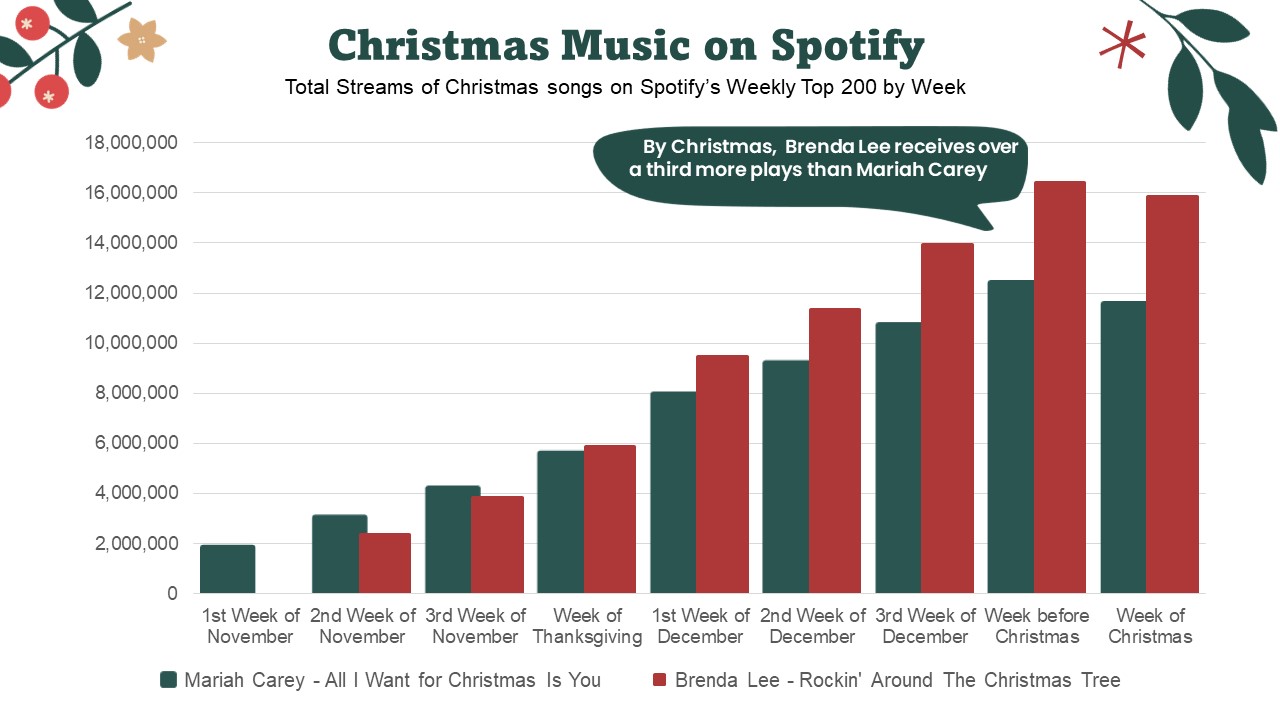
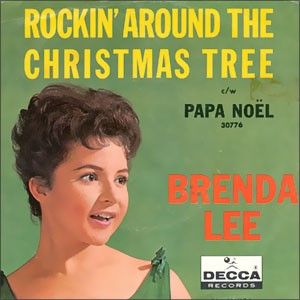
Early in the season, Carey’s “All I Want for Christmas” is the song Spotify users are most likely to play. Starting after Thanksgiving, however, Brenda Lee’s “Rockin’ Around The Christmas Tree” consistently garners more streams each week than what Carey wants. By Christmas week, Little Miss Dynamite is rockin’ over a third more plays per week on Spotify than is Carey.

Christmas music on Spotify: Mariah vs. Brenda

Hail to the real Queen of Christmas.

Brenda Lee Rockin' Around The Ch

The Hot New Radio Format You’ve Probably Never Heard Of

Right now, there are more people listening to this radio station than are tuned in to the #1 station in Chicago.

Its logo is so iconic; fans use it in memes.

Even the New York Times has written about it.

The thing is, technically it isn’t a radio station. It’s a YouTube channel called Lofi Girl

Lofi Girl’s main video is a 24/7/365 stream called “lofi hip hop radio – beats to relax/study to”. The channel has 12-million YouTube subscribers and between 30,000 and 60,000 listeners at any given moment. The channel’s music is accompanied by an animated image of a girl studying while wearing headphones and a listener chat thread.

LoFi Girl

True to the name, the stream plays Lofi Hip Hop—or simply Lofi—a style of instrumental music that merges hip hop beats with slow and simple melodies and ambient sounds into hypnotic but non-obtrusive music. It’s intentionally and unapologetically background music, intended to help you “relax” or “study.”

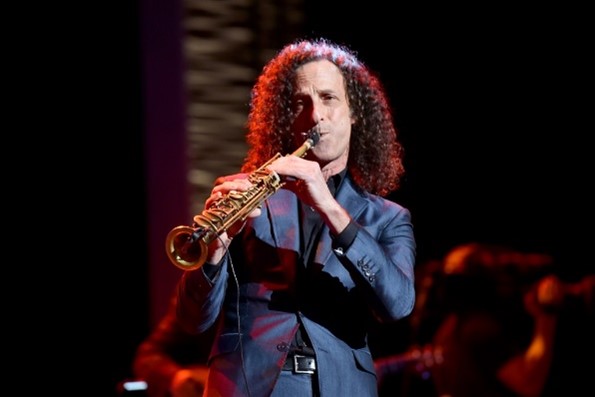
Don’t let the Hip Hop moniker fool you. While the beats are from that genre, there’s no rap—or any words—in Lofi Hip Hop. Its vibes are more Kenny G than Kendrick Lamar.

Kenny G

The genre is so intentional in its purpose of blending into the background that the music avoids very low base and very high treble, focusing on the 200Hz to 10kHz range—hence the “Lofi” name. The idea is that since fans are listening on headphones, limiting the frequency response of the music will better blend the beats the listener hears in their headphones with the random and distracting noises in their environment.

Lofi also leaves in imperfections, from beats that aren’t always on beat to ambient noise. For such a minimalist music style, it is those imperfections that give the music character.

SOUNDS FAMILIAR?

This meticulous musical engineering of a relaxing mood might sound vaguely familiar to radio pros old enough to remember the 1970s, when the Beautiful Music station was often the highest rated FM in town. (Jim Shulke, Elevator Music’s #1 syndicator, demanded meticulous detail to sound levels, audio qualify and format execution from subscribing stations to scientifically maximize TSL)

Then came Smooth Jazz in the 1980s, when Al Jarreau, Dave Koz, Acoustic Alchemy and Spyro Gyra provided the new-age chill after a hard day for sophisticated yuppies.

There’s a fundamental difference, however, in Lofi’s fan demographic: Its appeal stems nearly entirely from Gen Zs in their teens and early 20s.

It’s their parents who are lambasting the genre, as in this New Yorker article that called it Apathetic Music to Make Spreadsheets To.

KIDS THESE DAYS

Why are kids embracing an Easy Listening genre? It makes sense when you understand today’s teenagers.

Their childhood has seen financial uncertainty, political divisiveness, climate fears, European and Middle East wars, and a deadly pandemic. For college bound teens, choosing the wrong school—where a degree’s earning potential can’t pay off the massive student loan debt—is a financial life and death decision.

As generational historian Neil Howe highlights in his new book, while we Generation X teens craved more freedom from a society with stifling structure, today’s teens are craving security from a society with crumbling structure.

No wonder they’re embracing music that takes the edge off.

In our lifetime, softer styles of music have always attracted older ages of listeners. Each new generation has pushed popular music to harder places. Rock led to Metal then to Grunge. Soul became Funk became Hip Hop.

That Michael Bublé CD you bought was for your mom, not your kids.

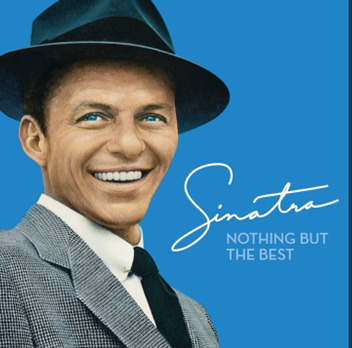
However, we have seen this pattern before just before this blog’s oldest reader was born. The Silent Generation kids who grew up too young to fight in World War II turned popular music tastes away from the ballroom-oriented Big Band style popular among the Greatest Generation and towards the crooners and small jazz combos you’d enjoy in your bedroom. They made music softer.

Frank Sinatra

In our time of crisis and confusion, young people are changing popular music comparably.

Lo Fi’s Gen Z appeal also explains why it’s not on radio’s radar: As FM radio’s TSL becomes increasingly generated by listeners over 30, we’re simply not probing the tastes and mindsets of music fans under age 25. That’s a mistake.

Lofi probably isn’t a viable FM format. However, understanding why Lofi appeals to Generation Z could help us—as Coleman Insights’ Jay Nachlis highlighted—evolve our existing formats to be relevant to Generation Z, from our presentation styles to our social media engagement—and even our audio processing.

Even though it’s a YouTube channel, make no mistake: By providing a constant stream of curated music designed to fulfill a specific emotional need, “lofi hip hop radio – beats to relax/study to” is a radio station.

Why Country is Kicking It in ‘23

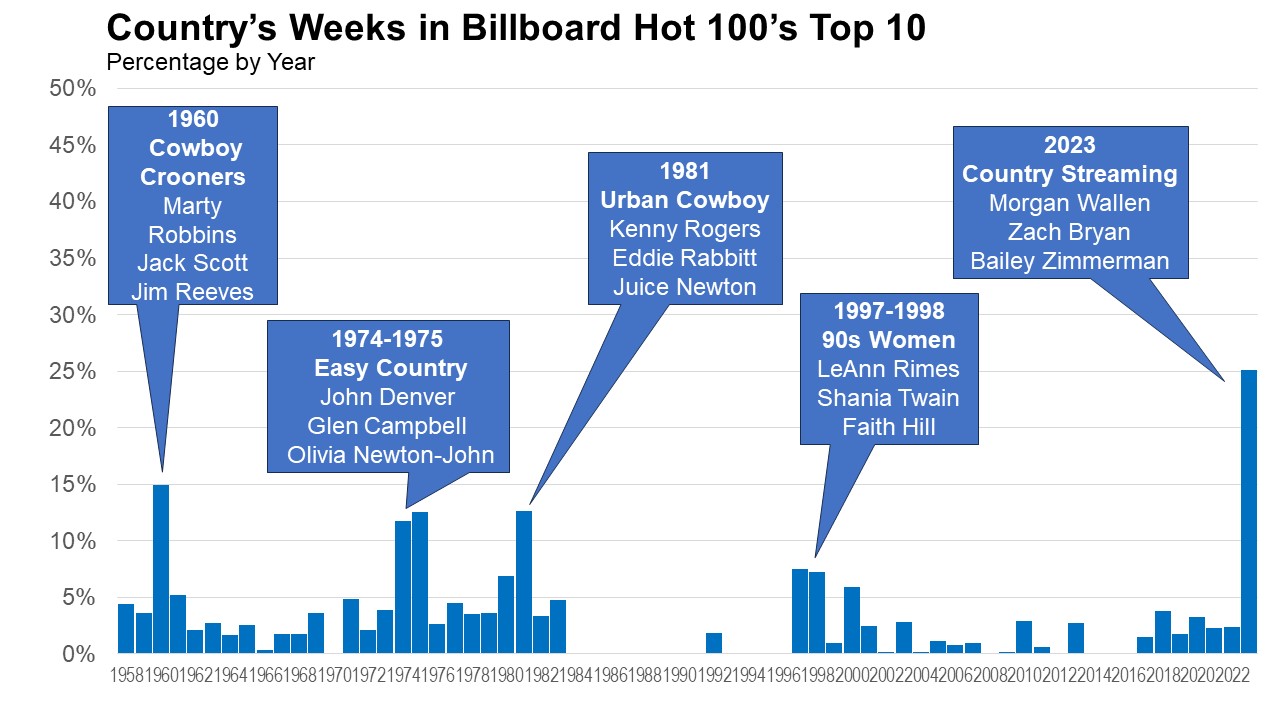
The last few years were tough for Country. The genre has always maintained its passionate fan base, but that fandom simply hadn’t translated into music consumption. From 2017 to 2022, when considering the combination of radio audience exposure, song sales, and streaming plays, a scant 2% of the most popular songs in the U.S.A. in any given week were Country songs, according to the Billboard all-genre Hot 100 chart.

Some programmers at the Country Radio Seminar (CRS) expressed such serious concern about the format’s future health in those years, you’d think they were discussing Smooth Jazz.

This year, everything changed.

Country has enjoyed several popular periods during the Rock Era, but none as big as 2023

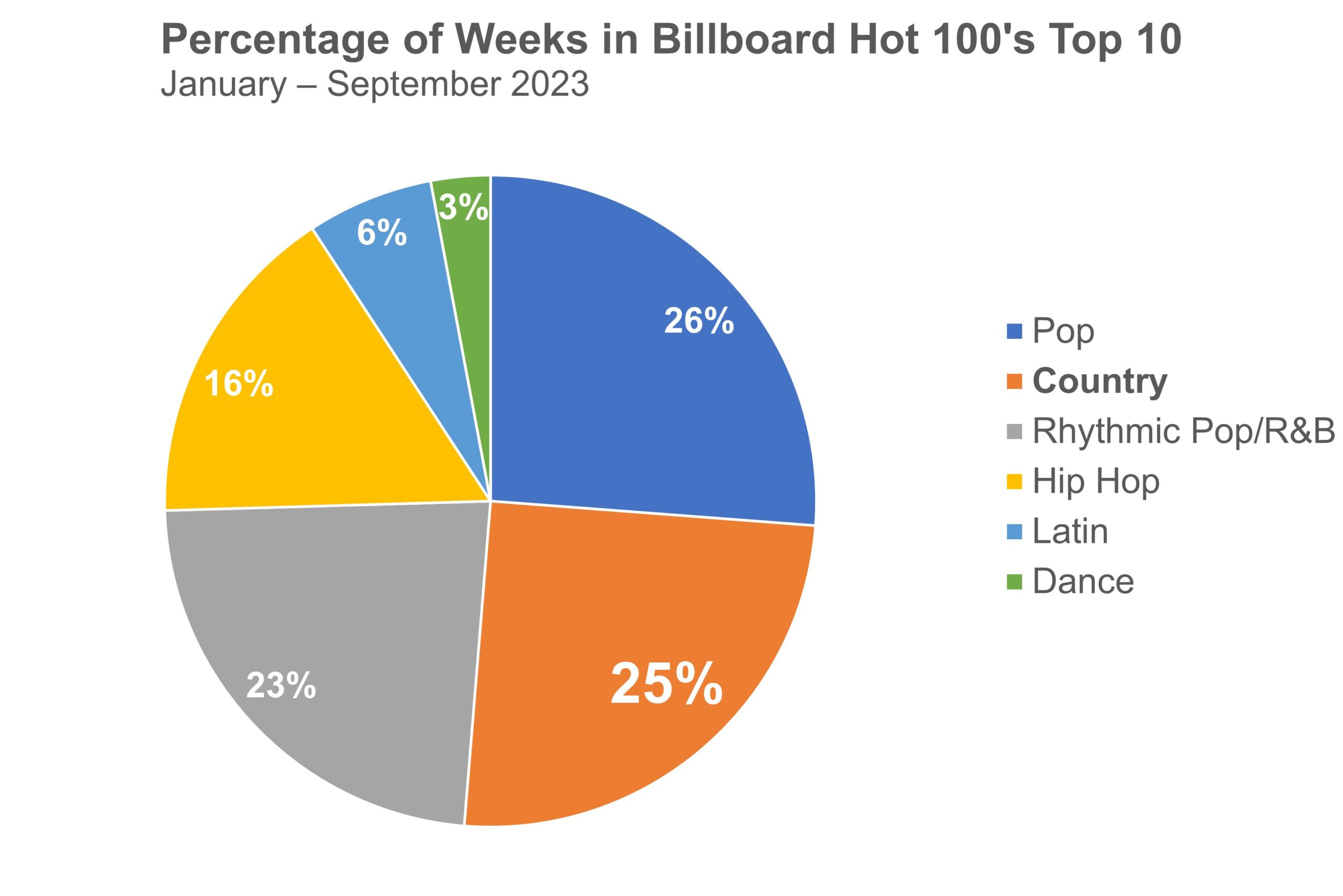
Through the end of September 2023, about a quarter of the Top 10 songs on Billboard’s all-genre Hot 100 chart in a typical week this year have been Country songs. Country is spending more time in the Hot 100’s Top 10 than any genre other than Pure Pop.

Yes, Country has even been bigger than Hip Hop in 2023

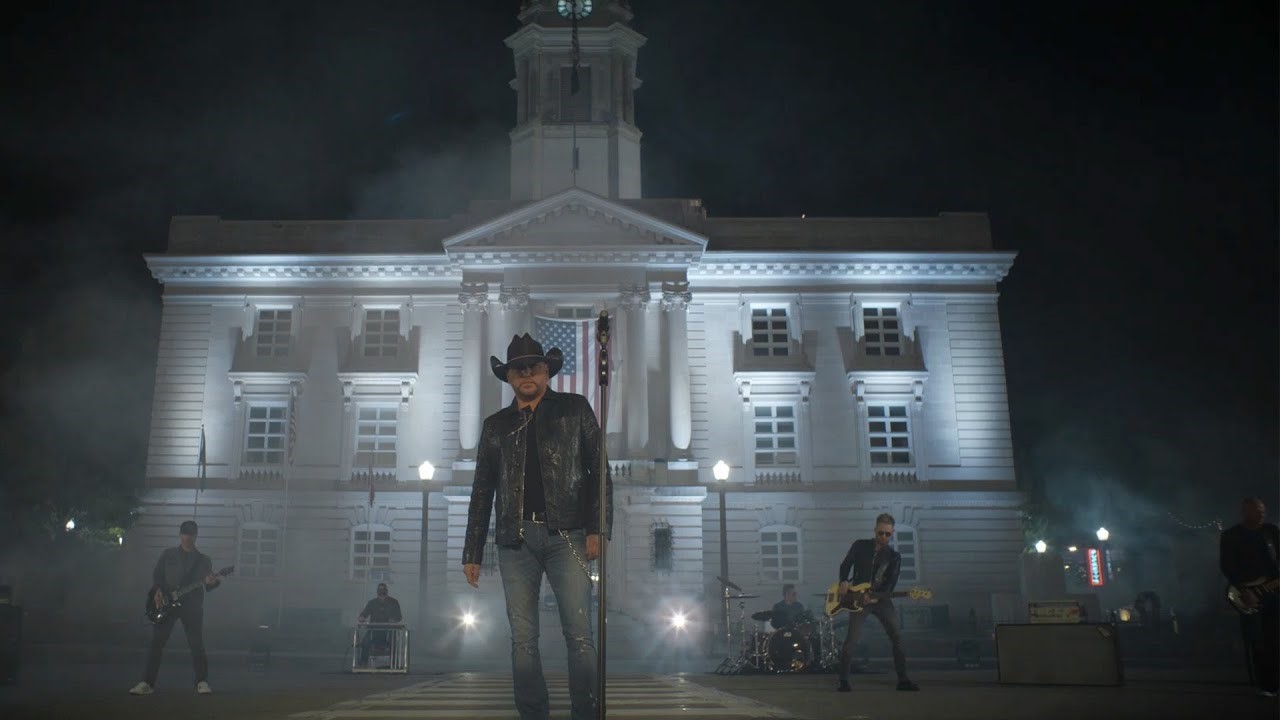
Some of those songs, such as Morgan Wallen’s “Last Night”          and Luke Combs’ “Fast Car,” have also received significant CHR and AC radio airplay. Other songs, such as Zach Bryan’s 2022 holdover, “Something in the Orange,” have been massive streaming hits, even as Country radio hasn’t been quite sure what to make of it. Finally, some songs have been political lightning rods, namely Jason Aldean’s “Try That in a Small Town” and Oliver Anthony Music’s “Rich Men North of Richmond.”

This summer’s radio ratings confirm Country’s ascension. Country’s nationwide audience share grew 5% from this spring to this summer—the only contemporary format that grew in the summer of ’23.

Why is Country suddenly on fire and what does this burst of Country consumption mean for how you program your station?  Let’s dive into three causes of Country music’s strong appeal—and one big thing that is not causing it.

REASON #1: COUNTRY FANS HAVE FINALLY EMBRACED STREAMING

When streaming eclipsed paid digital downloads in the mid 2010’s, Hip Hop fans were first to jump from iTunes to Spotify. As late as 2018, seven of the Top 10 most-streamed songs in the U.S were Hip Hop.

By 2021, however, mainstream Pop fans had fully embraced streaming. It was the first year that seven of the 10 biggest streaming hits were Pop, with the remaining three titles categorized as crossover Pop Hip Hop. Streaming finally mirrored mainstream CHR.

All the while, Country was Missing from Streaming.

Part of it was age. Unlike contemporary formats that appeal primarily to teens and young adults, Country appeals to everyone from Boy Scouts to Branson visitors. That audience includes a significant number of listeners over age 40 who had not given streaming a shot.

Some of it has been loyalty to their local Country stations. More so than other formats, Country listeners generally find their P1 station satisfies their musical appetite. If it ain’t broke, why fix it?

As with so many things in 2020-2022, however, the pandemic changed those habits.


With commuting and lifestyle habits disrupted, Country fans sampled streaming and stuck with it. Country fans already comprised a strong portion of Amazon Music and Pandora users before 2020. Now, Country fans are now using Spotify, streaming music’s dominant platform. About 60 percent of Country radio listeners in our nationwide Integr8 USA Country research also listen to Spotify weekly—comparable to Alternative and Pop listeners nationwide.

With Country fans now fully embracing streaming, Country music’s total consumption is no longer reliant on airplay and song sales alone. In other words, Country’s consumption finally correlates to its fandom.

REASON #2: THE EMERGENCE OF NEW STARS THAT APPEAL TO YOUNGER FANS

The first Country superstar of the streaming era is Morgan Wallen. He appeals to the same young adult audience that’s been using Spotify and YouTube for years. However, Wallen is also arguably the first major Country artist to release music with streaming in mind, including famously long track-laden album releases and using TikTok to connect with fans.

Thanks in large part to his streaming numbers, Wallen has generated eight Top 10 hits on the all-genre Hot 100 chart. His Dangerous: The Double Album toppled 90s-era records for the album with the most weeks at Number 1.

Like Wallen, Zach Bryan enjoys strong appeal among younger Country fans who grew up with streaming. However, he’s even further removed from the traditional tactics of Music Row, beginning his career by uploading his songs to YouTube and sharply criticizing the industry. While Country radio doesn’t know what to make of him, Bryan’s breakthrough hit “Something In The Orange” doesn’t need the airplay. It’s been among the most streamed songs on Spotify for well over a year now and Bryan is playing packed concerts because of it.

Country has a history of new superstars invigorating the genre with younger fans. Garth Brooks merged authenticity of late 80s New Traditionalism with the sensibilities of 70s Classic Rock to sell more albums than any other artist of the 1990s—in any genre.

REASON #3: COUNTRY HISTORICALLY DOES WELL WHEN CHR STRUGGLES

The early 80s were one of the darkest periods for Top 40 radio. Anti-disco backlash kept anything remotely rhythmic off most mainstream hit stations, but MTV-fueled New Wave hadn’t yet revitalized the format.

Amid those days of Air Supply and REO Speedwagon, Disco’s #1 movie star ditched his white suit for a black hat in Urban Cowboy, the 1980 film where John Travolta remakes Saturday Night Fever at Gilley’s nightclub in Pasadena, Texas. The movie sparked a cultural phenomenon that did for Country’s mainstream appeal what Saturday Night Fever did for Disco.

From 1980-1982. the Hot 100’s Top 10 included multiple pop-friendly hits from Kenny Rogers, Eddie Rabbitt and Juice Newton. Johnny Lee, Ronnie Milsap and The Oak Ridge Boys also found non-Country fans for bona-fide Country songs. Finally, Dolly Parton cemented her place as an American icon with both the movie and the song “9 to 5”.

This burst of interest in Country at a time when CHR is struggling isn’t unique. Guy Zapoleon’s 10-year music cycle shows that Country typically does well when CHR is in the depth of its Doldrums phase. Between Elvis and The Beatles in the early 60s, Rock ‘n’ Roll was awash with genuine Country classics from Marty Robbins and Jim Reeves, plus some Native American themed novelty songs better left in history’s dumpster.

During times when CHR struggles to find consensus hits, songs with Crossover potential are more prone to find a Pop audience, as Morgan Wallen’s “Last Night,” Luke Bryan’s remake of Tracy Chapman’s “Fast Car”, and Jelly Roll’s “Need A Favor” easily find an audience beyond Country’s core.

NOT A REASON: POLITICS

Of course, we have to talk about those songs.

Two particular songs have received more attention than the rest of 2023’s Country hits for their political overtones: Jason Aldean’s “Try That In a Small Town” and Oliver Anthony Music’s “Rich Men North of Richmond.” On the charts, however, these two titles only account for 8% of Country’s time in the Top 10 this year, significantly underperforming non-political tunes from Morgan Wallen, Zach Bryan, and Bailey Zimmerman.

Our own Integr8 USA Country report, which surveys Country radio partisans nationwide, shows that more listeners dislike both “Small Town” and “Rich Men” songs than every other song we’re testing.

Yes, these tracks have ardent fans. But Country would still be having a historically phenomenal year without them.

ADVICE FOR RADIO

So how can your station maximize Country’s success? Here are three tips for Country programmers, plus one for Pop.

1) Fully examine the appeal of up-and-coming streaming stars with your audience. It’s been all too easy in recent years to assume artists like Zach Bryan and Kacey Musgraves are niche artists that don’t appeal to mainstream Country radio listeners. But listeners are changing. The Country artists that perform well on Spotify appeal to younger listeners in your audience. Yes, there may emerge some artists with strong streaming stories that simply don’t catch on with mainstream Country radio listeners. However, making that decision based solely on how they sound is a mistake. Examine these songs’ appeal in your own research (or in our Integr8 USA Country report) with the same thoroughness and patience you would give to traditional stars with proven track records. After all, today’s rebels are tomorrow’s legends.

2) Be careful with songs that make strong political statements. Songs that take strong stances on contested issues not only make the news; they also easily rile up an audience that wants to support that song’s statement. A few thousand iTunes downloads or a few days of binge-streaming can make a song look huge in the moment. Does that support for the statement translate into passion for the song? More importantly, does the song alienate a significant portion of your audience? Merle Haggard, Hank Williams Jr., Randy Travis, Garth Brooks and Brad Paisley have all had hits that made political statements on controversial cultural issues, so you shouldn’t rule out every song that takes a stand. Just be skeptical of the hype such songs have the power to generate today.

3) For CHR and AC stations, don’t ignore potential crossover hits. Both streaming data and callout research validate that several Country songs this year also appeal to Pop fans. Not every song has crossover potential. Some market’s non-Country P1s are more open to Country crossovers than other markets. As CHR and AC stations struggle to find strong songs from other genres, however, ignoring a song simply because its also a Country hit is a mistake.

4) Long range, remember that Country ebbs and flows, but it always endures. Radio history shows that Country is at its best when Top 40 Pop is at its worst. However, history has also shown when Pop inevitably makes a comeback with a reinvention of its style, Country struggles. When MTV New Wave reinvigorated CHR, Country was in crisis as the crossover appeal of the Urban Cowboy fad crashed. Burned by fickle city-slickers, Country embraced neo-traditionalism, a sound focused on Country’s core fans and traditional aesthetics. Randy Travis and George Strait became superstars. In turn, they launched the now revered 90s Country sound, including Garth Brooks. Country has been a viable radio format ever since the launch of the WSM Barn Dance in 1925 (which you know as the Grand Ole Opry).

The Paradox of Playing New Music

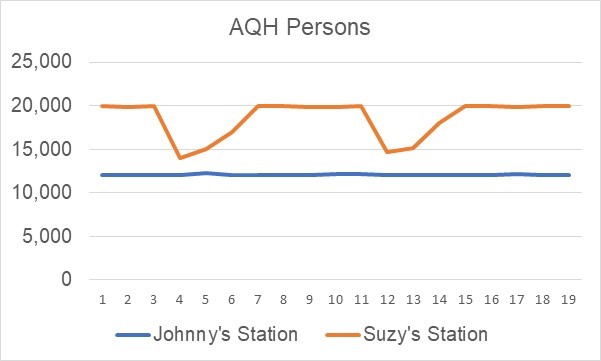
Johnny’s radio station typically has 12,000 listeners in a key daypart and that audience remains stable throughout the daypart.

Suzy’s radio station has as many as 20,000 listeners in that same key daypart, but sometimes her audience falls to as few as 14,000 listeners several times during the daypart.

Whose station has a bigger AQH Persons audience for the daypart?

Example of two station's AQH shares

It’s not a trick question.

It’s also not a rhetorical question.

It’s a real-world example of the decisions many radio stations make when basing programming decisions primarily on avoiding tune-out without evaluating what factors cause listeners to tune in.

I once worked with a heritage CHR station whose ratings had consistently slid over the past 18 months. Management was dumbfounded: They were meticulously following their callout research’s Pop scores. They scrutinized M-Score. They knew they were playing the songs listeners knew, loved, and stuck around to hear. They’d seen their minute-by-minute meter counts stabilize by avoiding brand new songs and keeping the best-testing songs in power rotation. Nevertheless, those meter counts—while stable in the moment—continued slipping each month.

A perceptual study with Coleman Insights crystallized the problem: Listeners had long counted on the station to keep them up to the minute with the music scene. In just two years, however, the station’s image for playing the latest new music plummeted, replaced by a strong reputation for playing too many tired and stale songs. As more and more listeners felt the station was musically out of touch, they tuned in less and less frequently, as the station failed to live up to their expectations.

Coleman advised the station to move songs out of power categories after 26 weeks of exposure. Coleman also advised the station to give sufficient rotations to the most strategically relevant new releases, no matter how badly they first looked in callout or M-Score. Within a year, the station’s ratings rebounded while it regained its reputation for relevance.

Yin-Yang

This true tale is the paradox of playing new music.

When it debuted, PPM glaringly spotlighted the negative impact new, unfamiliar songs have on a station’s meter count in the moment. In contrast, the most well-known songs typically cause the least tune-out. Strictly looking at Popularity scores in callout research validated that, yes, songs that listeners know and love have higher scores than brand new releases that listeners have barely heard.

But when you talk to listeners in perceptual research, focus groups, or at a station event, they’ll tell you a key reason they choose a contemporary radio station is to stay up to date on the latest music. They want to know about those new songs from their favorite artists. They want to hear from new artists that are bending the trends their way.

That’s the paradox of playing new music.

The challenge is that while PPM made it easier to gauge which programming elements cause listeners to tune out in the moment, it is much less obvious to see which programming drives listeners to turn on your station in the first place.

Building tune-in occasions requires months—sometimes years—of branding through well-coordinated external marketing, promotions, and programming. It means breaking listeners’ old habits. It requires that listeners reset a preset for you. Even when ratings growth says you’re winning, you’ll often need perceptual research or focus groups to fully understand which aspects of your brand drive usage.

Modern car radio display

In contrast, tune-out only takes seconds.

It is right to avoid unnecessary tune outs, especially given the time and effort it took to get those listeners to tune in. So, what do you do when the very same programming element that causes tune-out right now also generates tune in tomorrow?

Here are four ways you can do it.

1) Have your personalities get listeners excited about new songs: Radio used to be really good at introducing listeners to new songs. Personalities would hype a new song from a core artist. They would give us the back story of a brand-new artist that piqued our interest. They would share their own excitement for brand new songs. But when PPM said we lost meters when we played those new songs, we threw out the Bubble Bath that made the bathwater inviting. Given how passionate most radio personalities are about music—especially songs they haven’t already played 1,200 times—accomplishing this goal merely requires unleashing our air talent.

2) Bet big on the songs you believe will be hits: Your gut tells you this song will be huge. But you put that new release in a low rotation category or limit it to low listenership dayparts “just to be safe.” Unfortunately, this practice keeps songs perpetually in that very state of unfamiliarity that causes tune out. A better approach is to play the song often, play it 24/7, and let listeners hear it enough to definitively embrace or reject it. Your top salesperson will tell you that the most effective advertisers on your station air their spots frequently. It takes multiple times hearing a message for it to sink in. That doesn’t happen when too much time passes since the last time they hear that message, however. Our brains work the same for songs and spots.

3) Strictly limit the number of new songs you add: Since you’ll be airing your new releases frequently, strictly limit your slots for new songs to the very few songs you most passionately believe will blow up. Not only does this practice ensure most of the songs you play are already hits, but it also means your listeners only have a couple of new songs to get to know.

4) Interpret ratings strategically: You lost some meters when you played that new song. Could that song be the reason listeners tune in next month once it’s a hit? Did the meters that left belong to the P1s who expect you to keep them up to date with the culture, or are they P3s who only tune in occasionally when their Classic Hits station is in a stopset? Is the in-tab even high enough to trust the tune-out? The most reliable way to tie ratings data to the health of your station is if your audience keeps growing quarter to quarter.

Given the dearth of sure-fire hits these last few years, the tough books for CHR stations, and young listeners rediscovering old music, it’s understandable why many traditionally contemporary stations are leaning in to proven library hits. As a lifelong radio fanatic, however, I worry that if our entire medium plays it safe today, it could cost radio its relevance tomorrow.

Introducing Integr8 USA: Real Callout Research You Really Can Afford

The most frustrating thing I face in my work with Integr8 New Music Research is talking with a station who really wants callout research, but whom we simply aren’t able to help.

Sometimes, the cost of customized local new music research—even for the most bare-bones program we can offer—doesn’t financially make sense for the station. In a few cases, the station is in a market that’s too small for us to reliably recruit enough listeners.

I’m sure it’s far more frustrating for those stations’ PDs than it is for me.

Historically, if you couldn’t get custom local new music research, you couldn’t get real research—at least not from us or other respected music research firms. It was your own local callout or nothing.

That’s left stations in small, medium, and even many large markets with subpar resources, from using Mediabase or BDS Radio (R.I.P.) to see what big city stations are playing (with the assumption that they have and are effectively using good callout), to scouring Billboard charts or trying to decipher streaming data.

Radio deserves better.

That’s why I’m excited to announce Integr8 USA. And while I shudder to think I’m sounding like your sales manager here, it really is a big freakin’ deal.

Integr8 USA logoWHAT IS INTEGR8 USA?

Integr8 USA is a nationwide subscription new music research service, available for individual stations and groups for whom custom local callout research doesn’t make sense. When it launches this June, Integr8 USA will offer CHR, Hot AC, Alternative, and Country stations access to real new music research. Since it’s nationwide data that’s shared with other subscribers nationwide, Integr8 USA costs substantially less than having your own local callout.

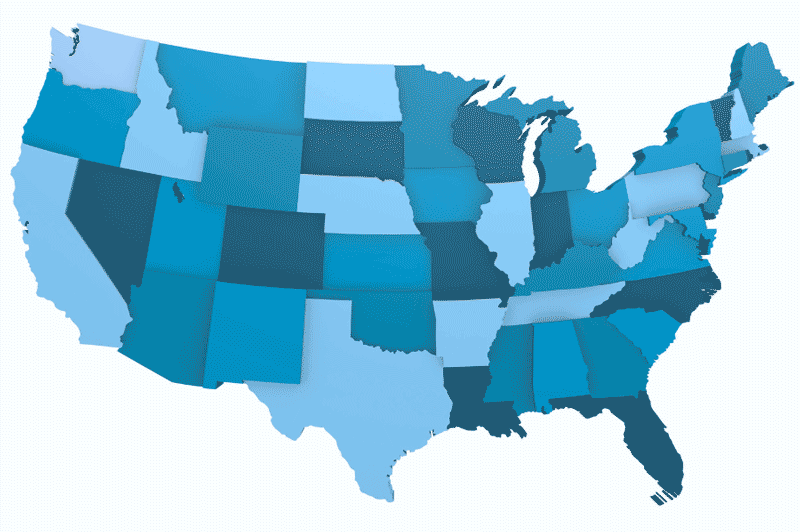
A truly nationwide sample of radio listeners recruited specifically for Integr8 USA: Unlike other offerings, Integr8 USA is not a Frankenstein mashup of data we’ve collected for other stations. (As always, that data remains the proprietary property of each client.) Instead, we’re recruiting radio listeners that truly reflect the whole USA, from big cities to small towns, from Manhattan to Modesto, from Destin, Florida to Duluth, Minnesota. Integr8 USA breaks out data into five distinct regions mirroring U.S. Census Bureau designations.

Subscription map

Real listeners who really are paying attention to the music:  Integr8 USA uses the same multi-methodological recruitment we use for local clients to ensure we’re finding a representative cross sample of relevant radio listeners. It also uses the same 17-factor quality control system Integr8 Research uses to ensure listeners are who they say they are and are really paying attention to evaluating the music.

FIVE THINGS INTEGR8 USA TELLS YOU ABOUT EACH SONG

There are plenty of numbers you can find about new music; airplay ranks, streaming plays, iTunes downloads. Integr8 USA is different. You’ll see a complete picture of how Americans who are fans of your format react to each song:

  1. Do listeners love a song, or do they merely like it? Some songs have a cult following, but never catch on with a broader audience. Others might not elicit strong passion, but they’re songs listeners universally like. Integr8 USA will give you the information to program each song accordingly.
  2. How many listeners hate a song? Simply examining airplay or streaming data can’t tell you how many listeners hate a song—and for radio, haters matter. They tune out when you play songs they passionately dislike. Integr8 USA will help you identify the songs that might garner plays on Spotify, but will drive away your listeners.
  3. How familiar is a song? Integr8 USA you can spot the songs that all your listeners know verses which songs have strong potentail if more listeners get to know them.
  4. How do different segments of your audience feel about a song? In these times, there are songs that are wildly popular among Gen Z listeners, but simply don’t connect with Millennial listeners. You’ll spot which songs enjoy wide appeal versus the songs that have passionate but limited fan bases not only by age, but also by gender, ethnicity, and region.
  5. When should I move a current to recurrent? Integr8 USA includes our proprietary Hitcycle® measure to tell you exactly when listeners are ready for you to move each song to recurrent rotation.

This information is the same depth of insight Integr8’s customized research clients receive. Integr8 USA delivers that information in MusicMeetingSM, the same online interactive report platform our clients with their own local callout use.

So, what’s the catch?

While there’s no catch, there are compromises when compared to having your own callout.

SHARING SAVES MONEY—BUT DOES COME WITH SOME SACRIFICES

Subscribers to Integr8 USA share the research. That means you share our cost of recruiting, vetting, and interviewing listeners to your format. As with any shared resource, you will have to give up some things our custom local research clients have:

  • You won’t have total control of the test list. We’ve partnered with a team of top programmers to select the most relevant current music in each format. As a subscriber, we’ll solicit your feedback to know if there’s a song or two you think we’re missing. You won’t, however, be able to personally compile your test list.
  • You’ll need to filter the results to mirror your station’s audience. For Integr8’s local research clients, we tailor the sample specifications and reports to precisely reflect that station’s market and music strategy. In contrast, Integr8 USA interviews a broader makeup of American radio listeners for your format, which means you’ll need to drill down to those listeners that matter most for your competitive situation. For example, you may wish to only examine Caucasian listeners if your market doesn’t have a large Hispanic population. Fortunately, Integr8 USA’s sample of hundreds of respondents per week allows you to dial in your demographics.
  • It’s not local. There are times when a song simply hits differently in your town than it does nationwide. While our clients with local Integr8 New Music Research see those differences, you’ll have to interpret Integr8 USA’s nationwide information with your own gut knowledge of your market. If your market has too much advertising revenue at stake to not understand your own local market, Integr8 USA isn’t for you.

For stations whose market size and revenue potential simply make callout cost prohibitive, Integr8 USA changes the math.

HOW TO DISCUSS THE DETAILS OF INTEGR8 USA

We’re offering Integr8 USA to both individual stations and radio groups. You can fund Integr8 USA with cash or barter.

Interested? Click here and my colleague Scott Musgrave will connect with you about the details.

I’d especially love to hear from you if you’ve tried to work with us before and we couldn’t help you affordably.

WEBINAR: Retention Rate: The Magic New Metric for Measuring Hit Potential in Streaming Data

Here’s our webinar from April 19th, 2023 introducing Retention Rate: The Magic New Metric for Measuring Hit Potential in Streaming Data.

This webinar shows real-life examples of how last year’s biggest hits performed on Spotify compared to how those songs performed in Integr8 New Music Research. You’ll learn the correct way to examine music streaming data to separate the songs that become enduring, mass-appeal hits among radio listeners–and those songs that quickly vanish.

Retention Rate: The Magic New Metric for Measuring Hit Potential in Streaming Data

Today’s Tuesdays With Coleman blog post comes courtesy of Matt Bailey, president of our sister company, Integr8 Research. Integr8 Research is focused solely on new music research, and Matt regularly offers thought leadership to his clients regarding the interpretation of streaming data. In this entry, he explains Retention Rate, a new metric to recognize which songs have staying power.

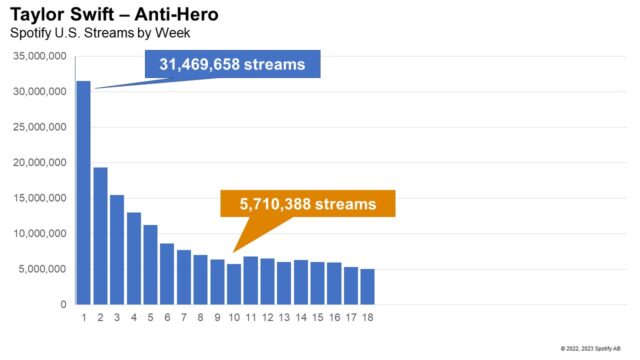
Within a week of its debut, Spotify users in the U.S. played Taylor Swift’s “Anti-Hero” a record-shattering 31 million times—more streams in one week than any other song at the time.

Naturally, CHR and Hot AC stations also immediately added the highly anticipated song by an iconic core artist.

Surely, with record-breaking streaming figures and substantial airplay, “Anti-Hero” was destined to be the most popular song of 2022, as validated by stations’ callout research, right?

Eh.

__________________________________________________________________________________________________________

In this post…

  • Why record-breaking streaming doesn’t mean big hits for radio
  • Introducing Retention Rate
  • Streaming peaks reflect the artist’s power; Retention Rate reflects the song’s appeal
  • Practical ways to use Retention Rate

___________________________________________________________________________________________________________

 WHY RECORD-BREAKING STREAMING DOESN’T TRANSLATE TO BIG HITS FOR RADIO

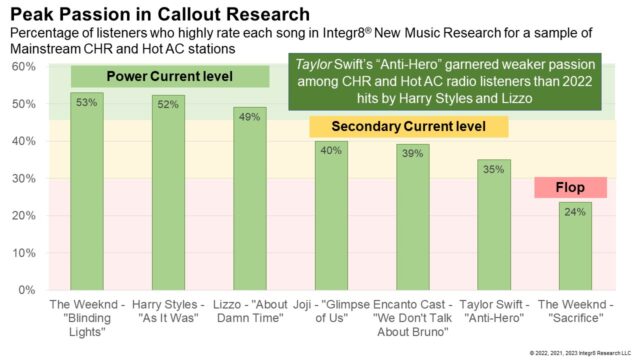
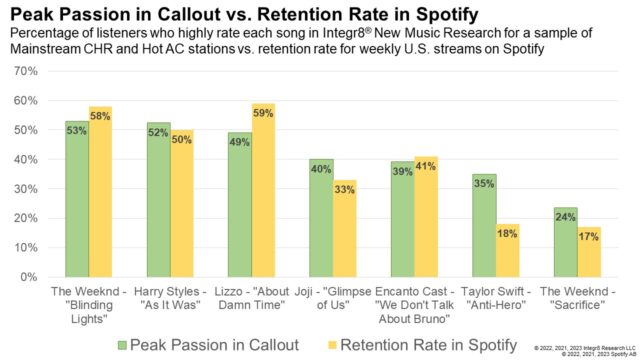
While “Anti-Hero” is hardly a flop, it also hasn’t been the instant home run that “Bad Blood” or “Shake It Off” were. On average, about 35% of CHR and Hot AC listeners said they loved “Anti-Hero” at its peak.

That’s strong enough for a secondary current, but the biggest hits typically see 50% of listeners exhibit strong passion for them using Integr8 New Music Research’s methodology. Harry Styles’ “As It Was” and “About Damn Time” from Lizzo both achieved this metric among our typical clients.

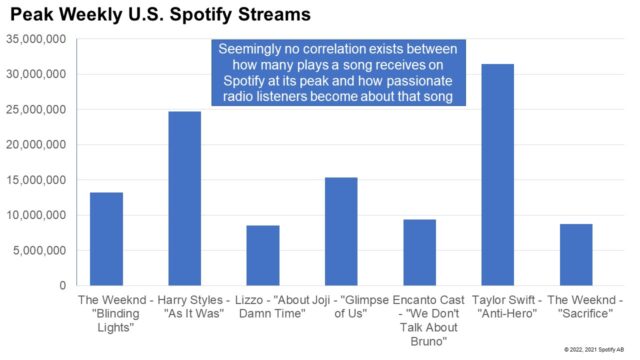
When we examine how these bona fide radio hits performed during their peak week in the U.S. on Spotify, there’s seemingly no correlation at all between streaming plays and passion among radio listeners: “As It Was” had a strong peak week, but Lizzo’s “About Damn Time” maxed out at well under one-third as many streams during its peak week, as did “Anti-Hero.” We will demonstrate this in a bit.

As we’ve noted in several previous posts, streaming data amplifies active fandom, which means a song’s peak week on streaming will often be on or shortly after its debut week. As weeks go by, however, streaming data increasingly reflects the passive fandom of people who discovered the song after its release.

With those behavior patterns in mind, let’s fast-forward to “Anti-Hero’s” 10th week from its peak. (Why 10 weeks? Typical top 10 hits for CHR radio reach their peak passion level among listeners around 10 weeks after debuting.)

Taylor Swift - Anti-Hero

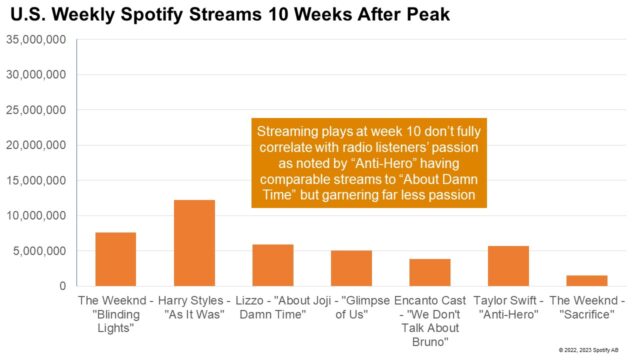
Spotify users in the U.S. played “Anti-Hero” about 5.7 million times ten weeks after its record-breaking debut week. That’s still sufficient to be among Spotify’s Top 10 songs in subsequent weeks. However, that’s less than one-fifth as many plays as its debut.

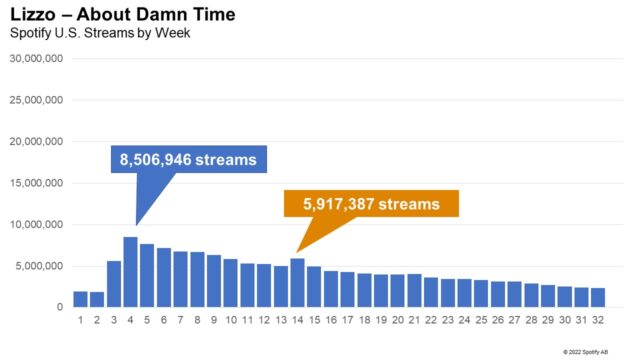
In contrast, Lizzo’s “About Damn Time” only garnered around 8.5 million streams when it peaked in its fourth week. Fast forward 10 weeks, and Lizzo’s summer anthem was still pulling almost 6 million streams.

Lizzo - About Damn Time

That puts “About Damn Time” on equal footing with “Anti-Hero” in its 10th week after its peak.

However, simply examining how many times people play a song at 10 weeks doesn’t explain why “About Damn Time” was a much bigger radio hit than “Anti-Hero” has been, either. There’s still no clear correlation between streaming plays and callout passion scores.

If you can’t simply examine how a song performs at its peak and you can’t examine how a song performs once the initial interest in the song dies down, is there any streaming metric that does track with listeners’ passion for a song, as measured in your callout research?

Comparing plays for a song’s peak week on Spotify with its play count 10 weeks after its peak reveals a telling story.

INTRODUCING RETENTION RATE

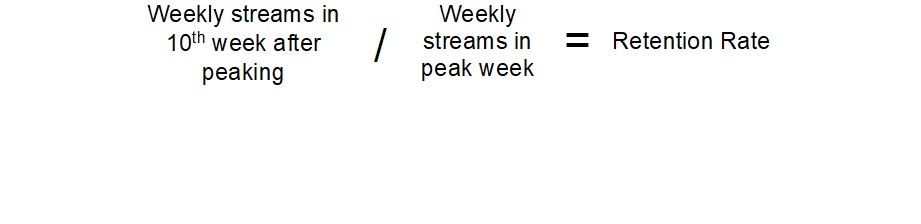
Retention Rate is the ratio of how many times streaming music consumers streamed a song in its 10th week after peaking, compared to how many streamed the song during its peak week.


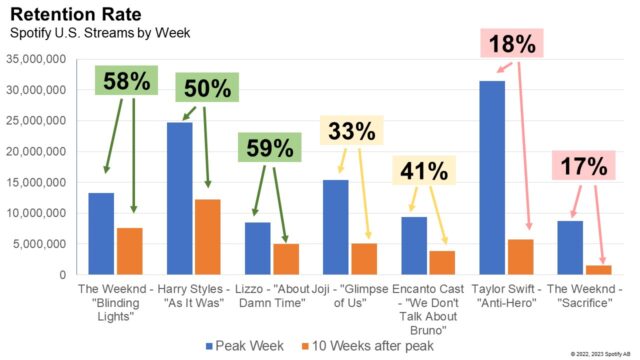
Comparing the Spotify streaming retention rate for the songs for which we initially examined passion in callout research, we finally begin to see some semblance of a correlating pattern:

Why does Retention Rate make sense?

PEAK STREAMS REFLECT THE POWER OF THE ARTIST’S FAN BASE

A song’s peak streaming week is a measure of how many fans an artist has and how passionate and engaged those fans are. Artists like Harry Styles, Morgan Wallen, Drake, and of course Taylor, have fan bases that run wide and deep. The decision to stream a brand-new song when it drops has everything to do with the artist and nothing to do with the song itself.

In order for a song to continue to garner strong streaming plays, at least one of two things must happen—and generally both:

1) Those diehard artist fans who played the song when it debuted must decide they like it enough to keep playing it week after week.

2) Music fans beyond the artist’s diehard supporters must discover and like the song enough to start streaming it.

For music consumers who like a song but aren’t superfans of the artist, they have to discover the song out in the wild because they’re not explicitly seeking it out: A friend has to tell them to check it out. They have to hear it on a curated streaming playlist. Or perhaps—just maybe—they hear it on the radio.

Usually both #1 and #2 must happen for a song to become a lasting hit.

If an artist’s biggest fans are underwhelmed, it’s unlikely listeners who aren’t even that into the artist will be big fans of the song.

Even for superstar artists like Taylor, there are generally a lot more people who love the song than there are who are hard core fans of the artist. They may “like” the artist, but they’re not buying concert tickets, t-shirts, and fan club memberships.

RETENTION RATE REFLECTS A SONG’S STAYING POWER

Retention rate captures both phenomena. A high Retention Rate means:

  • An artist’s biggest fans like the song enough to keep playing it week after week. A low retention rate means those fans may still love their artist, but found the song itself a letdown.
  • Retention Rate also reflects new people who have discovered a song after it debuted and have gone to Spotify to play it. A low Retention Rate can indicate few people are discovering the song passively.

In short, while a song’s debut streaming plays is a referendum on the size and passion of an artist’s fan base, a song’s ability to remain among the most streamed songs week after week is more predictive of a song’s hit potential.

PRACTICAL WAYS TO USE THE RETENTION RATE CONCEPT

First, forget about using Retention Rate exactly as we have described it here. Nobody has time to track weekly streaming data for dozens of songs week after week in Excel to precisely calculate a 10-week retention rate.

Heck, I don’t have time to do it, but I find it too much fun to resist.

Fortunately, you don’t have to spend hours creating Excel formulas. Here are some easier signs to examine when you’re reviewing streaming data:

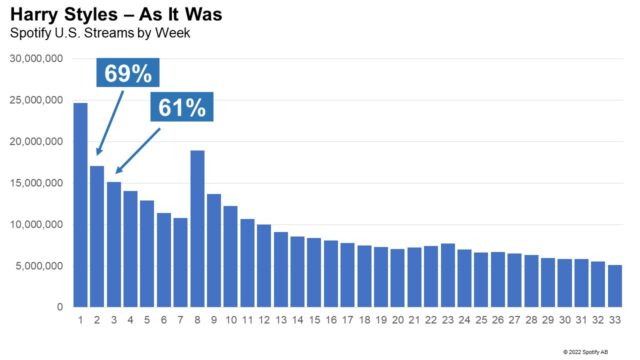
1) How do the song’s streams hold up in the first couple of weeks after debuting?  Harry Styles’ fans in the U.S. played “As It Was” on Spotify over 24 million times the week it debuted. As expected, the song got fewer plays in subsequent weeks—but with 17 million streams in its second week, “As It Was” maintained 69% of its weekly plays in week two. In its fifth week, “As It Was” still garnered 12 million streams a week, holding up over half of its weekly streams at its peak.

Harry Styles - As It Was

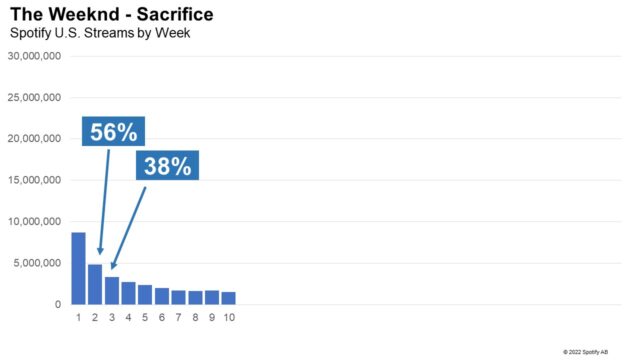
In contrast, The Weeknd’s “Sacrifice” got almost 9 million streams in the week it debuted on Spotify, but users played it less than 5 million times the week after it debuted. Not surprisingly, Integr8 New Music Research clients quickly saw their listeners had little passion for this song.

The Weeknd - Sacrifice

2) Ignore rank in streaming data. “As it Was” and “Anti-Hero” both debuted as the week’s #1 most streamed song on Spotify. However, so did the Weeknd’s “Sacrifice”, even though it got less than one-third as many plays the week it debuted. A big debut by a major artist such as Drake or Taylor Swift will knock hit songs out of streaming charts’ Top 10, even though those songs saw little erosion in actual plays. Bottom line; look at the raw number of times streaming users play a song from week to week, not changes in chart rank.

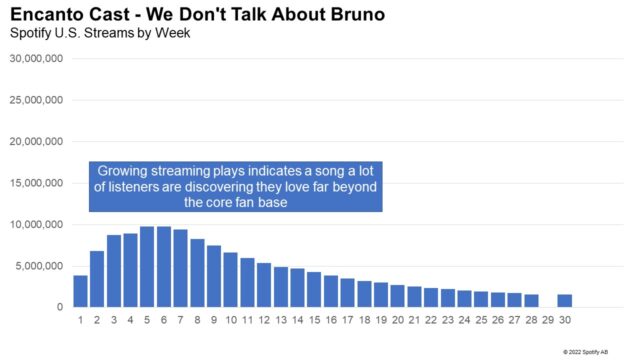
3) Look for songs that are growing week to week. The norm for streaming data is to see big debut weeks. Not all songs work that way. As observed earlier, Lizzo’s “About Damn Time” grew in its first few weeks. As the rare artist whose core fans are older than her casual fans, Lizzo’s “About Damn Time” didn’t see a burst of streaming activity as fans flocked to hear the song right away. Instead, causal fans likely discovered the song on the radio, then went to Spotify to hear it again.

Another example is 2022’s surprise hit “We Don’t Talk About Bruno.” Neither the song nor the movie Encanto were hits when first released in late 2021. But in January 2022, a cold snap and a COVID wave left parents working at home with their kids. Encanto not only came to their rescue to entertain the homebound kids, parents discovered they liked Bruno even after the kids were in bed.

In short, “We Don’t Talk About Bruno” was a song that picked up a much wider fan base than the core Disney fans who played the song when the movie debuted.

Encanto Cast - We Don't Talk About Bruno

Let’s apply these concepts to a song that—as of this writing—is relatively new.

Miley Cyrus - Flowers

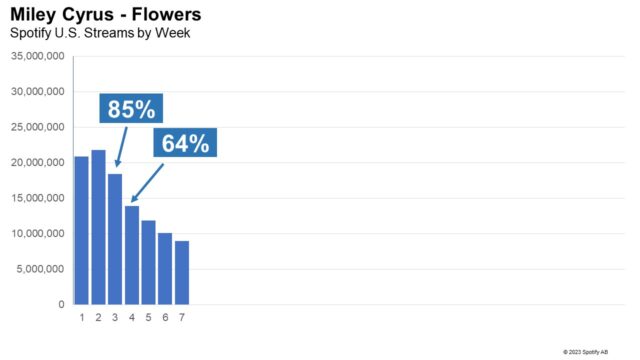
After peaking with almost 22 million streams the week after debuting, Miley Cyrus’ “Flowers” maintained 85% of its weekly plays on Spotify in the U.S. the following week. This pattern suggests—and Integr8 New Music Research clients can confirm—that people are playing “Flowers” because they really like the song, not merely because they’re curious what Miley is up to.

WHAT STREAMING STILL CAN’T TELL YOU

I’ve been urging our clients to use streaming data as one of their new music intelligence tools ever since they were still tracking CD sales. Sadly, many programmers are still hesitant to trust streaming data because its metrics are unfamiliar and confusing. It is my hope that by empowering programmers to understand the story each song’s weekly play counts is telling about each song and its artist, radio programmers can confidently maximize this amazing resource.

However, streaming plays can never tell you everything you need to know about a song to know if your station should play it. It can’t tell you how many listeners know each song, which segment of your audience is most passionate about each song, how many listeners hate a song enough to change stations if you play it, and when listeners are ready for you to move a song to recurrent rotation. For these essential data, high-quality new music research remains the gold standard for selecting songs best aligned with your music strategy.

Want to go deeper? Join Integr8 Research President Matt Bailey for Retention Rate: The Magic New Metric for Measuring Hit Potential in Streaming Data: The Webinar Tuesday, April 19th at 2PM EDT/11 AM PDT.

Registration is now open.

The Five Most Important Hits of 2022

Understanding why these songs were big in 2022 will help you program effectively in 2023
If some expert tells you new music is dead, they’re looking at the numbers, but they’re not listening to the songs.

For the last few years, I’ve started each new year examining Billboard’s Top 100 Songs of the past year and bringing notable trends to your attention—usually involving charts and graphs.

Somehow, the real stories of 2022’s most noteworthy hits aren’t PowerPointable. The biggest lessons are in the lyrics, the music, and the stories of the artists who created them.

To help you understand where popular music is headed in 2023, here are five of 2022’s biggest hits that reveal the most important trends in new music.

1) Numb Little Bug – Em Beihold – #32 for 2022

Historically, popular music discussed mental health either as a romance metaphor (falling in love is, after all, a mental disorder) or to brag of nonconformity. “Numb Little Bug” by Em Beihold takes a musically forgettable adult-pop trifle and makes it a revolution by candidly discussing depression and burnout.

Music has always shared our deepest emotions. However, you’d be hard pressed to find a song that addresses psychiatric medication—at least the legal, medically supervised kind.

“The prescription’s on its way with a name I can’t pronounce. And the dose I gotta take, boy I wish that I could count.”

A far cry from The Eagles’ approach to mental health.

The pandemic has simultaneously caused many of us to personally face mental health challenges while also making it far more socially acceptable to discuss those challenges openly. (My wife is a clinical therapist. Her agency isn’t facing any RIFs.)

Other big hits demonstrate a growing awareness of mental health jargon, from the therapist Olivia Rodrigo found for her ex on “Good 4 U” (“she really helped”), to Taylor Swift’s “Anti-Hero” referencing covert narcissism, a bona fide DSM-5 diagnosis.

“And I just want to see if you feel the same as me?”

Yes, Em, you’re not alone. A lot of us are “hanging by a thread,” but “somehow have to survive.”

2) Unholy – Sam Smith & Kim Petras – #98 for 2022*

As Chris Molanphy noted in his Why Is This Song No. 1 column for Slate, “Unholy” is the first Billboard Hot 100 chart-topper from an openly transgender artist, Kim Patras, as well as from a non-binary artist, Sam Smith.

If you only read the lyrics, you’d assume “Unholy” was about a cisgender husband having a heterosexual affair—and his wife is not down with open marriages.

With echoes of Sylvester or the Skatt Bros intertwined with a 2010 style EDM beat, it’s the music of “Unholy” (as well as the video) that throws ambiguity into the gender and sexual orientation of the body shop’s patronage.

This chart accomplishment is most noteworthy, though, because of how utterly unnoteworthy it is.

Just 15 years ago, Katy Perry objectifyingly kissed a girl and liked it. A mere decade ago, “Macklemore and Ryan Lewis’ “Same Love” took courage.

The mistreatment of Stonewall Inn is by no means in our distant past. But for today’s young musical tastemakers, there simply is no longer an expectation that songs conform to a cisgender heteronormative narrative. For further evidence, reference: Lil Nas X’s “MONTERO (Call Me By Your Name)”

*Debuting late in Billboard’s chart year, “Unholy” was only the 98th biggest hit on the Hot 100 for 2022. However, the song remains a massive hit this year and could end up being a bigger year-end hit in 2023.  
3) Bad Habit – Steve Lacy – #28 for 2022

I reached out to Mandy Couch and Jennifer Donnelly, the music gurus at Coleman Insights, to ask how they typically categorize “Bad Habit” for their research projects. If anyone could clear up whether this song is Pop, R&B, Alternative, or something else, they could.

“We hope it’ll go away.”

Steve Lacy does not make music that radio researchers can easily confine to predefined genres such as Pop, R&B, or Alternative. That’s exactly why Gen Z loves Steve Lacy.

A defining trait of this new generation is inclusion. (See “Unholy” above.) They don’t put people into boxes, knowing individuals are complex and messy. They like music that is also individual, complex, and messy.

Structurally, the song doesn’t follow a conventional verse-chorus-bridge pattern. What Billie Eilish started with “Bad Guy” with its lack of a chorus and non-sequitur ending, or what Travis Scott did in smashing together two songs to create “Sicko Mode”, Lacy takes to new levels with “Bad Habit.” The song has two choruses and what sounds like a bridge becomes its own song.

Lyrically, “Bad Habit” also exhibits Generation Z’s vulnerability compared to those of us in the “never let ‘em see you sweat” generation: The heartache that comes from realizing that the crush you never had the courage to approach may actually have been mutual. Even in its vulnerability, “Bad Habit” refuses categorization in both admitting the anxiety of having a crush (“I bite my tongue, it’s a bad habit”) while simultaneously exploring the fantasy of not having that fear. (“Can I bite my tongue like my bad habit?”)

Finally, “Bad Habit” never categorizes the crush’s gender. That fact—or that Lacy is bisexual—simply isn’t germane. The video, reminiscent of an iPod commercial, keeps it ambiguous.

In the end, Jennifer and Mandy said we should simply consider it pop music.

As usual, they’re correct.

4) We Don’t Talk About Bruno – Carolina Gaitan, Mauro Castillo, Adassa, Rhenzy Feliz, Diane Guerrero, Stephanie Beatriz & Encanto Cast – #24 for 2022

Most music analysts discuss the Encanto soundtrack’s success to highlight how streaming has changed music charts: Since streaming data shows how many times a song gets played—not merely how many people bought it as digital downloads and vinyl and CD sales did—they correctly note that “We Don’t Talk About Bruno” becoming the #1 song in the U.S.A. highlights how a song with a rabid fan base can become a chart-topper.

Yes, Disney fans played it over and over.

That’s not why Bruno is on this list.

After a disappointing launch in late 2021, Encanto blossomed on Disney+ in January when another Covid variant and winter weather were holding both kids and adults hostage at home. With parents needing to work, Encanto was simply a safe babysitter.

But then something unprecedented happened.

Parents discovered they loved the Encanto soundtrack. Lin Manuel Miranda had crafted Disney music that parents wanted to hear again even after their kids had gone to bed.

In 2014, “Let It Go” broke the mold when the Demi Lovato version made for radio stalled at #38, but the real version from Queen Elsa herself, Idina Menzel, went to #5 on the Hot 100. It had its grown-up fans, but the consensus was that parents turned to radio to get away from Frozen, not to hear it.

In 2022, however, “We Don’t Talk About Bruno” wasn’t a song parents wanted to escape. It wasn’t even supposed to be a hit, but in the age of streaming, Encanto fans rightfully made it the hit. “Bruno” consistently tested well in Integr8 New Music Research among most every station with the foresight to test it.

Many stations just couldn’t see past the Disney.

Programming legend Guy Zapoleon took particular issue with Bruno’s omission from hit radio stations:

“[It]t hurts your station, because you are playing weaker Pop songs in the place of this hit song, and probably overly hesitant about playing hits from other genres despite all the evidence. […] When you continue to avoid enough of these kinds of hits because they aren’t from the “Pop” genre, you will […] eventually lose ratings”.

“We Don’t Talk About Bruno” reminds us that CHR stands for Contemporary Hit Radio and that Pop is short for popular.

5) Industry Baby – Lil Nas X & Jack Harlow – #16 for 2022

Admit it. You first thought “Old Town Road” was the Macarena.

A fad. A novelty whose longevity would eventually lead to derision, and we’d never hear from Lil Nas Who again.

That’s what everyone over age 25 thought would happen with this group.

Anyone who heard Gen Z fans scream along to “Old Town Road” in 2019 understood Lil Nas X was bigger than one song, a song that doesn’t sound as left field as it did just four years ago.

“Industry Baby” is Little Nas X’s third #1 on the Hot 100. Already the 24th biggest song of 2021, the song was even bigger (#16) on 2022’s year-end Hot 100 chart.  It became part of the Zeitgeist. High school marching bands play it. PTA moms found themselves humming it. It made Lil Nas X bigger than “Old Town Road.”

He predicted as much in the song itself:

“Funny how you said it was the end, […] Then I went did it again.”

It also proves Lil Nas X’s mastery of internet promotion goes beyond one song. Using a Nike lawsuit to his advantage to trick fans into streaming the song’s debut, X demonstrates an innate understanding of Gen Z internet communications.

If Elvis is the King of Rock ‘n’ Roll and Michael Jackson is the King of Pop, Lil Nas X is the King of the Internet.

And Jack Harlow? Remember a decade ago when many Hip Hop icons could only achieve mainstream appeal by partnering with a white artist? It’s Lil Nas X raising Jack Harlow’s profile this time. “Industry Baby” made “First Class” possible.

Lil Nas X said it himself. He’s the Industry.

What these songs mean for radio in 2023
You’ve cursed the quality of new music during the past few years for good reason. Many have wondered if contemporary music will ever see the same appeal as it has in previous decades.

However, Pop music history suggests the bad times are about to get exciting again.

The five songs we’ve examined are still the exception among last year’s biggest hits compared to more predictable hits. In the next year or so, however, we can expect more and more fresh and innovative songs until we reach a tipping point where new music is once again exciting.

It happened with MTV-styled New Wave in the early 1980s. It happened with Party Hip Hop in the early 2000s. It was Beatlemania in 1964. (I outlined this frighteningly predictable pattern in my Generational Music Cycle theorem.)

Unlike past new music evolutions, however, there is real danger that radio won’t benefit when popular music reaches that tipping point.

Sure, technology changes and TSL challenges are huge. But the false belief that mankind has somehow permanently lost interest in new music is an even bigger threat to radio’s future.

By understanding why these five unusual hits of 2022 connected with music fans, you can be prepared to create compelling radio for a new generation when we reach that tipping point in 2023, 2024, or 2025 where those unusual hits are the typical hits.

Yes, there is a real chance the initiative to attract Generation Z to radio will fall short.

Yes, a successful Gen Z CHR will need to change more than the music.

There is only one guarantee here. Not trying will always have a 100% failure rate.



The Taylor Swift Effect: What Taylor’s chart triumph means for how listeners consume new music

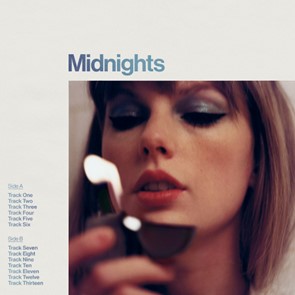
When Taylor Swift dropped her 10th studio album on October 21, 2022, Midnights instantly became the #1 album in the country, according to the Billboard 200.

The lead track “Anti-Hero” became the most added song on CHR, Hot AC, and AC radio.

It was even the top selling album on Vinyl for its debut week. In fact, Midnights sold more LPs in one week than any other album this century.

Par for the course for Tay-Tay.

What is earth-shattering is the feat Taylor Swift achieved with her new album that music geeks have deemed impossible since April of 1964: she made Billboard Hot 100 history as the very first artist ever to occupy all of the Top 10 slots on the Billboard Hot 100.

In recent years, however, music experts have assumed a Top 10 takeover was inevitable. Drake almost did it in 2021.

How did the impossible become the inevitable? Why Swift? And for those of us in radio programming, what does Midnights teach us about how listeners consume new music today?

Of course, it involves streaming. But perhaps not for the reasons you think.

To understand how Taylor is altering the universe, let’s examine how Swift’s album drop impacted what U.S. Spotify users played.

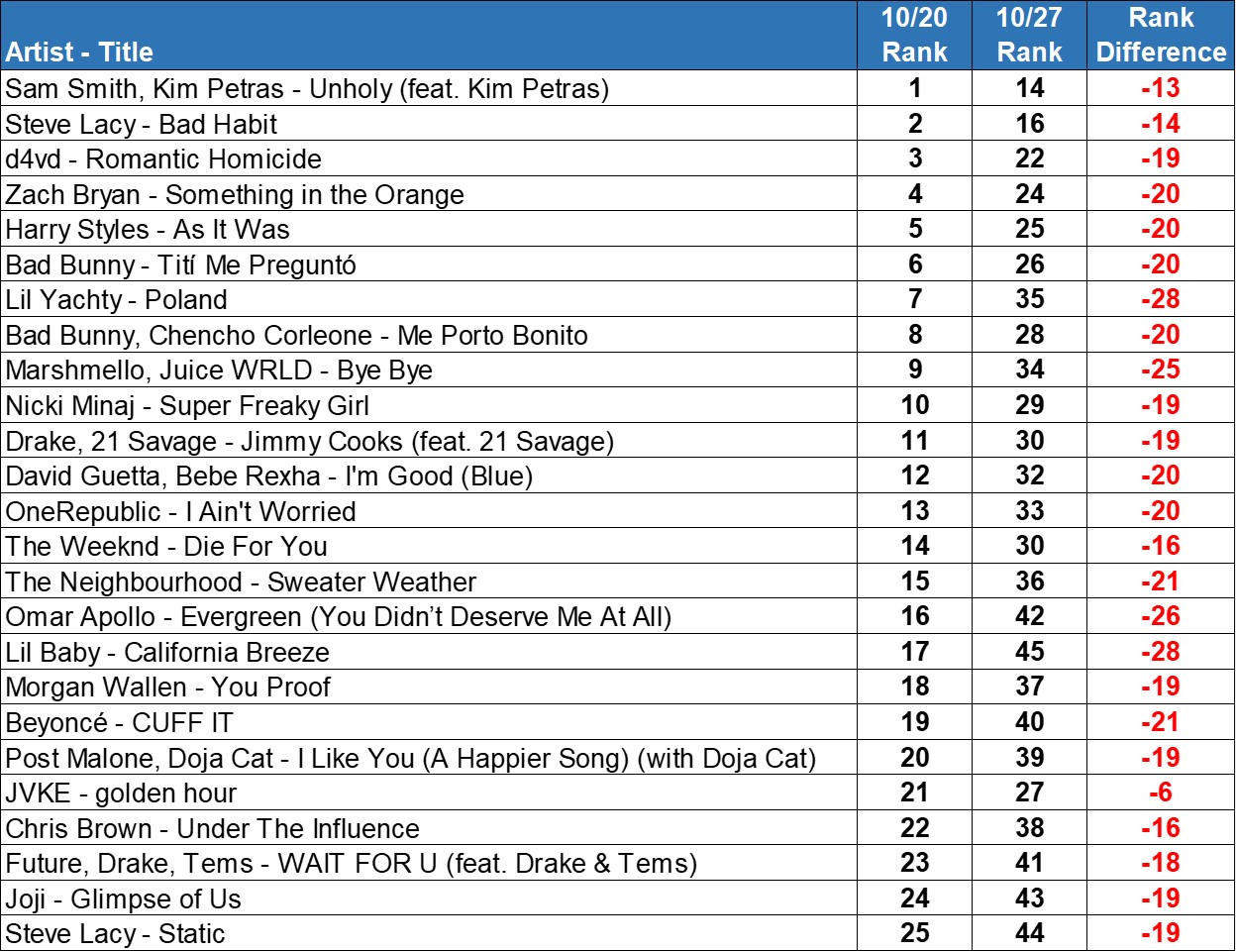
Below are the Top 25 most-played songs on Spotify in the U.S. for the week of October 20th, 2022, the week before Midnights debuted. Harry Styles, Bad Bunny, and Drake are predictably there. Steve Lacy and Zach Bryan’s archetype-defying hits are there, too.

When Swift released the 13 tracks on the physical CD of Midnights—along with the additional 7 tracks on the Midnights 3am Edition online—those 20 tracks immediately pushed all but five of last week’s most-streamed songs out of Spotify’s Top 20 for the week of October 27th:

Spotify’s Top 25 songs the week before Midnights debuted dropped 19 rank positions the week when Swift released Midnights.

“Wow,” you’re thinking, “everyone instantly lost interest in whatever songs they were streaming to go listen to Taylor’s Swift’s new songs!”

Except that’s not at all what happened.

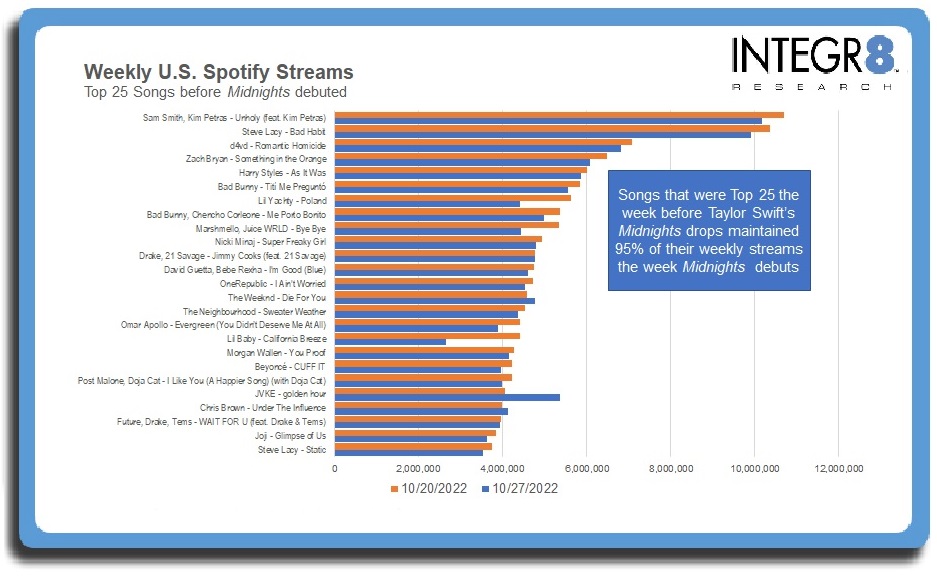
Here’s a chart showing the actual number of times each of those songs played on Spotify pre- and post-Taylor:

While Taylor’s streaming number dwarfed previously released tracks, plays for non-Taylor titles remained largely unchanged.
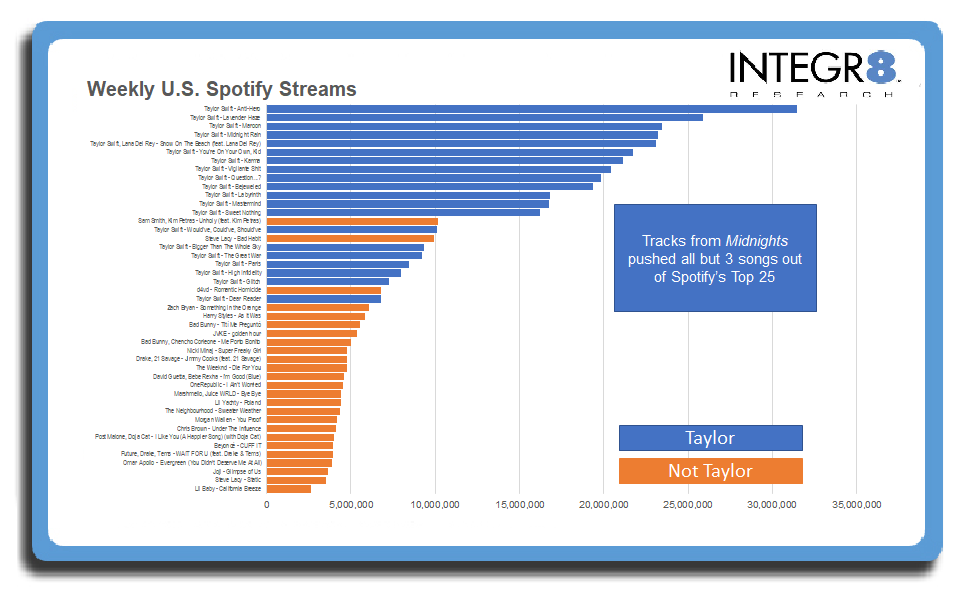
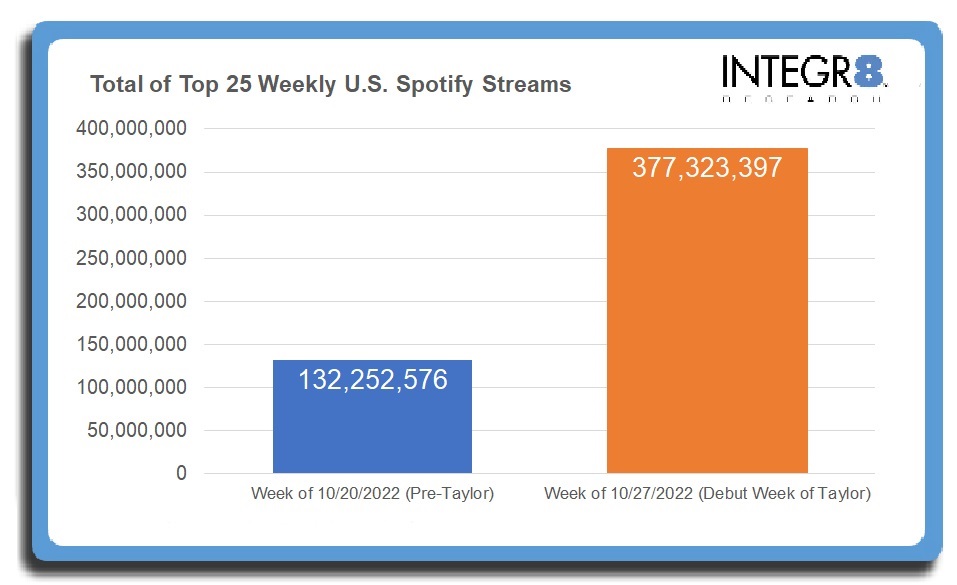
Generally, songs saw their week- to week Spotify play counts drop about 5 percent, which is exactly what most big hit songs on Spotify see. As much as some employed by CHR radio stations may have hoped, listeners kept right on streaming “As It Was” as if nothing happened.

Instead, what Taylor Swift did was create brand new streaming sessions on Spotify:

Taylor Swift’s Midnights did not diminish listening to other artists, but instead created new listening occasions.

How big was this impact?  The total plays for the Top 25 songs of the week on Spotify were almost three times higher the week of Taylor’s debut compared to the previous week.

As with most problems, we need to start not with how we as industry insiders evaluate music, but instead with how real listeners consume music.

THE OLD WAY AN ALBUM DEBUTS

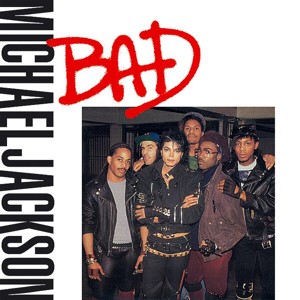
It’s Wednesday, September 2nd, 1987. Michael Jackson’s long-awaited new album is out and ever since you saw the “Bad” video on that “Michael Jackson: The Magic Returns” TV special Monday night, you’ve pestered your parents to get it.

Today they relent. You slap on your Swatch, hop in the Cutlass, and head to Northdale Mall, where you buy one of the 2.25 million copies of Bad that Americans will snap up this week. Your cassette purchase helps make Bad the #1 album. It will stay #1 for six weeks as various Americans pick up the album at Record Bar, Sam Goody, and K-Mart.

At home, you pop the tape in your boombox and listen straight through several times, hearing “The Way You Make Me Feel”, “Man in the Mirror”, and “Smooth Criminal” for the first time.

In coming months, a record-breaking five songs from Bad would become #1 hits. However, those songs became hits based on how many people bought the 45s (or Cassingles) and how often Z100 and Kiss-FM played those songs. Given the record and radio industry’s tradition of releasing singles sequentially, you heard most of those songs on the album months before casual fans did.

Since you already own the whole album, however, you never bought those singles. The music industry has no way to capture that you, an active consumer of Michael Jackson’s music, rewind for “Dirty Diana” and fast-forward past “Man In The Mirror.” Your one album purchase is your one vote.

THE NEW WAY AN ALBUM DEBUTS

It’s Saturday morning, October 22nd, 2022. You grab your phone, open Spotify, and search “Ta…” That’s all it took to take you to Midnights (3am Edition), the new project from Taylor Swift. You’ve been waiting for this day ever since she announced the new album on the MTV Music Awards in August. You watched her TikTok where she revealed the track list in September.

Now, it’s finally here.

You start at the top, determined to just play the album straight through, but you remember there’s a track with Lana Del Ray, so you skip to “Snow On The Beach.” Ultimately, you do play the whole album straight through—so many times, in fact, that you lose track that weekend.

Ultimately, you find yourself skipping back to replay “Anti-Hero” and “You’re On Your Own, Kid.”, which you later add to your “Taylor Favorites” playlist.

Unbeknownst to you, Spotify is tracking every track you play, every time you play it. Every time you play a track—even if on auto-repeat—is a vote for that track on the Spotify charts, which in turn feed the information Luminate aggregates to inform music executives and radio programmers.

1987 vs. 2022

Both our Bad buyer and Midnights streamer:

  • Eagerly anticipated new music from a beloved artist
  • Accessed the album as soon as they could
  • Carved out extra time to listen to the debut
  • Sampled every song on the album multiple times
  • Ultimately came to prefer a few specific songs

From the music fan’s perspective, the only real change is the investment to access the album: Our King of Pop fan had to wait a couple of days for a ride to the mall and have enough money to pay for it. Our Queen of Codependence fan merely had to wake up.

Additionally, that Michael Jackson fan also loved Def Leppard, but passed on Hysteria, 1987 allowance money being what it was. In contrast, our Taylor fan also binged Lainey Wilson’s latest. $9.99 to Spotify covers the entire month.

The transition from purchasing physical media to renting streaming access has dramatically increased the amount of music a typical consumer can access.

The real change, however, is how we track it.

STREAMING CAPTURES “MISSING” ALBUM TRACK FANDOM

Had we had methods to track CD and Cassette tracks played during those waning Cold War days, we may well have discovered that many tracks on Bad were among the most-played songs in the U.S.A. during that first week in September. One vote on the album sales chart would suddenly count for hundreds of plays on the streaming chart.

Conversely, if Spotify only reported the number of individual people who accessed a specific album in the course of the week, we would never know that “Anti-Hero” is played twice as often as “Sweet Nothing.”  Using old-school metrics, Taylor would merely have a #1 album until radio airplay gave her a #1 single.

That’s why it’s only been a matter of time that someone would own the Top 10 ever since song streaming eclipsed song sales.

Hip Hop icons, notably Drake, have come close, but it took an artist with the large and demographically broad appeal of Taylor Swift, coupled with streaming becoming common among a large and demographically broad consumer base, to finally command all 10 of America’s most popular songs in a single week.

Had Spotify existed in 1987, Michael Jackson was undoubtedly big enough to accomplish the same feat.

The one factor would have doomed it? Bad only has nine tracks.

WHAT TAYLOR’S FEAT MEANS FOR RADIO

  • Streaming has officially triumphed over sales: Streaming already surpassed song sales in the late 2010s for artists appealing to younger listeners, beginning with Hip Hop fans. Now that a broadly appealing artist such as Taylor Swift has dominated Spotify’s most-played songs, that transformation is complete.
  • You are now seeing the direct music consumption behavior of an artists’ active fanbase. Binge-playing every track on a heavily anticipated new album has always been a thing. Streaming simply shows us that consumption for the first time. What we used to measure as one album sale is now counted as potentially hundreds of song plays.
  • Big album drops create new music listening sessions. Simply examining streaming rank might make you think the appeal of existing songs is tanking. Examining a song’s raw play count, however, reveals that the appetite for existing hits remains relatively unchanged. Binge-listening to new releases is additive.
  • To measure how widely appealing a song is, don’t measure how big it is this week. Measure how many weeks it remains big. When an artists’ biggest fans binge-listen to a new release, the tracks’ play counts will be huge—at first. Those songs that grow to appeal to a larger group of casual fans maintain strong streaming counts week after week. Harry Styles’ “As it Was” is still among Spotify’s most played songs after 30 weeks.