Tag Archives: callout

Are Streaming Services Really That Different?

The second post in our series explores differences in the most popular songs on streaming platforms.

In our previous post, we examined how vastly different the Top 20 most-played songs on each of the five most popular streaming services are. We found:

  • Country is huge on Amazon Music and Pandora, but non-existent among Apple Music’s most played songs.
  • Hip Hop is huge on Apple Music and YouTube, but largely absent on Amazon Music. Meanwhile…
  • Spotify is the new Sam Goody, where fans go to soak up every track when their favorite artists’ new albums drop.

Most Popular Genres on Streaming Platforms

Our analysis, however, was merely one snapshot in time. Is there any evidence that our observations of each streaming service’s most streamed songs are a true reflection of their users’ tastes?

To find out, we asked Coleman Insights’ John Boyne if we could share some findings of the firm’s recent Contemporary Music SuperStudy 3, which compiled the most consumed songs in streaming, sales, and airplay during the past year, then tested the appeal of those songs using their FACT360 Strategic Music TestSM platform.

The result is a ranker of the United States’ and Canada’s most popular contemporary titles from the past five years among various music consumers—including those who prefer different streaming services.

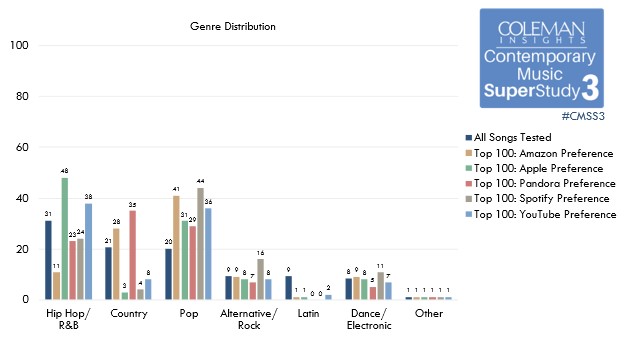
Their data of the Top 100 most appealing songs among each streaming service’s core users closely mirrors our observations:

Genre Distribution by Streaming P1s

  • Hip Hop is big on Apple Music and YouTube: Listeners who prefer Apple Music or YouTube have more Hip Hop titles among their Top 100 highest rated songs than listeners overall, while listeners who prefer Amazon music have far fewer Hip Hop titles among their 100 favorites.
  • Country is big on Amazon Music and Pandora: Conversely, listeners who prefer Amazon Music and Pandora have more Country tiles among their Top 100 than do listeners overall, while Apple Music, Spotify, and YouTube partisans have far fewer Country songs in their Top 100s.
  • Pop is the unifying sound popular on all services. As our examination of each streaming services’ most played songs also found, however, Pop is particularly popular among Spotify and Amazon Music users.

In short, both the behavior that Integr8 Research examined and the music appeal that Coleman Insights measured tell the same story.

Age might play a role in these taste differences. According to a recent study by YouGov, U.S. music consumers who prefer Amazon Music and Pandora are more likely to be older (35 and older) compared to other music services, while Apple Music and Spotify partisans are more likely to be younger (under age 35).

Another factor may be the device different streaming service partisans typically use. In 2019, Integr8 Research found that smart speaker owners were more than twice as likely to use Amazon Music compared to music consumers overall—suggesting that a significant portion of Amazon Music usage is on Alexa-enabled Echo devices.

Regardless of the reason, it’s clear different genre fans indeed use different streaming services. How do these findings impact how your radio station should examine streaming data? We’ll give you specific suggestions in our next post.

Here’s how to access each streaming service’s published charts of their most played songs:

How to access charts for major music streaming services
Spotify Logo https://spotifycharts.com/regional
https://music.apple.com/browse/top-charts
Amazon Music https://music.amazon.com/popular/songs
Pandora Logo https://www.nextbigsound.com/charts/top-spins
YouTube Logo https://charts.youtube.com


Five Very Different Streaming Services

Exploring differences in the most popular songs on streaming platforms

Most programmers now regularly examine streaming data from MRC Data’s BDSradio or whatever BuzzAngle is now to help pick the best new music. Have you ever looked behind the curtain to examine the data that drives those aggregated data platforms?

You have access to the same information that drives these platforms. Major streaming services all publish charts of the most popular titles on their services that you can easily peruse for free.

And when you do, you’ll be shocked at the differences in what songs are hits on each service.

How to access charts for major music streaming services

Spotify Logo

https://spotifycharts.com/regional

https://music.apple.com/browse/top-charts

Amazon Music

https://music.amazon.com/popular/songs

Pandora Logo

https://www.nextbigsound.com/charts/top-spins

YouTube Logo

https://charts.youtube.com

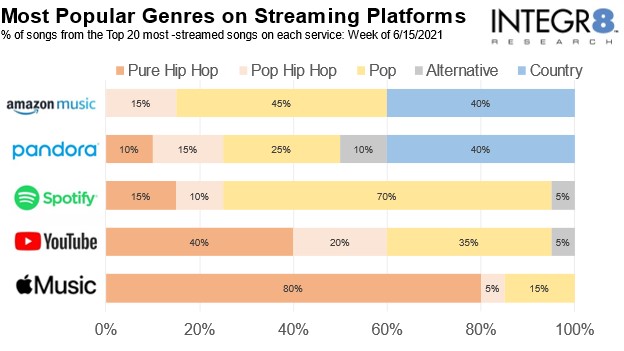
We examined the Top 20 most-played songs in the U.S. on the five major music streaming platforms during the week of June 15th, 2021.

Here are key discoveries we made about each streaming service:

#1: Amazon Music listeners have the greatest interest in Country—and Classic Rock.

When you examine the most streamed songs in the U.S. on aggregated charts, Country hardly exists. Among Amazon Music users, however, 40% of the 20 most-streamed songs are Country titles. Amazon has aggressively pursued Country listeners, most notably signing an exclusive deal with superstar Garth Brooks.

Several songs that are among the 20 most frequently played songs on Amazon Music are also big hits on Country radio—but are not even among the most 100 played songs on any of the other four major streaming platforms.

Country titles are Top 20 on Amazon Music
but not even Top 100 on other streaming services

Luke Combs Chris Stapleton Dylan Scott
LUKE COMBS
Forever After All
CHRIS STAPLETON
Starting Over
DYLAN SCOTT
Nobody

Amazon Music’s most played songs also include more Gold titles than any other service, too. The Lil Nas X feat. Billy Ray Cyrus mix of “Old Town Road” is still a Top 20 most played title on Amazon Music (#16). More noteworthy, Amazon Music users play Classic Rock than any other streaming platform: Guns N’ Roses, AC/DC, Metallica, Queen, Fleetwood Mac, Nirvana, Toto and Bon Jovi all have songs among the 150 most played songs on Amazon Music.

Finally, unlike the other four major streaming services, not a single pure Hip Hop title is among the 20 most played songs on Amazon music.

#2: Pandora users also love Country—but their charts have a caveat. 

Like Amazon Music, 40% of the Top 20 most-played songs on Pandora are Country songs, but some of the biggest Country hits currently, such as Luke Combs’ “Forever After All” and Dylan Scott’s “Nobody,” are notoriously absent from Pandora’s most-played chart.

That’s because Next Big Sound, the subsidiary of Pandora that publishes its streaming data, intentionally “sunsets” all songs they no longer consider new, typically after just 16 weeks on their chart. The oldest exception was Cole Swindell’s “Single Saturday Night,” which was still on Pandora’s chart for 24 weeks. As we’ve observed, while most CHR titles run their course around that time, Country fans remain interested in the format’s biggest hits for 28 to 44 weeks.

Therefore, relatively new Country titles such as Brett Young’s “Not Yet” are Top 20 on Pandora’s most played songs chart but are absent on Amazon Music’s chart which does not arbitrarily remove titles based on age—meaning the biggest hits remain atop Amazon’s chart as long as listeners keep streaming them.


Most Popular Genres on Streaming Platforms

#3 Apple Music users are heavily into Hip Hop

 Eighty-five percent (85%) of the 20 most played songs on Apple Music are Hip Hop titles, more than any other major streaming service. For our analysis, we separated the kind of Hip Hop titles that garner mainstream appeal (Pop Hip Hop) from those titles most likely to appeal to the genre’s core fans (Pure Hip Hop). Apple Music clearly is the destination for those core fans—80% of Apple Music’s Top 20 tiles are Pure Hip Hop titles.

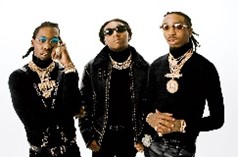
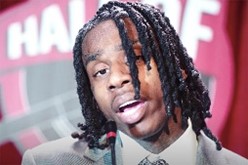
Migos’ newly released “Culture III” project dominated Apple Music’s Top 20, including “Having Our Way (feat. Drake)” and “Avalanche”, tracks missing from all other services’ charts. Hip Hop artists Polo G and Meghan Thee Stallion also have huge hits on Apple Music—but not on other streaming services.


Core Hip Hop tiltes are Top 20 on Apple Music
but not even Top 100 on other streaming services

Migos Meghan Thee Stallion Polo G
MIGOS
Having Our Way & Avalanche
MEGHAN THEE STALLION
Thot Shit

POLO G
Black Hearted

In contrast, Country and Alternative are completely missing from Apple Music’s Top 20 most played songs, while the only Pop titles among Apple Music’s most popular 20 titles during the week we examined (6/15/2021) were three newly released titles from Olivia Rodrigo.

#4 Hip Hop and Novelty at home on YouTube

YouTube is second only to Apple Music in the number of Hip Hop titles among its Top 20 most-viewed titles. Unlike Apple music, however, most of the biggest Hip Hop videos on YouTube also receive significant plays on other services. (A notable exception being “Outside (Better Days)” from the recently killed rapper MO3, along with OG Bobby Billions).

The songs that stand out as unique to popular consumption on YouTube, however, have some element of the offbeat. “Welcome to the Internet” from comedian Bo Burnham mocks the frivolity and annoyances that dominates our screen time, while former professional wrestler Tom MacDonald’s “Snowflakes” is what Sean Hannity would rap if, God forbid, he ever did.

Novelty titles are among the 20 biggest videos on YouTube, but don’t get streamed on audio services

MO3 & OG BOBBY BILLIONS Bo Burnham Tom MacDonald
MO3 & OG BOBBY  BILLIONS
Outside (Better Days)
BO BURNHAM
Welcome to the Internet
TOM MACDONALD
Snowflakes

#5 Spotify is the new Sam Goody

Until recently, you’d find far more Hip-Hop titles among the most played songs on Spotify compared to radio exposure or iTunes downloads. Today, however, there’s a wider variety of genres among the songs Spotify users play most as the service’s user base expands. There are more Pop titles (70%) among Spotify’s Top 20 than on any competing service, from big name artists such as Justin Bieber, Dua Lipa and BTS. While the week we examined saw no Country titles among Spotify’s Top 20, Morgan Wallen and Luke Combs have made several appearances in Spotify’s Top 20 in recent months.

During the week in mid-June (2021) we examined, however, 10 of the 20 most-streamed songs on Spotify were from one artist: Oliva Rodrigo. Her debut solo album SOUR dropped just three weeks before and Spotify users were streaming most tracks on the album in heavy rotation. Several of those tracks, such as “good 4 u,” “déjà vu,” and “traitor” also received plenty of plays on other streaming platforms. On Spotify, however, listeners also streamed deeper tracks from the album that aren’t hits on other streaming services.

That pattern mirrors what we discovered in our 2019 deep dive into Spotify usage: Listeners use Spotify as a record store, listening to every track on a new album of an artist they love. After a few weeks, however, the songs that are the real hits catch on with a wider audience and continue enjoying strong streaming on Spotify.

Artists as varied as Ariana Grande, Taylor Swift, Billie Eilish, J Cole, Justin Bieber, and Drake have all experienced the same pattern of releasing a new project and seeing multiple tracks from that release debut at the top of Spotify’s streaming chart.  While we do see a similar pattern for new Hip Hop releases on Apple Music, this “record store” effect simply isn’t prominent on the other major streaming services as it is on Spotify.

Top 20 on Spotify, but not on other streaming services: Deep tracks from a brand-new release

Olivia Rodrigo OLIVIA RODRIGO
favorite crime
brutal
happier
jealousy, jealousy
enough for you
1 step forward, 3 steps back

So how different are the five major streaming services’ biggest hits?

Sixty-six different individual songs comprised the list we examined of songs that were Top 20 on at least one streaming service. Among those 66 songs, only one song was Top 20 on all five services: Olivia Rodrigo’s “good 4 u.”

“That’s neato,” you say, “but you only examined one moment in time. Does broader research confirm your findings?”

In our next post, we’ll talk with John Boyne at Coleman Insights, whose Contemporary Music SuperStudy 3 examined the musical tastes of different streaming services’ users to answer that important question.

The Year Our Musical Tastes Stood Still

Part two in a series 2020 Sucked (for Music)

In our last post, we analyzed Billboard’s year-end charts to learn that listeners consumed less music in 2020 that was actually released in 2020 than they had consumed current-year music in previous years. This lackluster interest in 2020’s music holds true no matter how they were consuming that music.

By far, radio saw 2020’s hits hit hardest: Only a third of the songs listeners heard most on FM radio last year were actually from 2020.

Was radio right to hang on to the past?

To find out, we turned to Coleman Insights’ recently released Contemporary Music SuperStudy 3. Their annual study compiles the most consumed songs in streaming, sales, and airplay according to MRC Data during the past year, then asks 1,000 12- to 54-year-olds across the United States and Canada to rate each song using Coleman Insights’  FACT360 Strategic Music Test platform. The result is a ranker of North America’s most popular contemporary titles from the past five years.

Their study confirms it clearly—listeners would have rather stayed in 2019.

Era Distribution

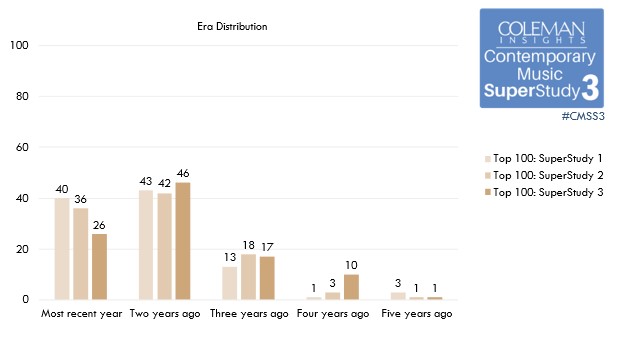
In previous studies, Coleman Insights found that 40% and 36% of the 100 of listeners’ most popular songs were from the previous year—that is—the newest songs examined.

In this year’s Contemporary Music SuperStudy, however, only 26% of the top 100 titles were from 2020, while interest in songs from four years ago (2017)—among the oldest songs in the study—grew significantly.

Dive deeper and the songs listeners love most seem suspended in time.

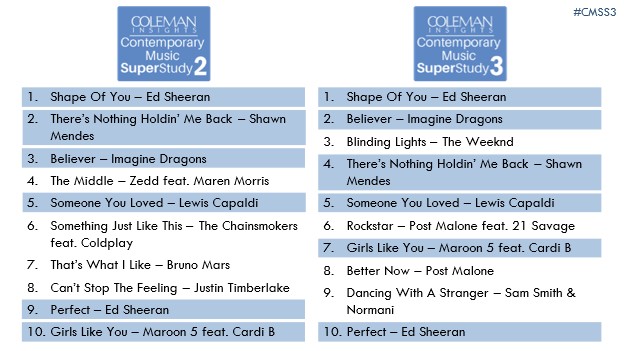
  • Ed Sheeran’s “Shape Of You” is the most-loved song in North America—just like last year.
  • Pinkfong’s “Baby Shark” is the least-liked song in the study—just like last year.
  • Moreover, six of the of the Top 10 songs listeners loved most were the same songs listeners loved most last year.

Top Songs by Year

I talked with Coleman Insights’ Executive Vice President and Senior Consultant John Boyne, who spearheads their annual Contemporary Music SuperStudy, to dig deeper into their findings and how it impacts how you should program contemporary formats.

John Boyne

[Matt]: So this year’s study found a lot fewer songs from the most recent year among the U.S. and Canada’s favorite songs than previous studies found for their respective most recent years. Did any particular audience segment or music fan base drive that trend?”

[John]: No, it wasn’t driven by any particular segment of the population. Instead, it was a broadly seen pattern. Among younger and older, among men and women, and among fans of different genres, the most popular music was relatively older than we had previously seen.

[Matt]: Should current-based radio stations shift their strategies to play more recurrent or recent gold based on your findings in the Contemporary Music SuperStudy 3?

[John]: While I believe Contemporary Music SuperStudy 3 gives us great insight into macro happenings, I wouldn’t go so far as to apply these findings to the strategy of an individual radio station. Every situation is different. In a particular market, with a particular target demo and a particular station, you may not see the same patterns that we see play out in this big, broad study.

Moreover, with this study, we’re looking backwards not forwards. With communities opening back up, I wouldn’t be surprised to see contemporary music go from “bust” to “boom” in the coming months.

[Matt]: At the risk of asking a researcher a subjective question, do you think listeners’ lackluster interest in 2020’s music is a reaction to the pandemic, a natural downturn in music that was already in the works, or a little bit of both?

[John]: I’d say “a little bit of both.” We do a lot of music research. Going into the pandemic, there was already evidence that some genres were slumping. The pandemic then made things worse, from some combination of artists not out promoting music, consumers not out at concerts/clubs/events, new music being strategically held back, and just a general retreat to that which is comfortable and familiar.

[Matt]: Have the styles of music North Americans enjoy changed this past year?

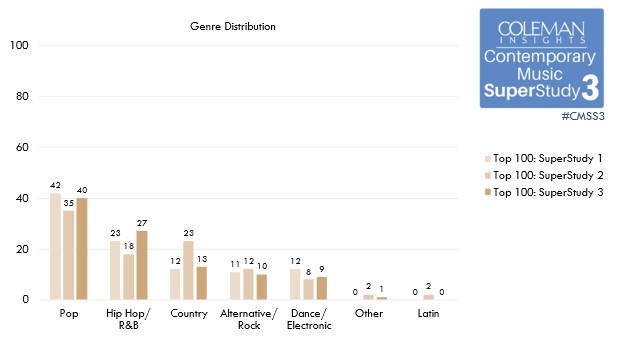
[John]: Yes. In this assessment of mass music tastes, the leading category of popular titles continues to go to Pop. Beyond that, we see that Hip Hop/R&B is up, while Country is down.

Genre Distribution

[Matt]: “You had an interesting finding about Country music that suggests last year’s indications of a revival might have been overly optimistic. Can you tell me more about that finding?”

[John]: Country came down to earth after an up-trend last time. Digging into it, we see that fans of the Country genre continue to exhibit a lot of passion for these titles. The problem is that Country’s performance among everyone else waned. And that’s typically the difference-maker when genres get hot; they blow up beyond their core fan base.

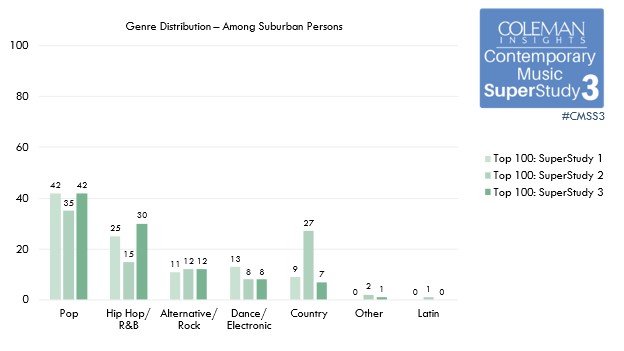
Also interesting is that the up-and-down trend for Country was most pronounced in the suburbs. They represent the swing district of both politics and music apparently!

Genre Distribution Among Suburban Listeners

[Matt]: What surprised you most about this year’s findings?

[John]: Prior to seeing the results, we theorized that they might be somewhat frozen in time, but even so, I will say it was surprising to see how consistent some things were. The most popular song was the same. Six of the ten most popular songs were the same. The most prolific artist was the same. And the least popular song was the same. One year later, one thousand surveys later…pretty wild when you think about it.

[Matt]: Will Coleman Insights do it again next year?”

[John]: That’s the plan! Hopefully, a year from now, the pandemic will be well behind us and we can talk about Contemporary Music SuperStudy 4 without making references to Groundhog Day.

Check out Coleman Insights’ Contemporary Music SuperStudy 3.

It’s Official: 2020 Sucked (for Music)

Guy Zapoleon’s 10-year music cycle already declared CHR was in “the extremes” phase, with “the doldrums” its next stop.

Our own Generational Music Cycle theory noted that as Millennials age out of youth, CHR music would sound increasingly stale and divisive until the next generation takes over control of determining popular music tastes in the mid-2020s.

And then. Sigh.

Whether the world had bigger issues or simply wanted familiar comforts, programmers sensed a collective meh in 2020’s releases. Many Integr8 New Music Research clients noted languishing passion scores and other signs of lackluster response to new songs. As we always remind our clients, however, callout research identifies the best songs you can play for your chosen music strategy today. Callout can’t evaluate the health of your format compared to others.

To see the big picture that our own research isn’t designed to see, we’re examining resources that broadly measure all the contemporary music Americans consume and how they’re reacting to that music.

First up, we analyzed Billboard’s 2020 Year End Charts, which showcase music consumer behavior from MRC Data, including:

  • The Hot 100 Songs: The 100 most-consumed songs of the year across platforms
  • Digital Song Sales: The 75 most purchased songs on iTunes and other digital download services
  • Radio Songs: The 75 most-heard songs on radio stations monitored by BDSRadio
  • Streaming Songs: The 75 songs streamed most on both programmed and on-demand audio and streaming services such as Spotify and YouTube

We then tracked how many of 2020’s most consumed songs were actually from 2020—and how many were holdovers from previous years. We then compared how many of 2019’s and 2018’s most consumed songs were from their respective years.

By every measure—but especially when examining what radio and streaming service users played—2020 had fewer hits than normal years.

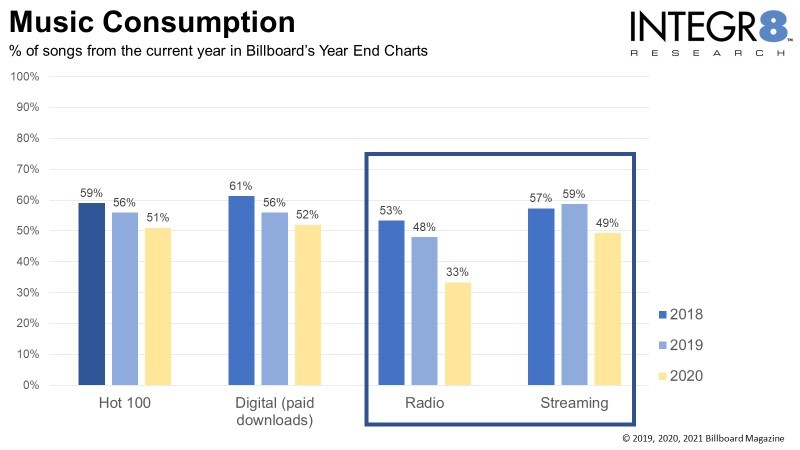
  • In 2020, streaming users streamed 10-percentage points fewer songs from the current year than they did in normal years like 2019 and 2018.
  • Most dramatically, while about half of the songs listeners hear on the radio in a typical year are released in that year, only a third of the songs they heard on the radio in 2020 were released in 2020.

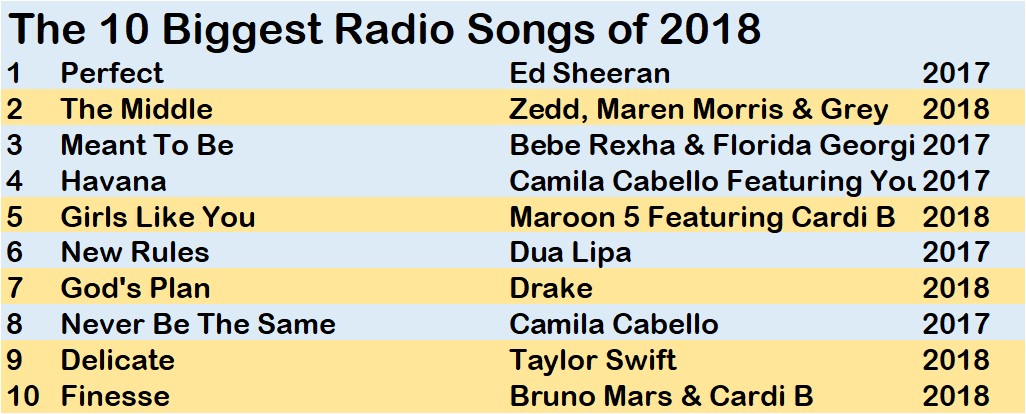
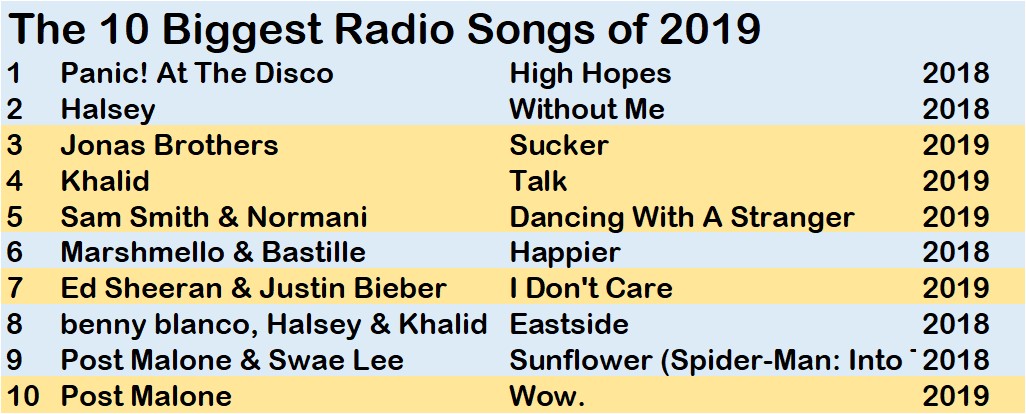
Let’s dial in on radio’s 10 biggest hits each year. During a typical year, about half of those biggest songs on U.S. radio are from the current year:

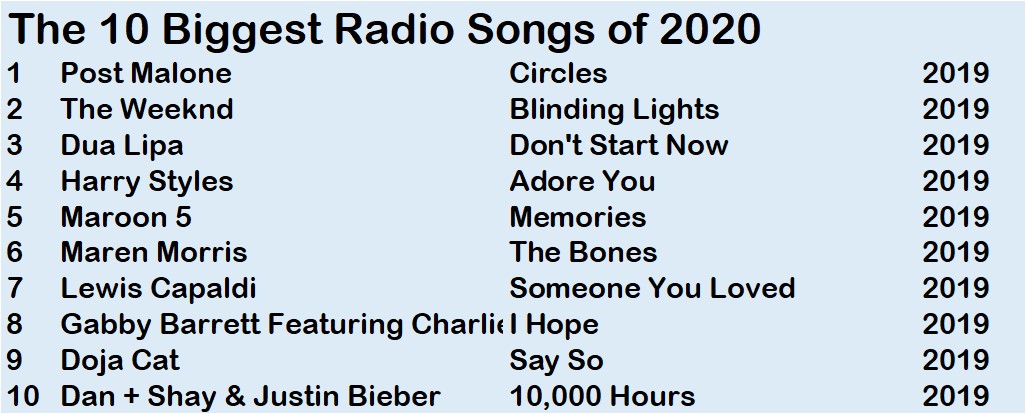
In 2020, however, not a single song that was released in 2020 made radio’s Top 10. All were from 2019:

Was radio right to be so disinterested in 2020’s music? Were listeners really that down on last year’s music as they were everything else last year?

We’ll share information from Coleman Insights that confirms it in our next post.

Why Your Station Needs to Lose the Loudness Wars

Part three in a series “How to prepare your station to appeal to a new generation.”

Did you ever work with an engineer who clearly yearned to be the program director?

Well, I have a confession.

I was a program director who secretly yearned to be the engineer.

So, while the Integr8 Research blog normally focuses on helping you pick the right new music, please indulge my passion for the tech side of radio to discuss how that new music sounds on your station.

Recently while watching This Week In Radio Tech, a video blog devoted to everything from the studio mic to the tower lights, a guest had an observation that directly impacts how your station should sound: Today’s younger listeners are growing up listening to music on Spotify with more dynamic range and without as much compression and clipping than on yesterday’s heavily mastered CDs. They’re also hearing spoken word programming on podcasts, which typically present the human voice in its full natural dynamic range.

Teenage Girl with Headphones

What happens when those younger listeners, accustomed to hearing today’s digital audio on smartphones and Bluetooth earbuds, turn on the FM radio in their cars? They’re greeted with audio that’s had every ounce of dynamic range compressed and clipped out of it.

To the ears of these digital natives, the music sounds shrill and distorted. The personalities’ voices sound unnaturally boomy, lacking intimacy and impeding relatability. Several tech consultants are therefore now recommending stations targeting younger listeners minimize their on-air audio processing.

It reminded me of another aspect of the next generation of listeners we discussed in our Generational Music Cycle series, which shows how music tastes change predictably when a new generation becomes the primary consumer or creator of popular music: The Homelander Generation—one name for the generation after the millennials—is about to take over the role of determining what music is popular. They’re slated to bring more sensitivity, inclusion, introspection, and intimacy to popular music.

The base-thumping energy that made Honda Civics sound like dance floors made sense for Pitbull and DJ Snake, but not so much for the next Olivia Rodrigo.

“But wait,” those tech-savvy programmers among you note, “Radio needs to transmit the highest possible audio level to maximize signal coverage and minimize interference noise!”

Correct: The physics of FM and AM radio do not change. Over the last half century, however, we’ve gone far beyond maximizing modulation to engaging in a war for which station sounds loudest on the dial.

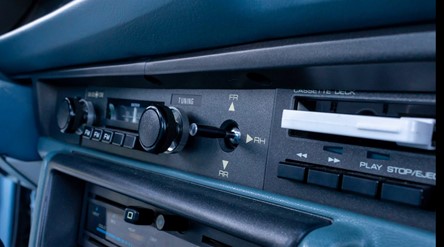
Analog AM/FM radio in a 1980 Datsun 200SX

Back when radios still had dials, listeners spinning that dial were most likely to stop on stations that sounded the loudest. encouraging stations to consistently one up one another for the loudest sound on the dial.

By the 1980s, the Loudness Wars were in full force, with Z100 New York’s engineer Frank Foti famously firing the first shot by sculpting a sound some coined The Voice of God.

Meanwhile, music buyers wondered why songs sounded different on the record then they sounded on the radio. When CDs replaced LPs, record labels used radio’s tricks to make CDs sound louder and louder.

The loudness warm came to a head with the 2008 release of Metalica’s “Death Magnetic” CD.

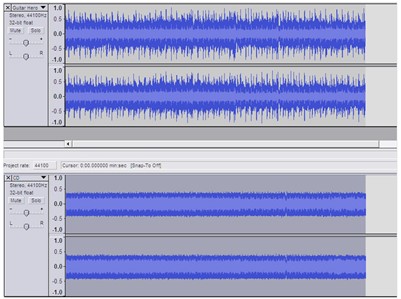
“The CD version on the bottom has been heavily compressed, limited and/or clipped, and sounds massively distorted as a result,” notes mastering engineer Ian Shepherd in Wired Magazine, “For the first time, however, listeners also could hear the album on Guitar Hero, which used audio without the final mastering compression. “The CD is 10 dB louder than the Guitar Hero version, which sounds about twice as loud to the ear. That’s some wicked compression.”

Death Magnetic CD loudness

Visualization of Metalica’s Death Magnetic showing extreme dynamic range compression and heavy clipping (bottom) compared to the more natural sounding version on Guitar Hero (top).

Record companies—once again noting customer preferences—reversed course: They began backing off aggressive loudness, Today, producers master music for the best experience of streaming audio, not to emulate highly compressed FM radio’s sound.

Somehow, radio missed the memo.

Touchscreen HD Radio in car

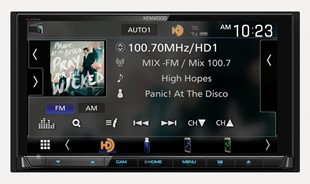
Most stations with formats targeting younger listeners still squeeze and clip every decibel of dynamic range out of their audio to achieve loudness supremacy, even though its been decades since digitally tuned radios eliminated the competitive advantage of being the loudest sounding station on the dial.

It doesn’t have to be this way: Today’s smart digital audio processing can maximize modulation for the greatest signal coverage and least noise, while also sounding more natural and giving music and voice the dynamic range to breathe.

Omnia SST Audio Processing Software

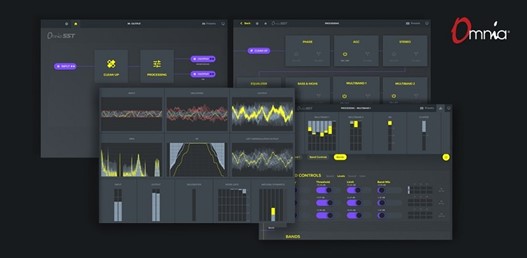
Modern audio processing, such as the Omnia SST software-based audio processor, can maximize modulation without the crunchy distorted sound of overly compressed audio. (Courtesy of The Telos Alliance)

But don’t take my engineering wannabe word for it.

Telos Alliance President and maker of Omnia audio processors Frank Foti offers expert advice on how stations can back off aggressive processing to avoid clipping treble frequencies and to reduce the bass clipping that distorts the entire sound.

Yes, that’s the same Frank Foti who used his tools to launch The Loudness Wars of the 1980s. He’s now advising you how to use his tools to call a truce.


Radio: You Need New Décor

Part two in a series: “How to prepare your station to appeal to a new generation.”


I don’t know how to tell you, but your radio station needs new décor.

Not that mystery stain couch in the lobby—but yeah, gross. Deal with that.

It’s your imaging.

Look, I know radio went a little overboard on the short and sweet when PPM hit. And spicing things up with production elements sounded good a decade ago between Calvin Harris and LMFAO. Between cutbacks and COVID lockdowns, we’re relying on those imaging elements more than ever to reenforce our brand identity and establish the station’s vibe.

But music is changing. Billie Eilish and Olivia Rodrigo are bringing a more intimate sound. They call it Bedroom Pop minimalism. It’s a style geared more towards headphone listening than blasting on dance floors. It speaks with listeners one on one, not en masse.

This trend is exactly what you’d expect as the kids that were The Minecraft Generation a few years ago become the tastemakers of tomorrow’s pop music.

A radio tower created in Minecraft

But sadly, the sound of what’s between the hits isn’t keeping up with the hits.

It’s not the first-time radio needed a fashion makeover:

  • The fast-based energy of 1960s Top 40 giving way to the laid-back stoner sound of 70s AOR
  • Then, “Flame-throwing” high energy CHR returned on FM in the early 80s on stations like Hot Hits 98 WCAU-FM and Z-100.
  • In the 90s, 80s style CHR sounded cheesy and fake, replaced by the “get real” grit of Alternative stations and early Hip Hop outlets became in vogue.

But isn’t imaging just there to spout the slogan? Hardly.

Great radio stations are restaurants with music instead of meals. Playing songs your listeners love and expect from your station is the bare minimum, just as tasty food is only the beginning in the restaurant business. How you surround those songs creates the experience that makes listeners feel at home.

The same food in your office break room won’t taste as good.

Here are three things you need to change to redecorate your CHR’s imaging:

1) Replace over-produced sweepers with simpler sounding ones. The most compelling new artists among younger listeners are streamlining the instrumentation, with fewer sounds competing with the vocals for listeners’ attention. Think the solo piano on Driver’s License. Think the singular base line and finger snaps of Bad Guy. These songs simply don’t mesh with laser-zap laden sweepers. Encourage your imaging producer to find simple musical accompaniment that stands out without adornment to add impact to your positioning statements.

2) Convey your brand in an authentic voice. Does your station imaging voice sound distant, robotic, or get processed through lots of sound effects filters? That style matched the music in the Autotune era. Nowadays, music vocals are moving away from those vocal effects that distort the voice, Instead, they’re using effects that bring the voice closer. Your station voice should talk like a normal person would talk with a friend and you should present their voice in a way that maintains that close connection.

3) Write positioning statements with language listeners actually use: Convey what makes your radio station unique by talking in a way your listener actually talks. Speak to her directly. Be authentic. Be a little self-deprecating when she’s not expecting it. Be real. Ultimately, your voiceover talent shouldn’t simply slam a slogan, it should make your listener feel like you’re the club where she belongs. As radio relies even more heavily on sweepers to handle what live personalities once did, rethinking our positioning language is more important than ever.

To your ears, these changes will sound weird. No one else is doing imaging this way.

But that fact is exactly why you need to implement these changes. To your listeners, these changes will make your station stand out from the sound of every other station in town.  Your changes will also re-position your competitors as stale and out of touch. Most importantly, these changes will prepare your station to resonate with the changing mindset of the generation soon taking over from Millennials.

Do you have specific ideas on how to makeover CHR radio imagining? Share your creativity in the comments below!

Please don’t share the story of that stain on the station sofa, however.

Seriously, just no.

Next up: Why Your Station Needs to Lose the Loudness Wars

How to Prepare Your Station to Appeal to a New Generation

A three-part series on future-proofing your station


As a radio programmer, sometimes your #1 job is to not break what’s working. Then there are times where the only way you can fix things is to break things.

If you program a hit music station, it’s time to start breaking things.

Scary. However, “[i]n times like these, it helps to recall that there have always been times like these,” advised Paul Harvey.

In our next three posts, we’ll outline things you should consider breaking at your radio station in the next few years, with some guidance from radio’s past to point the way.

Today, we’ll tackle the #1 trap you’ll need to avoid when choosing your station’s music.

Avoid the “It’s a hit but it doesn’t fit” hole.

Historically, CHR’s worst ratings came during times when the format has tried in vain to balance the tastes of younger and older listeners who no longer agreed on the hits:

1991: On the cusp of Alternative and Hip Hop breaking through to become the definitive sounds of Generation X, CHR radio was playing Paula Abdul and Wilson Phillips, holding on to the promise of a new day.

1981: As MTV launched with New Wave, CHR was powering “Love On The Rocks,” “Endless Love,” and endless supplies of Air Supply.

1971: The artists we now laud as Classic Rock attracted their far-out fans to FM radio. Meanwhile on AM Top 40, it was Osmonds as far as the ear could hear.

At each of these points in history, popular music was on the cusp of passing the torch to a new generation whose tastes would determine the hits.

When this schism first emerges, following the newest cutting edge music trends among younger listeners is foolish. Richard Marx clearly had more fans than did Morrissey in 1988.


As interest in new styles grows too big to ignore, but not yet big enough to win over older listeners, CHR has dealt with this impossible balance by maintaining a sonic style—namely conservative pop—instead of playing the hits. While this strategy does stop ratings bleed in the short term, it also lulls programmers into missing the tipping point in music tastes.

Be too far ahead of the curve and you’ll go down in history as a groundbreaking station that was ahead of your time.

Be too far behind the curve, however, and you’ll not only lose younger listeners, you’ll lose your relevance to contemporary culture—that’s very difficult to regain once you lose it.


In 2021, although Billie Eilish and Olivia Rodrigo hint at the future, we have not yet reached the critical tipping point where the musical preferences of the Homelander generation (the generation after the Millennials) are more salient than the tastes of older millennials. History suggests we will hit that mark in the middle of the decade.

In the meantime, prepare yourself by being in touch with the tastes and attitudes of teenagers. Specifically, look for songs emerging from communities that have historically not been mainstream:

  • Spanish-language songs: One of the hottest songs on Spotify so far this year is Telepatía by Kali Uchis, a sultry song of long-distance love. It’s been Top 10 among Spotify’s most-streamed songs in the U.S. for weeks, reaching as high as #4. Yet outside of a handful of CHRs in heavily Hispanic markets, the song has yet (as of the publication date of this post) to have a meaningful impact mainstream radio.
  • The LGBTQIA+ Community: Among the top 100 songs on Spotify is Hayloft from a 2008 album by Vancouver’s indie band Mother Mother. Seemingly out of nowhere, Mother Mother’s music has become a connection point for nonbinary and genderqueer teens who have TikToked the band out of obscurity. Meanwhile, Sweater Weather by The Neighbourhood routinely appears among the most played songs on Spotify as bisexual young people have adopted it as an anthem. The less popular but more overt songs by Norwegian indie act Girl In Red have become code for lesbian teens.
  • K-Pop: BTS finally brought the genre a mainstream hit in the United States (beyond that YouTube novelty you’ve been trying to forget.) Could more Seoul based acts follow?

In our next post, we discuss programming elements beyond your playlist that will require your future-proofing attention.

What “Drivers License” tells us about the future of pop music

For the last two decades, Millennials’ tastes have driven the direction of pop music. They rejected the gritty reality Generation X expressed in Alternative Rock and Hip Hop for songs about friends out to have fun. They replaced the guitarist with the mix DJ as the hero of popular music.

But a new generation is taking over—and we have a glimpse of how they will change the charts in a #1 hit by a 17-year-old previously known for her work on Disney’s High School Musical: The Musical: The Series.


Here are three things “Drivers License” tells us about Pop music’s future.

#1: Pop music is becoming more intimate as a new generation takes over the teenage demographic.

Born in 2003, Olivia Rodrigo is—according to generational theory gurus Straus and Howe—the last of the Millennials, while the high schoolers just a year or so younger than her who have made “Drivers License” a hit are the first kids of the Homelander Generation (a.k.a. Generation Z).

So far, their childhood has seen the great recession, political instability, and now COVID-19. Their Gen-X parents are hell-bent on protecting their kids form these dangers, remembering all too well how their 1970s latch key kid childhoods offered little protection.

At school, Homelanders follow the rules, now as a matter of life and death. In their private lives, now lived largely online, they seek an individuality to a degree their older Millennial siblings did not. They’re looking inward in a way Millennials look outward.


That quiet inward reflection drips from “Drivers License”. Musically, it’s minimalist. As an SNL skit said, “sounds like it’s just some teen girl singing in a room to a piano.” It’s a  stripped down style some now call bedroom pop.

Lyrically, “Drivers License” is intimate, telling the age old story of broken love with multifaceted personal detail and emotional vulnerability.

A decade ago, this song would involve Friday night clubbing with friends to forget the breakup, but in the years to come, the Homelander generation won’t have its own Party Rock Anthem.

#2: More creators are crafting songs with Spotify and social in mind—not radio.

If you remember cart machines, you also know the joy of hitting the post. Through the 90s, you could do a legal ID, a PSA, and the weather over the intro.

Today, listeners sample songs on Spotify, often deciding within seconds if they’ll listen to the whole song—or at least the 30 seconds needed for streaming services to pay the performance royalty. A study from the Ohio State University found that the average hit song intro dropped from 20 seconds in the 1980s to just five seconds today.

The first few seconds of songs now function as advertisements for the rest of the song designed to reel in the listener, including more cold intros, mentioning the title within the first few words, and mini musical snapshots of the rest of the song.

This real estate is simply too valuable to waste on intros for screaming DJs.

True to this new form of songs selling themselves, “Drivers License” starts with the sound effect of Rodrigo’s mom’s car starting, then says the name of the song in the very first sentence.

Fade-outs have also faded away.

Starting with iPods, listeners skipped long fades. Why hang around when the best of the song’s obviously over? On Spotify, a listener who doesn’t skip might even listen to the song again—which doubles the royalty payment.

Like many songs today, the ending of “Drivers License” blends right back into the intro in a way that makes playing it over and over a seamless experience.

Finally, songs are increasingly including elements that are inherently sharable on social media. The piano beat-driving chorus, complete with two dramatic tempo changes, is there on purpose: Rodrigo told The New York Times’ “Diary Of A Song” that she intentionally designed the chorus’ dramatic changes “because I wanted people to be able to make TikToks where they could transition into it.”

Expect more songs’ structure to promote the marketing of the song itself.

#3: Radio doesn’t break hits, it validates them.

Radio’s new music discovery role has been slipping for years—and that wound is largely self-inflicted. In “Drivers License,” we have a song that didn’t merely first break on streaming, it hit #1 on the Billboard Hot 100 solely on the strength of streaming and sharing on social media.

Almost instantly, the song became a TikTok anthem, the platform on which Rodrigo announced the song’s release. Four days later, “Drivers License” set Spotify’s all-time record for most streams in a day with over 15 million streams globally.

Radio airplay, meanwhile, didn’t reach #1 until seven weeks after the song’s release.

Once the song had grown along a more conventional timeframe to become radio’s most played song, “Drivers License” was still #1 on Spotify. Radio undoubtedly exposed the song to a wider audience, many of whom would continue to stream it. More importantly, the song’s prolonged radio exposure—vetted by callout research—demonstrates that the song isn’t merely today’s TikTok. Radio cements the song’s sustained cultural relevance.

SNL would not have created an entire skit about “Drivers License” without radio embracing it.

Expect that listeners increasingly might not hear a new song on the radio first, but they will know it’s a real hit when they hear it on the radio.

Further Reading


How to Use Shazam, Streaming, Sales, and Callout in Radio Programming

Richard Sands, author and publisher of Alternative newsletter The Sands Report, featured Integr8 Research President Matt Bailey in the October 29 and November 5 editions. Matt covers strategy that applies to multiple contemporary formats, including Alternative, CHR, Hip Hop/R&B, and Country. The interviews are reprinted with permission.

Matt…tell me about yourself. Do you have a background in radio?

One night when I was three, my dad brought me home a black transistor radio. I tuned to 79/WQXI-Atlanta during AM Top 40’s last glory days. I was hooked. I’d later get the thrill of working with those same ‘QXI legends at Cox Radio Atlanta. So yeah, I’m a life-long radio geek!

Integr8 Research President Matt Bailey

What is Integr8 Research…and how long have you been there? 

Integr8 Research helps stations pick the right new music. It’s all we do. I joined in 2009, when Coleman Insights acquired the old Core Call Out with the mission of transforming it for the 21st century. Three years later, we launched Integr8 New Music Research.

What’s your take on Shazam’s value for radio?

Shazam has tremendous value in helping radio detect which new songs spark listener intrigue. In a study we conducted in 2016, we found that 73% of songs that became Top 10 most Shazamed songs also went on to become Top 10 Hits on the Billboard Hot 100. For 33% of those songs, Shazam spotted the hits at least 3 weeks in advance. .

Is there a certain way that PDs should look at Shazam that would be most helpful?

Remember why someone Shazams a song: They’re hearing a song that 1) someone else played and 2) they want to know the artist or title. If a song or its singer is easily recognizable, listeners don’t need to Shazam it.

So that’s why Shazam doesn’t predict many mainstream Pop songs?

Yes. You already recognize Taylor Swift. If listeners stream a song, they won’t Shazam it, because either they already knew the artist title, or that info is already on their screen. That’s why Hip Hop streaming hits don’t get Shazamed. Finally, when you see a song’s Shazams dropping, it doesn’t mean listeners don’t like the song anymore. It usually means they’re now familiar with it. With those caveats, the #1 place listeners hear songs they Shazam is on the radio.
Shazam can be a great tool for radio programmers, but it must be used correctly.

There’s more than just Shazam. What about streaming metrics – can radio programmers confidently use these numbers to augment their programming decisions?

Absolutely!  As with Shazam, it’s imperative to know what streaming tells you—and what it doesn’t: Streaming stats tell you the number of times a song played. It does not tell you how many different people streamed a song or how often each user streamed it. A song that 10 users stream 1 time is the same as a song 1 user streams 10 times. That’s how “Baby Shark” became a hit. (Thanks, toddlers). It’s like having AQH share, but not knowing your Cume or TSL.

What does your research show you on the subject of streaming?

In a Spotify deep-dive we conducted in 2019, we found listeners use Spotify much like they used Tower Records 25 years ago. When your favorite artist drops a new project, you rush to Spotify to sample it. At first, most of the tracks in the new album will dominate Spotify’s ton 10 most streamed songs. Over time, however, listeners settle on one or two songs that they want to hear repeatedly for weeks—and those songs are the ones that become radio hits. So when looking for hits on streaming, don’t simply look at what’s big this week: Look for songs that are big week after week.

What about Alternative in particular?

For Alternative, the biggest hits aren’t likely to dominate the most-streamed songs the way Hip Hop songs does, plus many tend to build over time just as they do in radio. When using streaming, look for songs that listeners consistently stream week after week. Those titles are your hits.

Richard Sands of The Sands Report

I see! Good advice. Anything else?

Streaming doesn’t tell you how many people hate a song—because if you hate a song, you simply don’t play it. In radio, haters matter—because they tune out.

What about digital sales? When I first started in San Francisco, sales helped determine what songs got added to the playlist!

It depends. In some formats such as Country, enough listeners still want to own music, so knowing which songs people pay to keep forever is valuable data. For other genres such as Hip Hop, streaming has already usurped sales. Alternative lies somewhere in the middle.

Are there any other metrics we should pay attention to?

MScore doesn’t get PR these days, but stations still use it and it has the opposite limitation of streaming: MScore may tell you which songs cause people to tune away from your station, but it tells you nothing about which songs listeners tuned in to hear in the first place. So use it, especially for highly familiar titles, but remember: Avoiding tune out is of no use unless you first generate tune in.

How can programmers best using streaming?

Use streaming to see what new songs are culturally relevant that might not be on your radar as well as which songs in your format listeners keep steadily playing week after week—but streaming won’t tell you if a song has haters.

Next, Shazam?

Use Shazam to see which of the new releases you’re playing sparking interest among your listeners are—but don’t use it as a substitute for overall popularity for songs listeners know.

And callout?

Use callout to see a complete picture of each songs’ familiarity, appeal, and relevance among those listeners that most impact your ratings—just remember callout can’t tell you the future of a song your listener’s barely know.

Did I forget any?

Here’s a strange one for Alternative stations looking to break Indie artists: Wikipedia. If a seemingly unknown act has an extensive Wikipedia page, it shows they have a passionate fan base.

For those new to programming…what is callout research?

Callout helps stations pick the right currents by finding a station’s target listeners in their specific market, playing them the six-second “hook” of songs the PD chooses, and having listeners rate those songs. A callout report shows which songs listeners know, love and hate, so programmers know which songs should be in power, secondary, or recurrent rotation. Stations typically receive callout weekly or bi-weekly, so they can stay on top of fast-moving new music trends.

Is it difficult to find respondents? I understand fewer and fewer people want to answer their phones and participate.

That’s where “callout” is really an outdated term: The days of randomly calling people at home and asking them to stop what they’re doing and rate music on the phone are long gone. For Integr8 New Music Research, we use three different ways to find listeners—by calling landlines (fewer each year), calling mobile phones (expensive, but needed for a representative sample) and online. Then—regardless of how we find a listener—all respondents evaluate a station’s music online. Listeners have several days to take the survey whenever they have time and it’s optimized to be easy on a smartphone.

From a station standpoint, what is needed? Do stations still have to put together a tape of hooks to play to the respondents?

The days of preparing a tape have fortunately gone the way of the cart machine. Today, stations simply edit and send each hook as a digital audio file, or hire a hook vendor to do it for them. The most important elements really are carefully considering 1) which listeners are most important to your ratings success before you begin conducing new music research, and 2) which songs you test with an ear towards your station’s strategy. As Jon Coleman says, “every song is a marketing decision.” If you think your listeners might love a song, but you also think that song isn’t what listeners want from your station, for crying out loud don’t test it!

Is callout still the gold standard for figuring out rotations and recurrents?

The obvious advantage of customized new music research (a.k.a. callout) is that it focuses on people who actually live in your market and listen to your station. Streaming and Shazam data may drill down on your town, but can’t zone in on people who actually tune in. Beyond that advantage, Callout is the only tool that shows 1) both the positive and negative reaction to your music. 2) if listeners are passionate about or merely accepting of it, 3) how different camps within your audience respond to your music, and 4) where each song is in its lifecycle as a hit—which helps you know when it’s time to move a song to recurrent (Integr8 has a proprietary tool called Hitcycle that makes that decision clear.) No other tool is as comprehensive as callout.

What do you say to companies worried about budgeting for this kind of research?

How much revenue would your station lose if your AQH share slipped just 1% from playing the wrong currents? How much is customized new music research for your station? When you compare those two numbers, can you really afford not to have it?

Thanks for joining us, Matt! Any final thoughts?

Radio’s best listeners are people who love great radio. They enjoy the shared experience of your personality who loves the music as much as they do. They love your sarcastic afternoon jock who always can relate to their crappy day. They feel they’ve finally found their tribe when they tune in. Great radio takes real relationships—and real relationships require real people on the air playing the music you’ve painstakingly researched. Tools and technology change. Friendship doesn’t.



The Last Rock Song


When Shinedown’s “Second Chance” became a Top 10 hit in 2009, an era ended.

That song became the last Rock song to reach the Top 10 on the Billboard Hot 100.

No, we don’t mean people no longer love rock. From Queen to Nirvana, Classic Rock remains revered, even by people who are now hearing it from their grandparents.

And no, we also don’t mean the Alternative Rock format. After a slump in the mid-00s and despite recent struggles, It rebounded for much of the 10s thanks to a new batch of core artists that reflect a more pop-oriented style reminiscent of alternative’s pre-Grunge roots.

However, the screaming guitars and aggressive vocals that defined Rock from The Doors to Linkin Park are no longer a core component of contemporary hit music.

In our previous post examining what the past 20 years of music can teach us, we noted two genres that bounced back and the birth of another genre. Rock’s trajectory is different.


From 2000 to 2009, 61 different Rock titles became Top 10 hits, from mainstream artists such as 3 Doors Down, Linkin Park, and (gulp) Nickelback, to Alterative icons including the Red Hot Chili Peppers and Green Day. Even Aerosmith scored a Top 10 hit in the new century after scoring their first Top 10 in 1975.

After Shinedown’s “Second Chance,” the next three rock-oriented songs to become Top 10 hits were: Kings of Leon’s “Use Somebody”, “Pumped Up Kicks” from Foster the People and F.U.N.’s “We Are Young”.  While these songs would fuel a resurgence for the Alternative radio format, musically, they broke from the conventions that defined “rock” since the 60s.


Only 22 rock titles would reach the Top 10 of the Billboard Hot 100 from 2010 to 2019, predominantly from pop-oriented artists such as Imagine Dragons, Twenty One Pilots, and Panic! At the Disco, along with huge hits from Gotye and Hozier.

Is it really possible that Neil Young lied to us when he promised, “rock ‘n’ roll will never die?” Can a once dominant genre simply fade away?

Yes—and it’s not unprecedented.

Before the rock era, Jazz was the predominant sound of contemporary music.  From 1910s Dixieland and 1920s Swing, Jazz evolved from its improvisation roots to the highly orchestrated Big Band sound synonymous with the G.I. Generation. Then, popular Jazz-based music further evolved into the more intimate sound driven by small combos and crooner vocalists—notably Frank Sinatra.


Jazz remained the foundation for American popular music until 1955, when Bill Haley and the Comets’ “Rock Around The Clock” hit #1 and ushered in the Rock era. Pre-rock styles would co-exist on the charts alongside rock until the late 60s and early 70s, when Frank Sinatra, Peggy Lee, Perry Como and Andy Williams finally had their last major hits. Sure, Jazz continued and evolved, but it was now a niche sound outside the mainstream.

Youth culture never pivoted on Pat Metheny or Harry Connick Jr.


Rock has followed a similar trajectory. Following pioneers such as Buddy Holly, The Coasters and Elvis Presley, Rock ‘n’ Roll evolved into Rock, defined by The Doors, Led Zeppelin and The Eagles and later AC/DC, Van Halen and Mötley Crüe. Then, Rock further evolved when Nirvana launched Grunge and Alternative Rock became mainstream.

Today, Rock lives on among its core fans. No matter how much Michiganders espouse Greta Van Fleet, however, Rock is no longer a dominant force among youth culture. This shift is so big, it might contribute to the death of Gibson Guitars. Today, Hip Hop and elements of electronic music drive the music most relevant to youth culture.

To explore what trends await us in popular music, check out How The Homelanders Will Soon Change Popular Music, the second part of our series on The Generational Music Cycle.