Tag Archives: Integr8 Research

Three Lessons the Millennium Has Taught Us about Popular Music

As specialists in researching new music, Integr8 is generally focused on what’s happening today in contemporary music. However, there are times when clarity about the present comes from understanding the patterns of the past.

Now that so much of what’s to come seems uncertain, it seems like the perfect time to take a trip through time to see what we can learn about the future.

So, we examined every song that became a Top 10 hit on the Billboard Hot 100 from 2000 through 2019. We figured the last 20 years in music from Santana’s “Smooth” to Post Malone’s “Circles” might uncover some big picture trends that could help you program your station into the 2020s.

Here are three lessons from the past two decades to keep in mind in our new decade.

POP ALMOST DIED… THEN ROARED BACK

From 2000 to 2005, the number of pure pop songs to reach the top 10 of the Billboard Hot 100 sank steadily from a third of all hits to only 9%. In 2005, however, pop songs once again became huge hits, thanks to Kelly Clarkson. Then came Taylor Swift, Lady Gaga, Ke$ha, and Bruno Mars. From 2005 to 2014, Pop’s share of the top 10 hits each week grew until Pop once again filled the majority of top 10 chart spots each week.

The lesson? Don’t count out mass appeal pop. Eventually, it always comes back.

HIP HOP ALMOST DIED… THEN BOUNCED BACK

While Pop was declining, Hip Hop was ascending. From 2000 to 2005, Hip Hop doubled its share of the top 10 songs thanks to Nelly, Jay-Z and 50 Cent. Then for the next 10 years, Hip Hop—particularly the pure Hip Hop that is less likely to cross over to CHR—declined. By 2014, the most successful Hip Hop artist was a white Australian who learned to rap in Atlanta (Iggy Azalea). Then came Fetty Wap, Drake and Lil Uzi Vert who redefined the genre, followed by Post Malone, who helped bring those new trap sounds further into the mainstream.

The lesson? From Jazz to the Rhythm and Blues that birthed Rock ‘n’ Roll to Hip Hop, the cutting-edge music of the African-American community has always played a pivotal role in the evolution of America’s popular music. That tradition isn’t changing.

EDM WAS BORN

As is always the case with emerging music styles, EDM wasn’t really new when David Guetta and Calvin Harris broke into the Top 10, followed by DJ Snake, Major Lazer and Avicii.  Deadmau5 and Skrillix had passionate appeal among young underground fans during the 00s.

So what pushed EDM into the mainstream in 2010?

The emergence of EDM as a mass-appeal genre with superstar DJs occurred at the same time the millennial generation took total control of popular music, which we explained recently in The Generational Music Cycle. Throughout the 00s, the millennial generation were the primary consumers of contemporary music, but most artists were still from Generation X. 2010 marked the moment when the millennial generation became both the dominant consumers and creators of contemporary music. With it, those underground sounds that were previously the province of “the weird kids” went mainstream.

As the 2010s unfolded, fewer pure EDM titles became Top 10 hits not because the style became less popular, but because the stylistic elements of EDM became a core component of mainstream pop.

The Lesson? The underground sounds of a new generation often become the mainstream sound of pop music a few years later. Just as the millennial generation made their mark on popular music by making EDM a mainstream sound, we’re on the cusp of the next generation making their mark on popular music. To see where pop music might be headed, check out our previous post, “How The Homelanders Will Soon Change Popular Music.”

There’s a fourth lesson we can learn from the first 20 years of the millennium that deserves a deeper evaluation—that genres really can die. We’ll tackle that lesson in our next port.

How The Homelanders Will Soon Change Popular Music

In our previous post, we introduced the Generational Music Cycle, which shows how music tastes change predictably when a new generation becomes the primary consumer or creator of popular music. For almost two decades, millennials have been the generation picking the hits. They made Hip Hop fun in the 00s. They made EDM DJs stars in the 10s.

But the reign of the millennials is almost over.

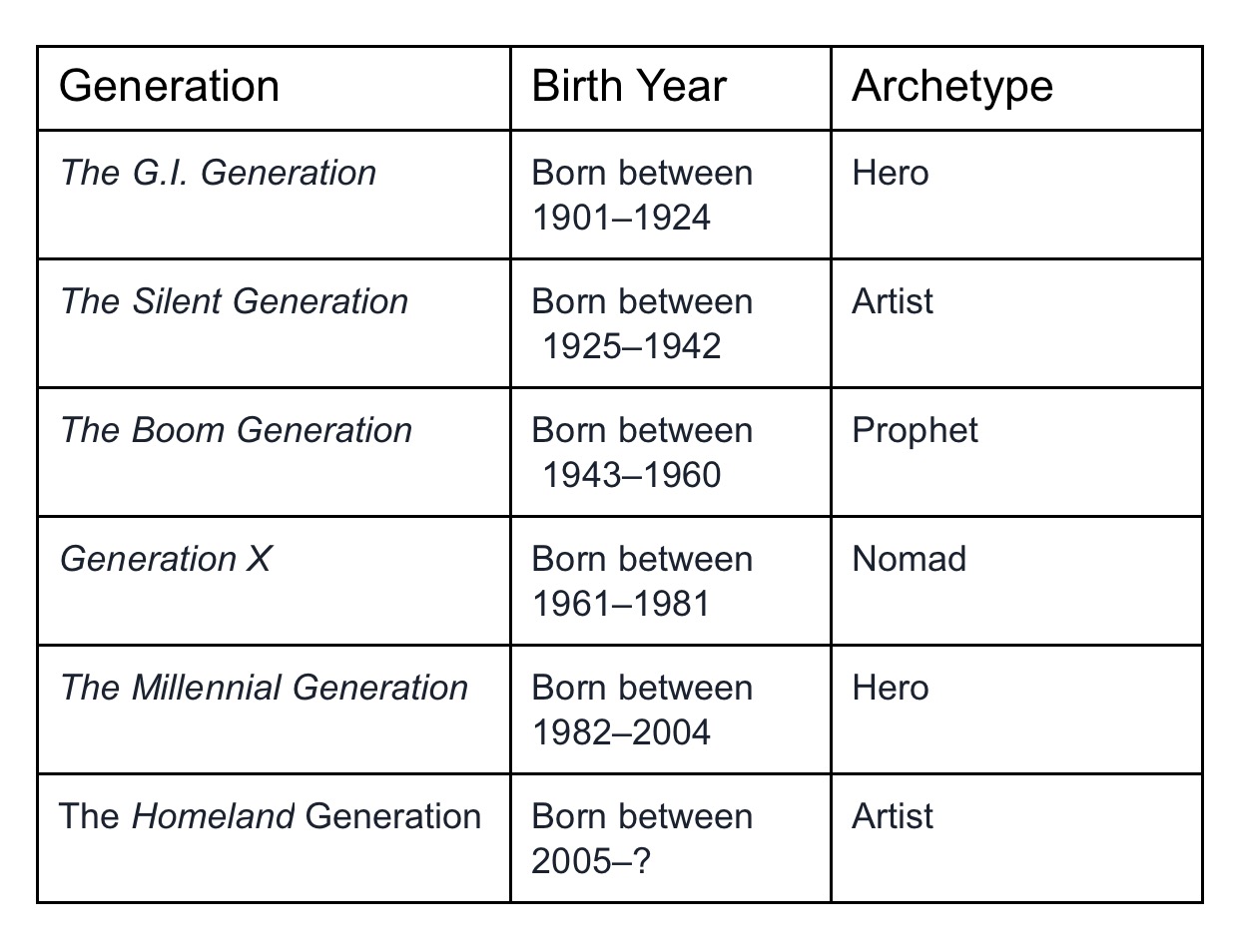
Sometimes called “Gen Z”, “iGen”, “post-millennial”, or most recently during the COVID-19 crisis “Generation C,” the Homeland Generation (a term coined by the father of generational research Neil Howe) is the generation after the Millennials, with a birth year starting around 2005.

Kids who can faintly recall a time before President Obama or the 2008 financial meltdown are the last of the Millennials. Kids who can’t are the first Homelanders.

THEY’RE NOT MILLENNIALS

While every person is unquestionably unique, the over-arching tone of the millennial generation is confidence and optimism. They grew up with the prosperity of the 1990s and 2000s. They are primarily the children of Boomer parents, whose helicopter parenting style made them feel special and important. They’re team oriented. They’re excited by progress.

They were the babies when “Baby On Board” stickers were a thing.


In contrast, Homelanders are growing up amid financial uncertainly, political divisiveness, climate fears, and now a deadly pandemic. That environment is making them cautious and insecure. Their Generation X parents, all too aware of life’s dangers, are as over-protective of their Homelander kids as their parents were under-protective of them in the latch key kid 1970s. They’re not merely helicopter parents; they’re stealth fighter parents.

In public life, Homelander kids are rule-oriented and pragmatic, now as a matter of survival. Privately, they’re quietly seeking their own identity as they connect with their friends on Discord. They’re sensitive. They value kindness and don’t want anyone to feel left out. They’re looking inward in a way Millennials look outward.

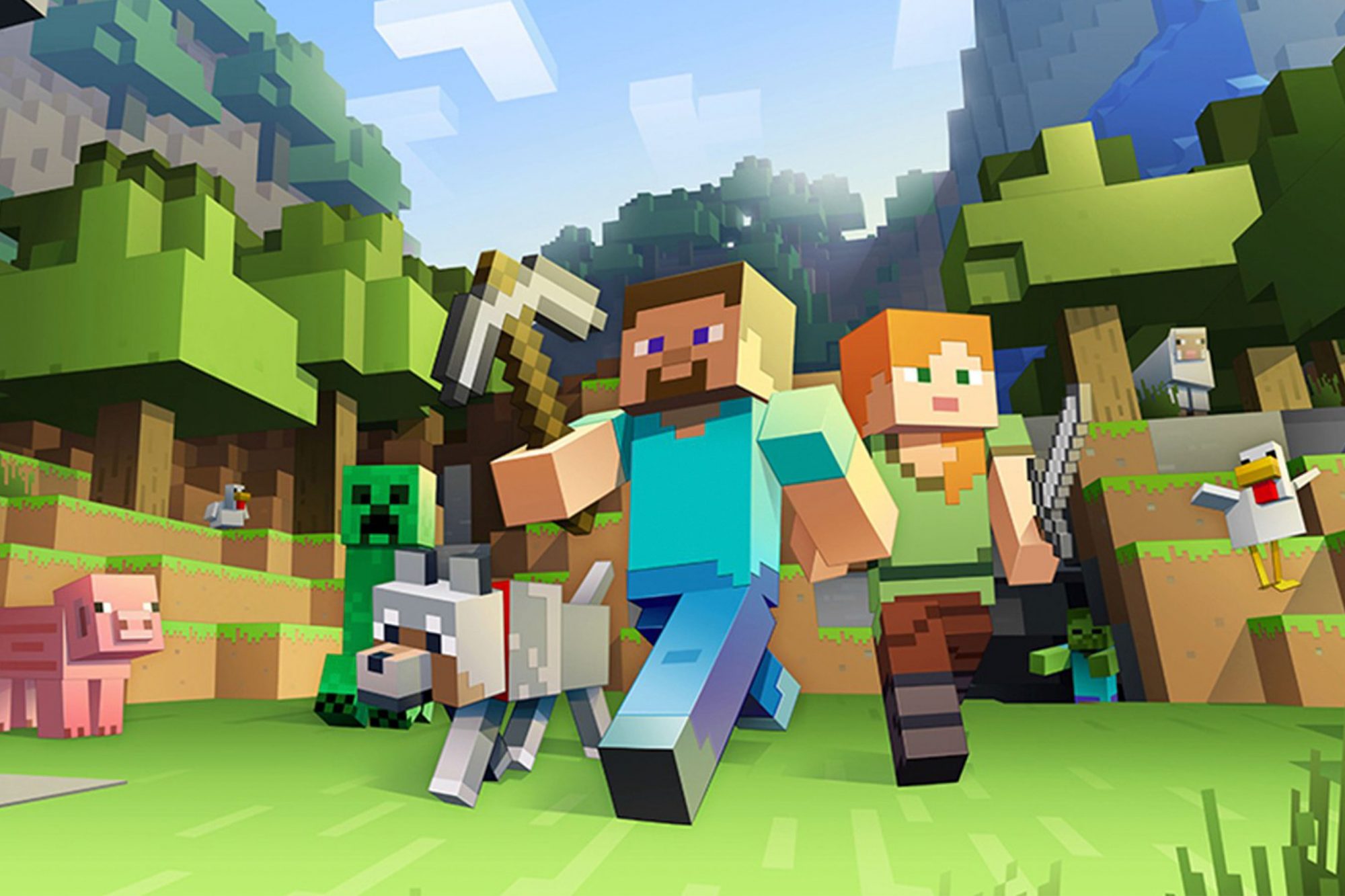
They’re the Minecraft generation.

With 2005’s babies now high school freshmen, we’re on the cusp of experiencing how their worldview will soon alter popular music.

 ENTER BILLIE EILISH

Eilish isn’t a Homelander. Born in 2001, she’s among the last wave of Millennials. However, her life has details familiar to Homelanders, from the parental protection of home-schooling to the introspective self-exploration of her work.


More importantly, Eilish is the first new artist that Homelander teens have helped make a star.

  • Her music is intimate—her microphone technique, especially when her fans use their earbuds, makes her feel as if she’s right next to your ear, leaving middle age dads of her teenage fans asking, “Why is she whispering?”
  • Her music is sensitive—she’s willing to share her own struggles with depression and anxiety in songs like “Xanny” in a way that eschews the sexualized glamour typical of female pop stars.
  • Her music is inclusive—musically, she defies genres by mixing many different elements. Lyrically, “Wish You Were Gay” treats sexual orientation diversity as a given, not a novelty.

These traits may well be definitive of the songs that become hits as Homelanders increasingly determine popular tastes—because these traits define the generation.

No wonder her music sounds strange to listeners over 25.

HAVE WE SEEN THIS PATTERN BEFORE?

According to Strauss–Howe generational theory, The Homelanders fit the same generational archetype as the Silent Generation, who came between the G.I. (Greatest) Generation and the Boomers. They were too young to fight in World War II, but too old for the Sixties. As kids in the 30s and 40s, their job was to stay out of the way.

In school, they followed the rules.

In the 50s, they were the men in the grey flannel suits.

By the 70s, however, they invented the midlife crisis, trading in their Oldsmobiles for Porsches and creating a divorce epidemic that turned their Gen X children into latch key kids.

But first, they made popular music more intimate and then they made it more inclusive.

In the mid-40s, the Silent Generation evolved popular music tastes away from the Big Bands of Glenn Miller and Tommy Dorsey to the more intimate sounds of small jazz combos and crooning vocalists. The G.I. Generation was still making the music, but unlike the ballroom-filling dance sounds they loved, the Silent Generation preferred a more personal style of music that took full advantage of microphone technology to feel like the singer was singing just to you.

Their Bobby Soxer teenagers made Frank Sinatra a star.


By the early 1950s, their music sounded awfully sappy. Novelty songs were rife. Meanwhile in Memphis, a country bumpkin was playing “race” records for cutting edge teens on the Red Hot ‘n’ Blue show on WHBQ. Soon came a late night radio show on WJW Cleveland that later spread to WINS New York, exposing kids beyond the South to this music.

Suddenly in the summer of ‘55, this music went mainstream when a Rhythm & Blues styled song by a white artist hit #1 thanks to the movie The Blackboard Jungle: Bill Haley & The Comet’s Rock Around The Clock marked the beginning of the Rock ‘n’ Roll era. The Silent Generation was now creating their own music by mixing mainstream pop with R&B and Country.

Their inclusive mix of musical styles made Elvis Presley an icon.


TRENDS TO EXPECT

First, we are not predicting Billie Eilish is destined to be the next Sinatra or Elvis. Predicting the future precisely is a losing gamble. World events, technological advancements, economics and even legal battles have shaped what styles of music become popular. As we noted, COVID-19 could suddenly change which songs resonate with listeners.

Broadly speaking, here’s what Generational Music Theory suggests awaits us:

  • Millennial Doldrums: Right now, the sound of most hits won’t change much. As the early ‘20s progress, expect grumblings that music was better in the 2010s, while new releases from the biggest artists of the 10s seem increasingly dull. (Who? ME!)? Meanwhile, start looking for the “weird kids” to be into some strange sounding songs, likely on media platforms older adults seldom use. They’ll point you to what’s about to change.
  • Homelander Evolution: Around the mid ‘20s, music will develop a more intimate tone. It could be musically more intimate, as in the close-mic’ed “whispering” style of Billie Eilish that annoys her fans’ Gen X dads. It could be lyrically more intimate, reflected in personal openness and emotional vulnerability, such as Eilish sharing her struggles with depression and anxiety. Regardless of how music evolves, the DJ-driven party feeling of the ‘10s biggest hits will be a passé memory. A new Evolutionary cycle, as we outlined in our previous post, has begun.
  • Homelander/Millennial Extremes: By the 2030s, this intimate style that seemed refreshing in 2026 will be stale, as people will once again complain that new music sucks these days. There might be a rash of novelty songs, as well as the last splash for aging millennial stars. Imagine a 40-year-old Justin Bieber or a 47-year-old Drake with a song that sounds strangely mature compared to their hits today. Meanwhile, out of view of the mainstream, culturally cutting edge teens will be embracing a radically different style of music, one that may include elements from people or cultures historically excluded from American pop music.
  • The Homelander Revolution: Around 2035, that once underground music will suddenly burst onto the mainstream with a brand new style that would sound as weird today as Nirvana would have sounded in 1975. Middle-aged millennial parents will hate it. Today’s infants will find it liberating. It’s now the Homelanders’ turn to start a music revolution, with influences currently unimaginable in pop music.

PROGRAMMING IN 2020

Whether you’re sold on our predictions or not, your goal today is to program to the tastes that are most relevant today. While you should always be looking around the next curve, your music should not be ahead of the curve if your radio station is designed for mainstream appeal.

Keep using your callout research, streaming data, and spin observations to know what your audience wants today.

However, it’s also wise to spend time talking with today’s teenagers, as they will determine tomorrow’s music trends. Find out what they’re listening to, especially artists that aren’t yet popular among adults. Talk about their hopes and fears, so you can understand why certain songs resonate with them. Then, when strange new sounds begin to garner mass appeal, you’ll be among the few that understand why and be ready to pivot your programming accordingly.

One final prediction: Today’s kids will come up with a much better name than Homelanders.


Introducing the Generational Music Cycle

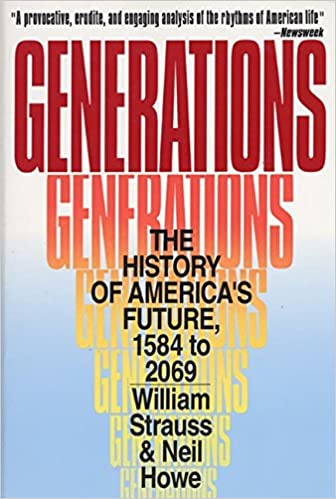
In their best-selling book, “Generations: The History of America’s Future,” William Strauss and Neil Howe describe in great detail The Crisis of 2020.

They talk about how the crisis would seemingly come out of nowhere. They talk about how an era of incurable divisiveness and political bickering would suddenly shift to a mood of community solidarity and resolve. They talk about how the crisis would ultimately change America forever.

Strauss and Howe wrote about The Crisis of 2020 in 1991.

“Generations” proposes there are four different types of generations and four different phases of history, with patterns that predictably repeat. Some might argue Strauss and Howe predicted The Crisis of 2020 with such accuracy because it aligns with other crisis eras in American history, such as World War II and The American Revolution.

If it could foretell COVID-19 in 1991, wouldn’t you love to know what “Generations” could teach us about where popular music is heading?

The idea that music is cyclical isn’t new of course. Legendary programmer and consultant Guy Zapoleon has long championed The Music Cycle, observing that Contemporary Hit Radio (CHR) moves through three predictable phases during a decade: Birth/Pop, Extremes, and Doldrums.

But why does music move through these phases?

THE GENERATIONAL MUSIC CYCLE

There is a longer-range cycle that both drives Zapoleon’s music cycle and explains why we never seem to avoid its doldrums. We call it the Generational Music Cycle, and we base it on Strauss and Howe’s generational archetypes theory.

Two factors drive the Generational Music Cycle:

  • Which generation is the primary creator of popular music?
  • Which generation is the primary consumer of popular music?

Combined, these factors spawn two different music cycles, each of which lasts about a decade and each of which contains the Birth/Pop, Extremes, and Doldrums phases Zapoleon outlines.

Evolution:  During this stage, an older generation continues to create the music, but the next younger generation becomes the primary consumer of new music. It is the younger generation’s tastes that shape which songs are hits. While not fundamentally changing what style of music is popular, it does bring new excitement to pop music and shapes new music styles that will emerge in the future.  The Evolution stage typically begins when the oldest members of a younger generation turn 21.

Examples of Evolution phase:

  • 1964 – The British Invasion: The Beatles storm America to throngs of Boomers who are now the tastemakers, while artists from the previous Silent Generation continue to create the music. Today, this era defines what people think of as “Oldies”.
  • 1982 – New Wave: Duran Duran, Men At Work and A Flock of Seagulls videos play on MTV to Gen Xers, while Boomer artists from Michael Jackson to Madonna cater to Gen X tastes. When people think of “80s” music, they think of this era.
  • 2003 – Happy Hip Hop: A new breed of feel-good Hip Hop from artists such as Outkast, Black Eyed Peas, 50 Cent and Jay Z emerges, shedding the gritty gang life images of 90s Gen X Hip Hop. Millennial listeners were ready to have fun again. Keep an eye out for nostalgia around this era to emerge.


Revolution: During this next stage, the younger generation that has been shaping music tastes during the past decade also spawns the artists creating contemporary music. Whenever a brand-new style of music seemingly suddenly emerges and becomes the dominant force in popular music, it is almost always at the beginning of the Revolution.  The Revolution stage typically begins when the last members of the older generation turn 31 and no longer represent the bulk of popular artists.

Examples of Revolution Phase:

  • 1955 – Rock ‘n’ Roll: Bill Haley & The Comet’s “Rock Around The Clock” becomes #1 and, seemingly overnight, James Dean era teenagers dump Patti Page and Perry Como for Elvis Presley, Little Richard, Buddy Holly and Chuck Berry. The Silent Generation has replaced the Greatest Generation as the makers of their own music.
  • Early 1970s – Classic Rock: While “Rock” had already emerged with The Doors, Cream and Jefferson Airplane, the early 70s saw what was left of the other 60s styles vanish as Boomer artists Fleetwood Mac, Pink Floyd, The Doobie Brothers and The Eagles define the decade. This era was for Boomers by Boomers.
  • 1991 – Grunge: With “Smells Like Teen Spirit,” Rock suddenly transitioned from hedonistic hair bands to dark realism, as those Generation X latch key kids take over creating music from the Boomers and change Rock to reflect their reality. Jeremy spoke in class that day indeed.
  • Early 2010s – EDM: The DJ replaced the rock star as the center of popular youth music culture, as Millennial-aged artists such as David Guetta, Diplo, Major Lazer, and Swedish House Mafia drive tastes. Their EDM styles also become infused by millennial pop artists such as Bruno Mars and Justin Bieber and Hip Hop artists such as Drake. Generation X’s influence is over.


“BIRTH” HAPPENS WHEN GENERATIONS AGREE ON THE HITS

Typically, people remember the first four to five years of an Evolution as the “fun” years. From mid-60s “Oldies” to “80s”, they’re the years you hear at wedding receptions and sports events when it’s time to have a good time.

In contrast, the first few years of a Revolution often represent the halcyon days of a genre. The days when the music was pure; Classic Rock from the early- and mid-1970s. Grunge and Hip Hop from the early and mid-90s. Rock ‘n’ Roll before “the day the music died” when a plane crash killed its stars in 1959.

So why don’t the golden years last?

“EXTREMES” AND “DOLDRUMS” OCCUR AT GENERATIONAL TENSION POINTS

In 1979, tens of thousands gather at a baseball double-header sponsored by FM 98 the Loop (WLUP) in Chicago. The promotion? The chance to come destroy Disco records.

They almost destroyed Comiskey Park in the process.

Those disco demolitioners were overwhelmingly 15- to 18-year old teens representing the first wave of Generation X, rebelling against the Boomer-driven dance fad.

Meanwhile in New York, The Talking Heads, Blondie and the Ramones were playing CBGB, hinting at the new wave sounds that would take over Top 40 a few years later.

Welcome to the Extremes.

Both an Evolutionary phase and a Revolutionary phase will ultimately devolve into the Extremes and Doldrums before the next phase begins. Why?  Generational transition tension: During the Birth phase, there is agreement among the generations about what’s popular. As a new generation emerges first among consumers and then later among artists, conflict emerges between the aging establishment and the younger generation who want something new.

After a revolution, the “Extremes” phase is most likely to launch fads that appeal to the older generation, but generally don’t have the staying power of the halcyon days of the genre that preceded it. Beyond Disco:

  • The early 1960s were rife with musical fads, from the faux folk and hootenanny of The New Christie Minstrels to death discs of teenage tragedy such as “Last Kiss.”
  • The late 1990s saw a slew of quirky pop alternative from one-hit wonders from Cherry Poppin’ Daddies and the Squirrel Nut Zippers to Fastball and The Cardigans. How bizarre.

In contrast, the Doldrums’ phase that happens after an Evolution and just before a new Revolution often bring the last gasp for icons of a soon to be irrelevant generation.

  • Consider 1988-1990, when Chicago, Don Henley, George Harrison, The Beach Boys and a slew of other Boomer icons had their last major hits.
  • Likewise, Red Hot Chili Peppers and Green Day had their last mainstream hits before 2010, while overnight, Nickelback went from a stalwart hit maker to a punchline.
  • And while the early 1970s likely remind you of Led Zeppelin, it was also when pre-rock crooners Perry Como and Andy Williams had their last Top 10 hits that didn’t involve Christmas.

2020 AND BEYOND

What does this generations-based music cycle suggest awaits us now?

In 2020, we’re nearing the end of the millennial generation’s Revolution phase. Since the early 2010s, they’ve been the dominant music makers and tastemakers.

But waiting in the wings within the halls of America’s middle schools—or at the moment at home on Google Classroom—are the kids that will soon begin impacting popular music.

In our next post, we’ll introduce you to them.

Should you change your music in a crisis?

One of your listeners is working from home. She hadn’t even heard of Zoom or Slack two weeks ago. She misses her office buds.

Another is working from home, but she’s trying to be a parent and schoolteacher while still trying to be a coworker. She feels like a failure at all of them.

Then there’s your listener who, out of nowhere, lost his bartending gig. There’s no savings. He has no idea how he’ll pay the rent.

You also have a listener worried about her mom in Palm Beach County. She so much wants to be there for her. It breaks her heart to know visiting her could be fatal.

In these times, does it matter if Post Malone is a power or a secondary?

Even in typical times, great radio stations inform, connect and entertain—all basic human needs.

Information provides listeners’ need to feel empowered—to feel in control of their destiny. In a crisis, timely and trustworthy information can save a life.

Connection fulfills listeners’ need to feel they’re not alone, even when they’re by themselves. Stuck in traffic, a favorite radio personality is a friend coming along for the ride. No wonder radio is huge in cars. Right now, when your listeners can’t socialize normally, hearing a familiar voice in real time is an emotional lifeline. Your voice—and the connections you make with and between listeners—reassures us of the kindness within us. No tweet can compete.

What about entertainment—which for your station is probably first and foremost your music?

The role of music on your station right now is escape.

Every song you play is three and a half minutes of normalcy. Your listener desperately needs something to be normal. Our adrenal glands simply can’t pump enough hormones to stay in crisis mode 24/7. We need a break.  As Chicago’s 97.1 The Drive told its listeners, our favorite songs are ““an escape from the news and a safe haven from the gloom and despair.”

Escape is far more important now than it was before.

The best way you can serve your listeners with your music programming is to keep playing the songs they love most.

  • Continue to utilize your callout and library testing to stay on top of listeners’ tastes;
  • Maintain the tempo and energy of your station so that your sound is what listeners expect from your station;
  • If you need to alter your clock structure to make more room for information, drop the weakest songs, but maintain your overall sound.

Your station might need to air information you traditionally didn’t provide. Your morning show may need to change the tone of its humor to reflect the gravity of the times. However, you should not make wholesale changes to your music strategy based solely on assumptions.

As Coleman Insights’ John Boyne put it, “If you liked ‘Don’t Stop Believin’ last week, you probably like ‘Don’t Stop Believin’ this week.”

Will this crisis ultimately change the music artists create and the songs listeners embrace? Recent history hasn’t seen such a reaction:

However, some experts suggest we haven’t seen a crisis on par with COVID-19 since World War II. During the Big Band and Crooner era, the war did significantly impact the themes of popular music. In addition to songs about military life, songs about separation and the loneliness that comes from being far away from loved ones during wartime topped the charts—most enduringly, I’ll Be Home For Christmas, if only in my dreams.

If 2020 is indeed on par with 1942, relevant themes may well emerge in popular music that resonate with life in this era.

Either way, you’ll want to keep using the tools you use now to know what resonates with your audience and play the songs they love and expect from your brand.

As you change seemingly everything about how you run your station, take comfort that the best way to serve your listeners with your music is to keep doing exactly what you’ve always done—play the songs they love and expect from your station.

Your listeners will appreciate the normalcy, even if you’re scheduling those songs from your bedroom.

Is Radio too Late to Add New Songs?

I was at Supercuts when that song came on.

You know which one. It involves a horse.

“Oh no, not this song again,” my stylist bemoaned. “First it was all over Tik Tok. Then everyone was playing it on their Spotify. Now, even the radio is playing it!”

There it was.

“Even the radio is playing it”.

Music journalists and fanatics alike have asserted that songs don’t receive significant airplay on FM radio until weeks after they’ve already been exposed on Spotify. Now, this perception wasn’t limited to music snobs. Even everyday listeners like my hair stylist are saying it.

Is it true?

We’ve examined the Top 200 most-streamed songs on Spotify from January through August 2019 to find out what radio can learn from Spotify. Today, we’ll compare Spotify to data from the Nielsen-BDS powered Billboard Radio Songs chart during the same period to see if radio really is behind the curve.

To set the framework for how to answer this question objectively, let’s briefly recap what we discovered in our post Is Spotify Replacing Record Stores or Radio Stations:

  • On Spotify, the biggest songs often receive the most plays the week they’re released, as an artist’s core fans check out their latest project, or as curious music fans simply sample what everyone’s talking about. This pattern is the same pattern music sales have exhibited for decades.
  • On the radio—whose audience is broader than an artist’s die-hard fans—it typically takes weeks for listeners to get to know and warm up to new songs.
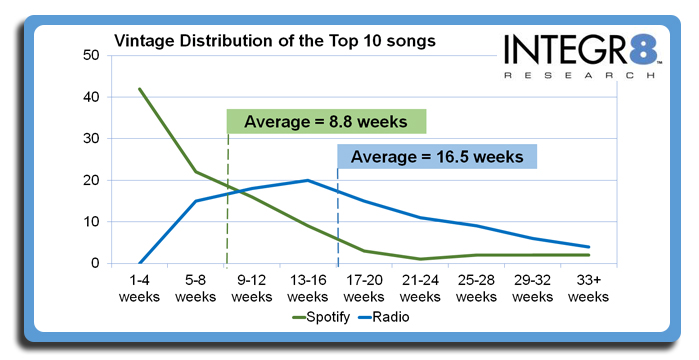
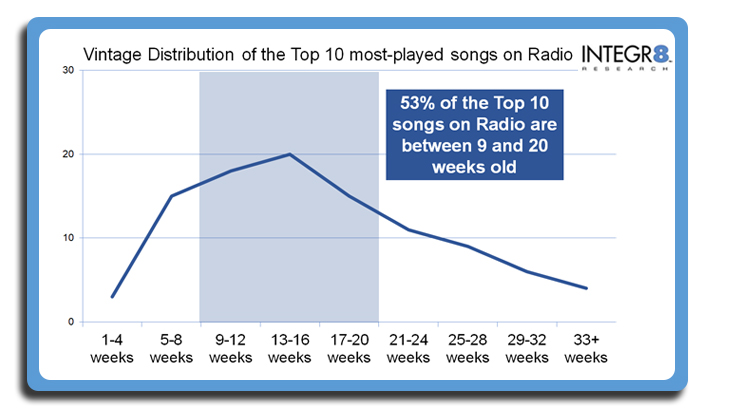
Because of this fundamentally different usage pattern, the average vintage of a Top 10 song on Spotify is under nine weeks, while the average vintage of a top 10 song on the radio is over 16 weeks. Therefore, if we’re simply going to compare what’s #1 on Spotify to what’s in radio’s power rotations, radio is going to inherently appear late to the party.

A better way to approach this question is to examine if radio starts exposing a song when it first makes a splash on Spotify—and if radio exposes songs often enough for the song to reach peak airplay on radio within a typical timeframe.

With these two criteria in mind, let’s dive in to some of 2019’s biggest hits:

When Radio Adds a Song at the Start

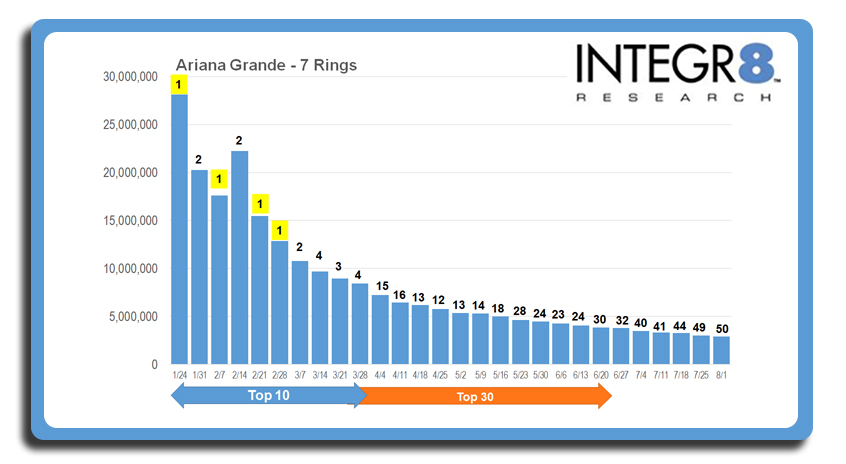
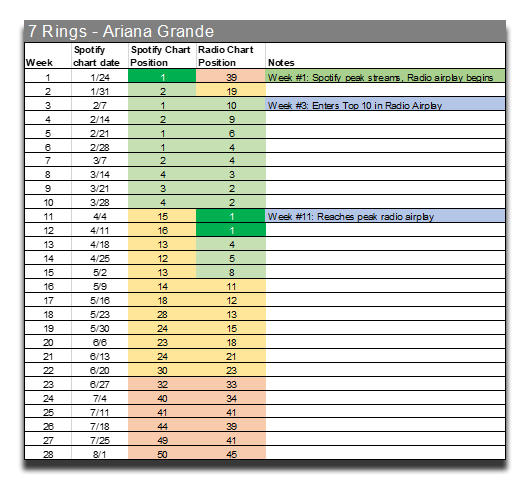
A prime example of the expected pattern is Ariana Grande’s “7 Rings”.

  • Spotify users flocked to listen to the track the week it debuted; the same week radio programmers flocked to add it into rotation.
  • By the song’s 3rd week, it was already among the Top 10 songs on U.S. radio. The song reached peak airplay by week #11, several weeks ahead of schedule for the typical title.
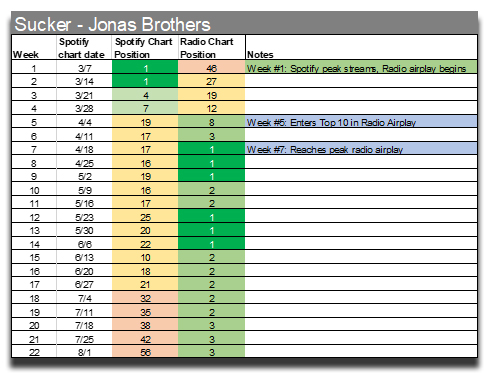
Jonas Brothers’ “Sucker” also followed this pattern of debuting big on Spotify and growing quickly on radio.

  • It went Top 10 in radio airplay by week #5 and peaked at #1 in radio airplay by only week #7.
  • While Spotify streams declined each week as they typically do for many big songs that debut #1, “Sucker” remained among Spotify’s Top 30 for a healthy 17 weeks, coinciding with the song’s peak radio exposure.
When Radio Generates Greater Spotify Streaming

As we noted in our previous post, not all songs follow the pattern of debuting big. Some songs work their way up week by week on Spotify just as they typically do on radio.

Country songs frequently follow this pattern. Country doesn’t yet garner nearly as much usage on streaming platforms as it does radio airplay, for reasons we spotlighted in Why Country is Missing from Streaming.

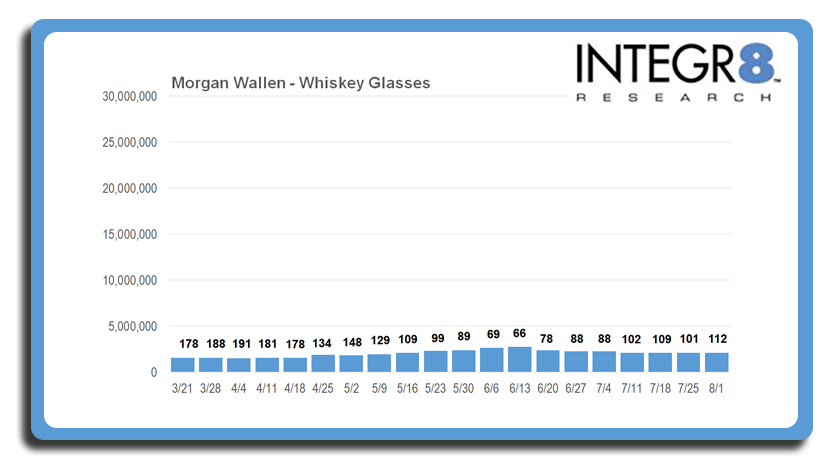
Consider Morgan Wallen’s “Whiskey Glasses”:

  • Airplay started at the same time as it started charting on Spotify.
  • Both airplay and Spotify plays grew in unison.
  • “Whiskey Glasses” reached its airplay peak in week #11, followed later by its Spotify streaming peak two weeks later.
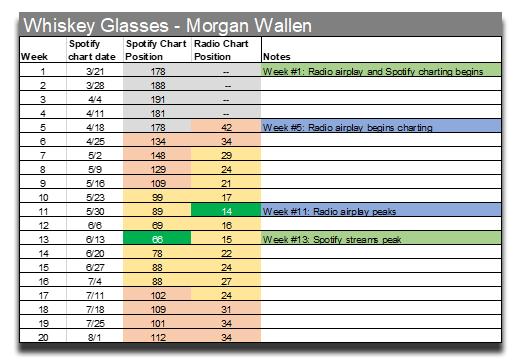
For these songs, hearing them on the radio arguably bolstered listeners’ interest in playing them again on Spotify. These examples demonstrate that the traditional model of radio exposure generating label and artist revenue is still relevant in the era of streaming.

When radio hangs on too long

There are cases when radio is quick to embrace a new song, but hangs on to that song after Spotify users have already rejected it en masse.

A prime example is Taylor Swift’s “ME!”

  • Radio eagerly added the song as one would expect from Swift: “ME!” was Top 30 in airplay in its debut week and among the Top 10 in radio exposure by week #3.
  • Also as expected, “ME!” debuted #1 on Spotify, but after only two more weeks, the song fell from #8 to #26.
  • After only five weeks, “ME!” was out of Spotify’s Top 30 songs, while many U.S. stations were still powering it.

Radio didn’t start backing off “ME!” until the song’s Spotify stream count fell unusually fast for a month.
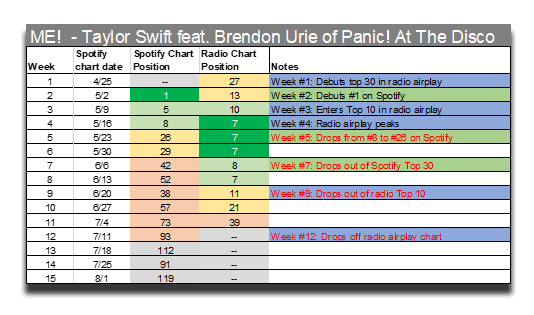
Some stations likely didn’t believe Swift could really have a stiff until the callout never improved.  However, examining how quickly Spotify users abandoned the song compared to bona fide pop hits could have given radio an earlier indication that it was time to move on from “ME!”

When radio is late to the party

Finally, there is evidence that radio was arguably late to embrace some of 2019’s biggest hits, particularly songs that first became hits online.

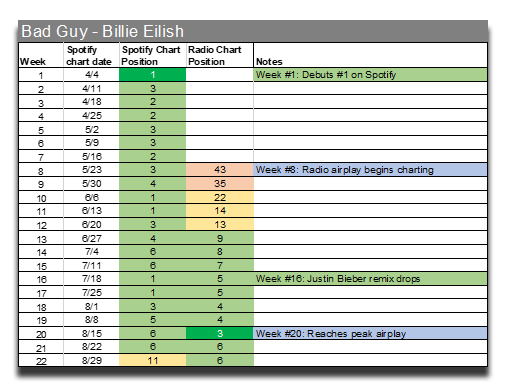
Billie Eilish “Bad Guy” dropped in April and instantly become Spotify’s most-streamed song in the U.S. that week.

  • Although the song did receive smatterings of airplay in April, “Bad Guy” finally began receiving enough airplay to be among the Top 50 most played songs on U.S. radio in late May. At that point, “Bad Guy” had already remained in Spotify’s Top 3 for an impressive eight weeks.
  • In July, the remix with Justin Bieber dropped, bolstering Spotify plays.
  • Finally in mid-August, radio airplay peaked for “Bad Guy”, 20 weeks after the song debuted at #1 on Spotify.
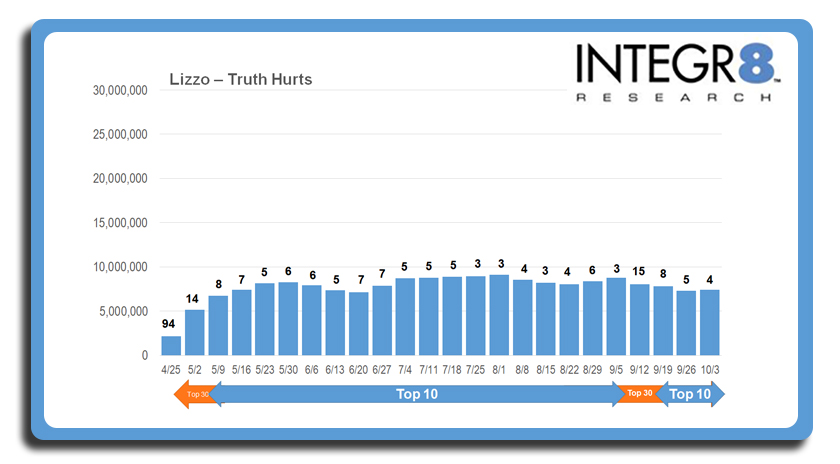
Then there’s the slow and symbiotic development on both Spotify and radio of Lizzo’s “Truth Hurts”. Like Lizzo herself, “Truth Hurts” crept its way up on Spotify after being a cult favorite.

  • While some radio stations did pick up on the song around the time it became a Top 10 song on Spotify, it didn’t receive significant radio exposure for another six weeks.
  • At this point, “Truth Hurts” already appeared to have peaked on Spotify. However, the song’s new radio exposure appears to have contributed to a second round of streaming growth for “Truth Hurts”. It reached peak streaming 15 weeks after first appearing on Spotify’s Top 200 chart.
  • “Truth Hurts” wouldn’t reach peak radio exposure until week #21.
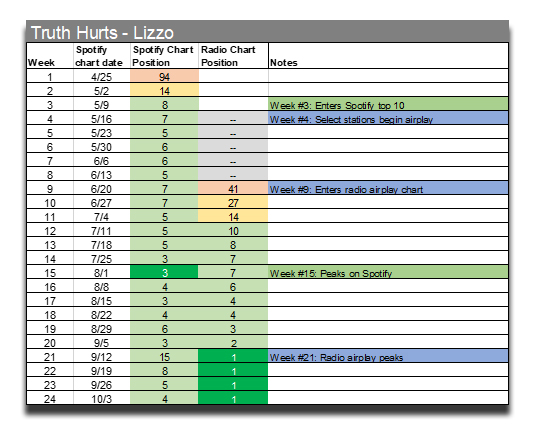
With all the buzz around Eilish and Lizzo, it would be easy to examine these discrepancies between streaming and airplay and assume radio is simply out of touch.

That assertion is neither accurate nor complete.

Billie Eilish and Lizzo both have rabidly passionate fans. However, their songs were unusually polarizing among the broader radio audience when they first heard them. Both “Bad Guy” and “Truth Hurts” simply don’t sound quite like any songs that came before. While many listeners did passionately love these songs from the start, a comparable number of listeners initially flat out hated them.

That leaves programmers with the dilemma of whether playing a buzzworthy act with a passionate fan base is worth alienating those listeners “who don’t get it”.  Unlike streaming, haters hurt radio—they tune out your station today. However, depending on what listeners expect from you, failing to play songs that elicit passion and represent the Zeitgeist can also hurt radio—fewer listeners tune in tomorrow.

As you’re debating whether or not you’re willing to take that gamble, consider that there’s another interpretation to my hair stylists’ comment, “even the radio is playing it”, than assuming she thinks radio is last to play new songs.

Her comment might instead reflect a perception that, once a song is on the radio, it truly is a mass-appeal phenomenon.

The Takeaway for Radio: Rest assured the pundits who claim radio is way behind streaming don’t understand how music consumption patterns differ on each platform. For most songs, radio is, in fact, right on time. In these times of changing tastes, however, you will have to carefully weigh both the impact on listenership and on your brand when your listeners have mixed reactions to songs that blow up on Spotify.

ANNOUNCING “WHAT RADIO CAN LEARN FROM SPOTIFY” WEBINAR

Join us Wednesday, November 13th at 2:00 EST / 11:00 PST for our in-depth analysis of Spotify listening behavior and what lessons it holds for radio programmers. In the webinar, we’ll examine:

  • What are the different consumption patterns for new music on Spotify—and how radio can use those patterns to spot real hits.
  • When should radio start—and stop—playing songs.
  • Why Spotify is replacing record stores more than radio stations—and why it matters for how radio programmers interpret Spotify data
  • How new releases have a major impact on music consumption that’s often ignored by radio.

REGISTER HERE



The Three Types of Hits on Spotify

Our last post examined how the usage patterns of contemporary music on Spotify look at lot more like record store sales than radio spin counts: Songs are most likely to achieve their biggest number of streams the week the song is released.

However, not every song follows this pattern.

Today, we take a deeper look into the three kinds of songs you’ll see on Spotify. Two of these patterns indicate a song has potential to become a big hit for radio. The other pattern could be a warning sign of a stiff.

1) The “Love You Long Time” Hit

These songs are huge when they’re released and, while the number of streams these songs receive each week does decline over time, they tend to decline slowly, remaining among the most streamed songs on Spotify week after week.

Arianna Grande’s “7 Rings” stayed in Spotify’s Top 10 for 10 weeks and in the Top 30 for 21 weeks:

Billie Eilish’s “Bad Guy” stayed Top 10 for 15 weeks—and when combined with the Justin Bieber remix for 21 weeks.  As of this post, it’s still in the top 30 half a year after its debut.

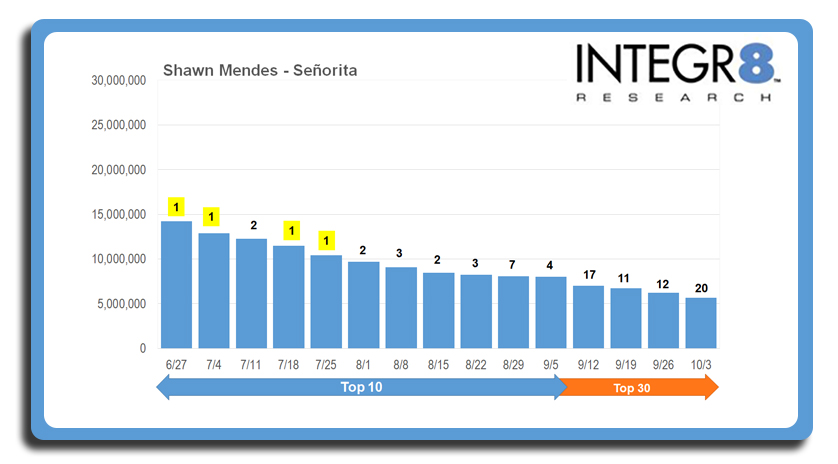
More recently, Shawn Mendes’ “Señorita” stayed in Spotify’s Top 10 of most streamed songs in the U.S. for 11 weeks.


2) The “Can’t Keep It Up” hit

These songs debut big—often enjoying record-level streams during their debut week—but listeners lose interest in them far more rapidly than they do in the “Love You Long Time” songs.

Compare Shawn Mendes’ “Señorita” above with Taylor Swift’s “ME!”: Both songs debuted as the #1 most streamed song on Spotify, with just under 15 million streams in their first week. Both songs were supported by strong exposure on the radio.

However, while listeners kept streaming “Senorita”, streams for Swift’s “ME!” shrank quickly, falling out of the Top 10 after only three weeks and falling below the Top 30 after only two more weeks.

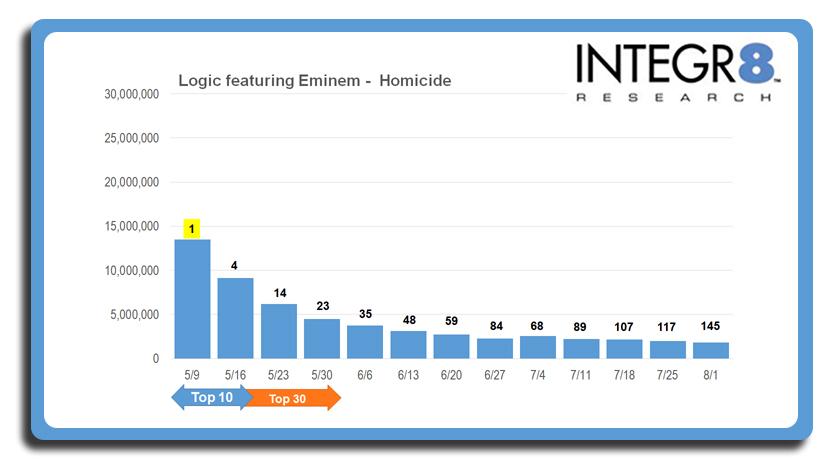
Logic featuring Eminem’s “Homicide” debuted at similarly strong at #1, but stayed in the top 10 for only two weeks and fell out of the top 30 after only two more weeks.

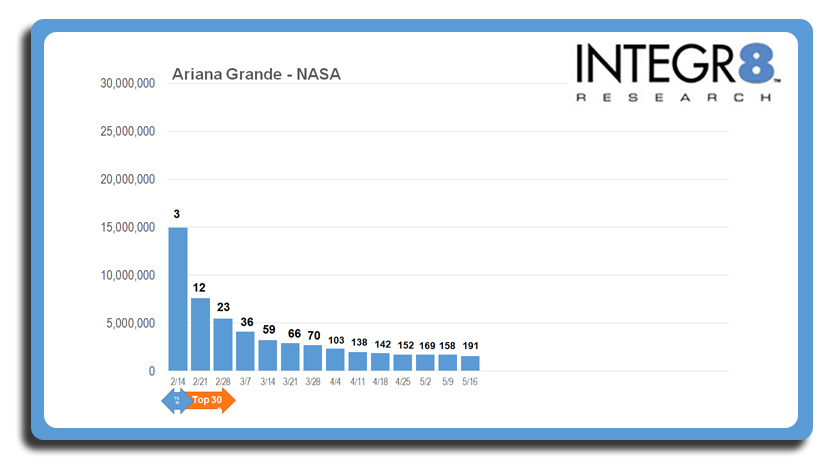
A similar fate often happens with what we called album cuts back in the day: Ariana Grande’s “NASA” debuted at #3, but with more streams (15 million) than most #1 debuts. Either because of lack of exposure elsewhere or a lack of listener interest, NASA fell from the top 30 after a scant three weeks.

3) The “Slow Grower” Hit

Although the majority of #1 hits on Spotify debut big, not all songs follow this pattern. Some songs grow slowly over time, just as most songs do in radio callout research.

Country songs: Country doesn’t garner the share of streaming on Spotify that mirrors its success on FM radio, for reasons we’ve outlined in previous studies. When Country songs do perform well on Spotify, they tend to follow a pattern highly similar to their growth on radio.

For example, Morgan Wallen’s “Whiskey Glasses” took 13 weeks to reach its peak on Spotify.


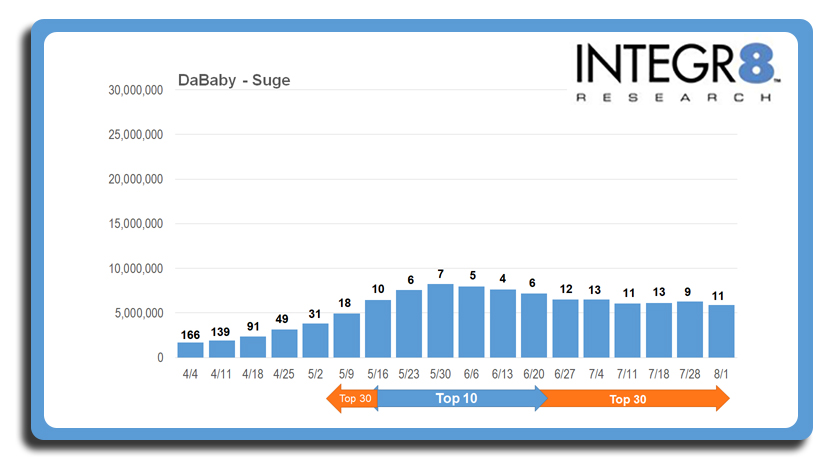
Songs radio champions:  Charlotte NC rapper DaBaby’s “Suge” took seven weeks to grow into Spotify’s top 10, a timeframe comparable to radio exposure. This development pattern may well reflect listeners discovering the song first on radio. As more listeners heard it on their local Urban Contemporary station, more listeners streamed it each week on Spotify.

And then there’s Lizzo, who had been fostering a fan base for several years before breaking through to mainstream success in 2019. Streams for “Truth Hurts” steadily grew for six weeks. Then, at the same time radio airplay increased, began growing again, ultimately peaking 15 weeks after debuting on Spotify and remaining strong ever since.

What these patterns mean for radio

Just because a song debuts big doesn’t mean it will be a hit:  The “Can’t Keep It Up” songs often debut with similar streaming levels as the “Love You Long Time” songs. While both types of tracks probably will quickly cede Spotify’s #1 spot to the next hot debut, those songs that remain in Spotify’s Top 10 and Top 30 week after week are the songs with real potential to be big hits among radio listeners.

Just because a song doesn’t debut big does not mean it can’t become a big hit: While we’ve highlighted the tendency of #1 songs on Spotify to debut at #1, a song doesn’t have to be #1 hit on Spotify to be a significant hit for radio. The “slow grower” hits still have potential on your station—and their growth on Spotify may well stem from you championing the song with ample exposure on your station.

The Takeaway for Radio: Don’t look how well a song is doing this week. Look how well a song is streaming on Spotify week after week, whether it’s a song your listeners will love a long time or the song that’s slow to grow. Stay away from the songs that can’t keep it up.

In our next post, we’ll tackle the raging question: Does radio only start playing songs after they’re already old on Spotify?

(All Spotify data © 2019 Spotify AB)

Is Spotify replacing Record Stores or Radio Stations?

This post is the second in the series “What Radio Can Learn From Spotify.”

Now that Spotify lets us see which songs listeners are playing for themselves, many who examine Spotify’s usage have expressed concern that radio is too late to the party on too many new hit songs. Anecdotal examples are easy to find of a song that was #1 on Spotify weeks before radio started spinning it.

Does Spotify usage support the idea that radio is too slow to embrace new hit songs?

To find out, we compared our ongoing analysis of the Top 200 songs each week on Spotify in the U.S. from January 1st to August 1st, 2019, and compared them to the 50 biggest songs on the radio in the U.S. according to the Nielsen BDS-powered Billboard Radio charts during the same timeframe.

The majority of the Top 10 songs on radio are between 9 and 20 weeks old.  For those huge hits that become the #1 most-played song on U.S. radio, it typically takes 13 weeks to grow to #1.

Data © 2019 Billboard

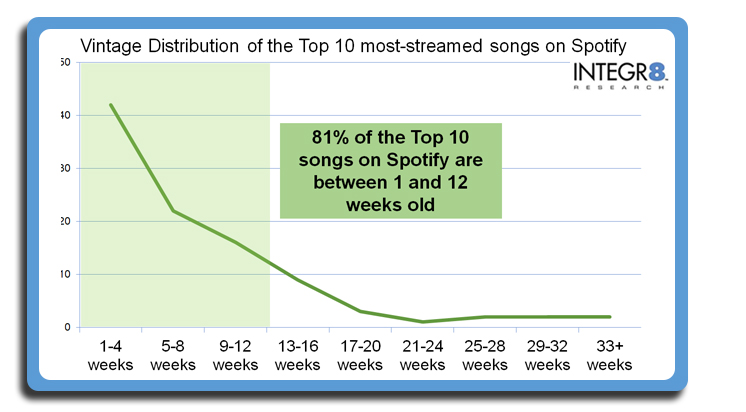
The vast majority of the Top 10 songs on Spotify are between 1 and 12 weeks old.  Not only are the biggest songs on Spotify newer than the biggest songs on radio, songs on Spotify typically garner the most streams the week they’re released. During the timeframe we examined, 11 of the 15 songs that hit #1 on Spotify debuted at #1 on Spotify.  Only one song took 10 or more weeks to work its way up to Spotify’s #1 song.

Data © 2019 Spotify AB

Before you jump to the conclusion that radio is inherently late to the party, recognize that Spotify’s usage pattern looks almost identical to a pattern radio programmers have seen for decades:

Music sales.

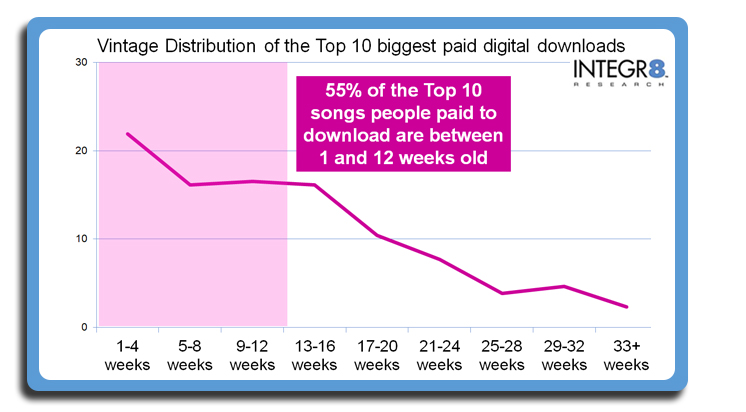
When we examined paid digital downloads (think iTunes etc.) in 2014, we saw the same pattern: Songs typically debuted with their strongest sales, then declined as fewer new people decided to buy the song.

Data © 2014 Billboard

It’s the same pattern as when listeners bought 45s.

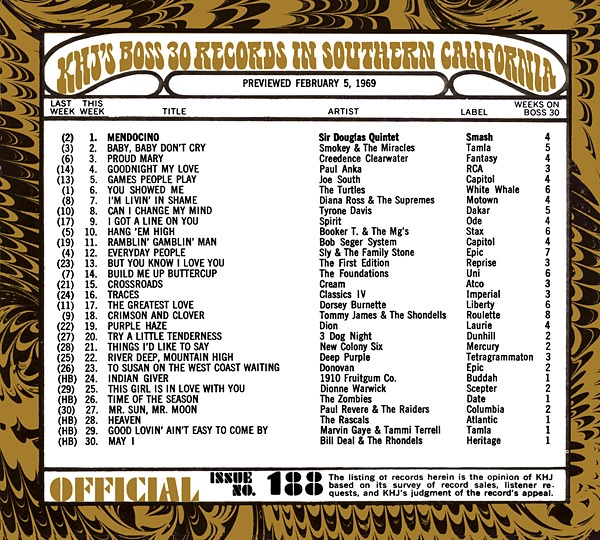
In fact, it was the same pattern as radio airplay back in the 1960s when radio’s only new music research tool was sales data from local record shops.

The 93/KHJ “Boss 30” reflected record sales, with the oldest song in rotation for only 8 weeks (and Quentin Tarantino was only 5 years old)

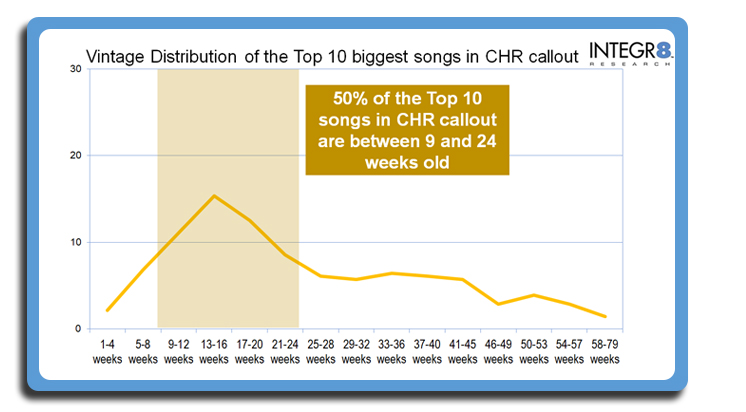
With the invention of callout research in the 1970s, radio learned that most listeners take time to get to know a song and once they like it, continue to like their favorite songs long after people have stopped buying new copies.  When we examined our own Integr8 New Music Research among CHR outlets in 2014, we noted it takes 8 weeks for the typical song to break into the Top 10.

Data © 2014 Coleman Insights, © 2019 Integr8 Research

The fact that Spotify usage resembles sales patterns more than airplay patterns suggests Spotify is replacing the function of a record store and not the function of a radio station:

It’s where artists’ biggest fans go to hear new releases as soon as they drop.

It’s also where curious listeners can sample new music from the artists everyone is talking about.


If Spotify is the new Sam Goody, does that mean radio doesn’t have to consider it competition? Hardly. Only people and mothers of toddlers can listen to more than one thing at a time. For everyone else, an hour spent with Spotify is an hour not spent with your station.

It does suggest, however, that there’s no need for alarm that Spotify streams peak sooner than does radio airplay. Just because a song garners a lot of sampling from fans the week it’s released does not pre-ordain that song to be a mass appeal smash.

Ten years ago, it would not have made sense to put every song that was #1 on iTunes into power rotation. Today, it doesn’t make sense to put every #1 song on Spotify into power rotation, either.

Spotify usage patterns do provide proof, however, that listeners care about new releases from big artists. PPM may have revealed that new and unfamiliar songs are a tune-out risk, but unless contemporary radio stations find new ways to be a part of the excitement of a big project dropping, radio risks giving music fans one less reason to tune in in the first place.

The Takeaway for Radio:  Examine Spotify charts similarly to how you once examined sales data. You don’t have to jump on every song that has a big release—but as noted in our last post, you should find a way to share in the moment when big artists release big projects.    

In our next post, we’ll examine the three most common patterns of hits on Spotify—and show you how to identify which ones will most likely become hits with your listeners.

Be the first to hear what radio can learn from Spotify: Sign up at the top of this page to receive our latest posts directly in your inbox.


What Radio Can Learn From Spotify

For decades, radio programmers have dreamed of crawling inside their listeners’ cars, bedrooms and earbuds to hear exactly how they consume music. Are there new songs listeners have discovered? When exactly do listeners stop playing songs they used to love?

That dream has finally come true.

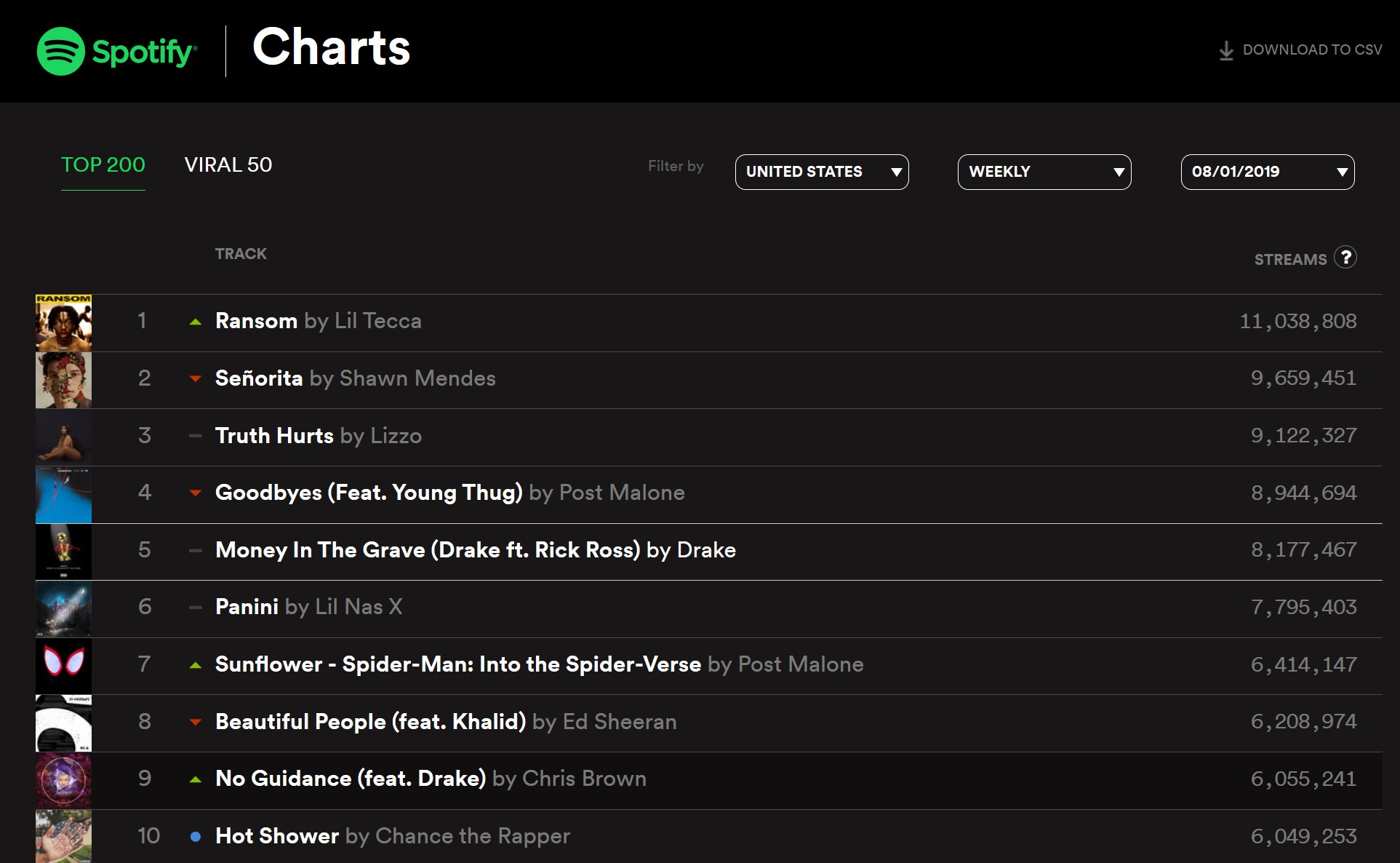
Spotify has emerged as the leading platform for listeners to control their own music. Generously, Spotify has a free gift for radio programmers: The Spotify Charts. They list exactly how many times listeners played the top 200 songs. Users can select daily or weekly charts, as well as drill down to Spotify users in specific countries.

To find out what radio programmers can learn from Spotify, we analyzed the Top 200 songs in the U.S. each week from January 1st through August 1st of 2019.

‘Over the next few posts, we’ll share what we learned from our Spotify usage deep-dive and how you should interpret Spotify data when selecting new music for your station.

Today, we tackle the age old question:  Is there a consistent demand for music, or does the amount of music listeners consume vary with their passion for the music that’s out at the moment?

Don’t miss our upcoming Spotify Insights: Sign up above on the right and we’ll deliver new Integr8 New Music Research Blog posts directly to your inbox

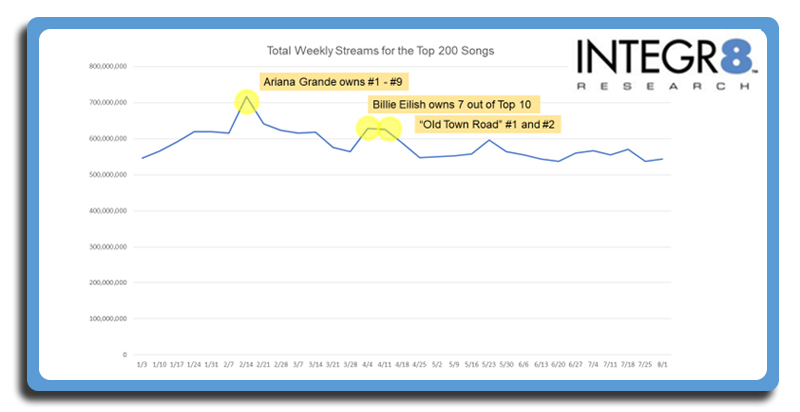
Music consumption varies by up to 34% from week to week.

In a typical week, U.S. Spotify users stream the 200 biggest songs 583 million times. However, that grows as high as 716 million streams per week or drops as low as 536 million streams per week.

What’s the biggest driver of those big weeks?

When big artists release new albums, listeners consume more music overall

All data © 2019 Spotify AB

The weeks with the most streams include:

  • February 14th: Ariana Grande drops her “thank u, next” project. That week, Grande held nine out of the top 10 songs on Spotify.
  • April 4th: Billie Eilish releases “WHEN WE ALL FALL ASLEEP, WHERE DO WE GO”. During that week, Eilish held seven of the top 10 spots.
  • April 11th: The Billy Ray Cyrus remix of “Old Town Road” hits, instantly taking the #1 spot while the original version grew to #2.

The low point during our eight-month analysis is June 20th, when Drake ft. Rick Ross’s “Money In The Grave” debuted at #1, but without a corresponding album release.

Consumption of the #1 song can double for a big song’s release

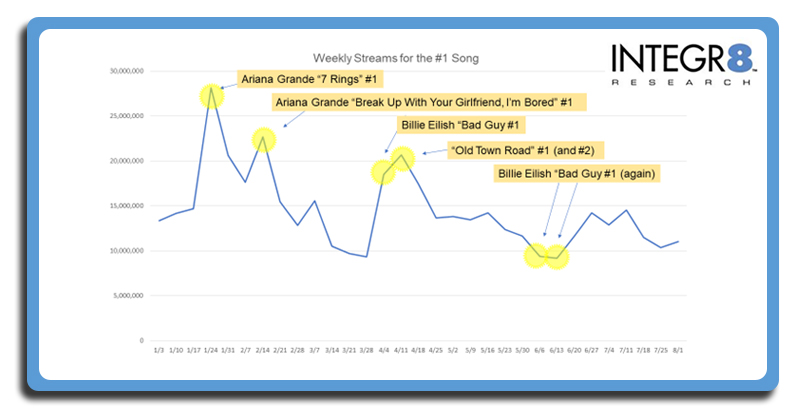
In a typical week, the #1 song on Spotify in the U.S. receives around 14 million streams. However, that figure doubles for the peak week and falls 35% for the lowest week.

By far, the most weekly streams of a #1 song came on January 24th, when Spotify users played Ariana Grande’s newly released single “7 Rings” 28 million times. When Grande dropped the full album in February, “Break Up With Your Girlfriend I’m Bored” racked up almost 23 million streams.

Other big #1 weeks included Billie Eilish’s release of “Bad Guy” and the release of the Billy Ray Cyrus remix of Lil’ Nas X’s “Old Town Road”

All data © 2019 Spotify AB

The low point for consumption of the biggest song on Spotify was also for Billie Eilish’s “Bad Guy”. Listeners only streamed it about 9 million times during the week of June 13th. That was ten weeks after its release and only half the weekly streams it got when it dropped. In the absence of something more compelling, however, sustained interest in “Bad Guy” was sufficient to return it to #1.

“Duh!”

The Takeaway for Radio:  The fact that listeners consume the most music when there’s a big release from a big artist suggests that at least some listeners are highly interested in sampling brand new music. Stations should find bold ways to satisfy this interest when big artists release new songs, without clogging up regular rotations with tons of titles other listeners would simply find unfamiliar.

In our next post, we’ll tackle the raging question: Is Spotify replacing record stores or radio stations—and why it matters for how you interpret Spotify data.

The Co-worker Who Can Save Your New Music Image

Radio is in grave danger of losing its position as the new music discovery leader.  As we noted in our study The Alexa Effect, teenagers are already more likely to think first of Spotify and YouTube than radio as the place to hear new music first—and young adults aren’t far behind.

The problem isn’t that radio plays new releases late. The problem is that listeners don’t remember that they first heard that new song on the radio.

Fortunately, you have a colleague at your station that can help combat this image—your engineer.

He (or all too seldom she) can help make sure your listeners discover the artist and title of the new songs they hear from you—and not from Spotify.


Listeners have always wanted radio stations to say what they play. Back when the radio dial was actually a dial, the only way to meet this need was to back-sell every song, which often meant a laundry list of artist and titles since listeners also like long uninterrupted sets of soft rock while they work.

(Sorry—flashback to my AC radio days there.)

Listeners still want to know the artist and titles of songs that catch their ear—hence Shazam—but today’s listeners won’t wait half an hour for your on-air talent to tell them. When listeners use Spotify, Pandora, Sirius/XM or MusicChoice, the artist and title is always available on the screen instantly.

Fortunately, radio technology hasn’t stood still, either. Modern car radios include RDS displays and about half of today’s new cars come standard with HD Radio. Live streaming platforms also have song metadata capability baked in.

Shockingly, even many stations in PPM markets fail to provide their listeners artist and title metadata on their FM signal or on their stream.

Why does metadata matter?  Because whether consciously or unconsciously, listeners remember where they first learn about new music. If a listener hears a song on your station, but then learns who sang it on Spotify, then Spotify gets credit in your listener’s mind for introducing her to her favorite new song, not your radio station.

So, at the risk sounding more like This Week in Radio Tech than the Integr8 New Music Research blog, here are five steps to make your metadata available to your audience.

1) Ensure artist and title information is correct and legible in your automation system.  Those of us who deal with music professionally have myriad ways of listing song details that are useful to our work, such as

“LAST, FIRST – Title ft. Second Artist”.

However, real listeners expect to see

“First Last featuring Second Artist – Title”.

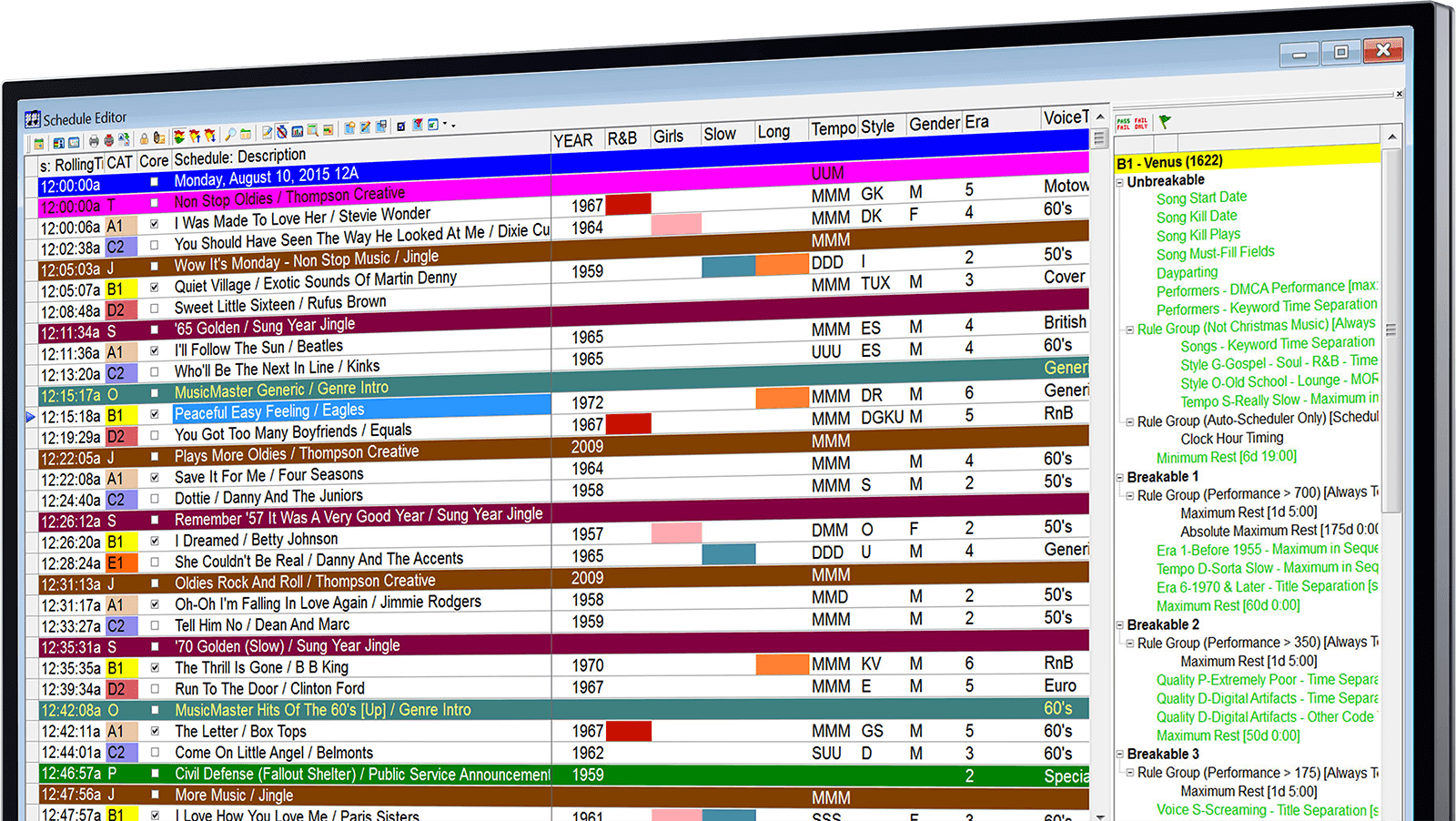
While matching Mediabase’s format is fine for Selector or MusicMaster, the artist and title information in AutoVault or Wide Orbit should be in a format that listeners comprehend.

2) Transmit Artist and Title information to your RDS and HD Radio encoders. It blows my mind how many stations in big competitive markets don’t bother to provide Title and Artist info to radio displays. There are several ways to convey “now playing” data from your on-air playout system in the studio to the RDS and HD Radio encoders at the transmitter. It might seem daunting, but your engineer knows the different data protocols and transmission options to make it happen. Explain why it matters and you’ll likely find your engineer is happy to embrace the project. If your station doesn’t currently broadcast RDS data, encoders cost as little as $495.

3) Also encode your streaming audio with artist and title information. All streaming audio formats support song metadata integrated with the audio. Ask your engineer to help link your automation to your streaming encoders so artist and title information is available to listeners.

4) Use metadata APIs for third-party players like TuneIn. So you’ve got your streams properly encoded, but your artist and title info is still missing. Many third-party platforms such as TuneIn don’t automatically read the information from your stream, but instead maintain their own database of now-playing information that require sending metadata separately. Ask your engineer to also set up the necessary plugin in your automation or stream encoding software to send metadata to all your streaming platforms.

5) List what you’re playing and what you’ve played on your website. It’s the oldest of the new ways to share the songs you’ve played with your listeners. Not only have listeners come to expect to find information on your website about songs they’ve recently heard, it’s consistently a top reason listeners visit a radio station’s website.

These five tech tips won’t fully do the job unless you also make this programming enhancement:

Teach your listeners where to find artist and title information.

Did you know Alexa will tell you the artist and title of a song, along with the name of the station that’s streaming it?

Your listeners probably don’t know this trick, either.

On the air, share with your listeners how to:

  • Ask Alexa and Google Home for the artist and title of the songs you play
  • Look on their RDS or HD Radio display in the car to see what’s playing
  • Look at the display in their streaming app or web browser
  • Visit your website for a list of the songs they’ve recently heard.

Tackling these tasks will ensure your station is technically on-par with your digital competitors. However, radio has a weapon Spotify will never have—personalities. The people you have on the air can add context that will make listeners excited to hear a song that otherwise would simply be weird and unfamiliar. It’s a deeply personal and emotionally engaging weapon algorithms can’t match.

Now more than ever, radio should continue to rely on its personalities to tell listeners what they’re hearing. At the same time, we also need to use our technology to ensure listeners aren’t left waiting for the stop-set to find out what we’re now playing.


Callout Summer School: The One Song You Should Never Test

In our previous call out summer school class, we outlined how to select the songs you’ll test in your callout research. Today’s class tackles the one song you should never, ever test in your new music research.

Don’t test a song your station shouldn’t play.

“Amazing grasp of the obvious over there at Integr8 Research.”

Usually, it is obvious. However, even the most disciplined, strategically-minded programmer will be tempted when that rare song comes along that defies the status quo.

Let’s flash back to October 2015. After four years in recluse, Adele releases her long-anticipated new song, “Hello.” People instantly love it. “Hello” debuts as the #1 highest scoring song for just about every Integr8 New Music Research client that tests it. The song gets so big that not only do mainstream CHR and AC stations test it, Hip-Hop oriented Rhythmic CHR and Urban stations start testing it, too.

Surprise—their listeners also love “Hello”.  Even cats love Adele’s “Hello” in late 2015.


So now what?

At best, you’ve wasted a test slot on a song you remind yourself you shouldn’t play.

At worst, you talk yourself into playing the song because it’s huge and your listeners love it, after all, and there are those meter counts to maximize in the moment.

Problem is, you’ve now violated the promise you’ve made to your listeners about what you would give them when they tuned in to your station.


Is your station Kroger or whole foods?

Free-range poultry? Keto diet items? The triumphant return of Twinkies? For the folks in Cincinnati, if a trend in groceries reaches critical mass, Kroger will carry it, alongside Kellogg’s cereals and Campbell’s soups. Going with grocery trends reinforces Kroger’s brand as America’s mainstream supermarket. A lot of people shop at Kroger, but the margin on each sale is slim, so it takes volume to make a profit. In radio parlance, Kroger has high Cume and low TSL.

Meanwhile in Seattle, Jeff Bezos reviews research revealing that a significant percentage of Whole Foods shoppers like Coca-Cola. Not wanting to send customers elsewhere to stock up on soda, he erects large Coke displays in the flower-filled entrance.

Not going to happen. Sure, enough customers might pick up a 12-pack to boost sales—at first. However, that one high fructose corn syrup laden product would seriously jeopardize their brand promise of only offering natural foods free of artificial ingredients. Suddenly, Whole Foods would be just an overpriced Kroger. Whole Foods doesn’t appeal to everyone, but shoppers who are into it generate significantly higher margins on each sale than does Kroger—hence “Whole Paycheck”.  They have low Cume, but high TSL.

Every song you play not only determines if a listener keeps listening today, it sets an expectation that determines if that listener comes back tomorrow. As Coleman Insights’ founder Jon Coleman says, “every song you play is a marketing decision.”

HOW TO FIND THE LINE

What if you’re really not sure whether a song violates your brand promise to your listeners? Integr8 New Music Research’s Fit measure can provide clarity on lines of your format lane from your listeners’ perspective.

If your station is a mass-appeal CHR, or even a broadly appealing AC or Urban station, you have more latitude with the styles of music you play, but less latitude in the depth of appeal in the songs you play. In other words, you can push into new styles as they become popular, but the songs you choose that push style boundaries better enjoy mass appeal. In other words, the songs you select need to delight your broad cume audience. You’re Kroger.

If your station is a format defined by your music style, you need to be far more careful about staying in your sonic lane. However, you have more latitude to select songs that might not enjoy broad appeal, but do enjoy appeal among your hard-core listeners.  In other words, the songs you select should first and foremost keep your high TSL core listeners happy. You’re Whole Foods.


CALLOUT IS LIKE WAZE (NOT TRIPADVISOR)

What if you’re simply not sure if the music your listeners expect from you is still what they want to hear?  Avoid the temptation to try to make this decision based on music research. It simply isn’t the right tool to answer that question. Only a well-designed perceptual study, which examines a broad range of listeners in your market with a variety of music preferences, can help you redefine your music strategy.

Callout is like Waze. It can tell you the best way to get there in real time and find you the best way to reach your goal without getting stuck. However, it can’t tell you where you should go.

And that wraps up Callout Summer School. If you want to revisit any of our past classes, here are the crib notes: