Tag Archives: Integr8 Research

Callout Summer School: Which songs should I test?

Your callout hooks are due in a few hours. You’ve got 30 slots. How can you know the songs you choose to test will have the greatest impact on your station?

It’s not a question you should take lightly.

Consider that for a typical CHR station:

  • Your six most-played currents account for 25% of your station’s weekly programming (including the commercials).
  • Your 20 most-spun songs make up over 50% of your programming.
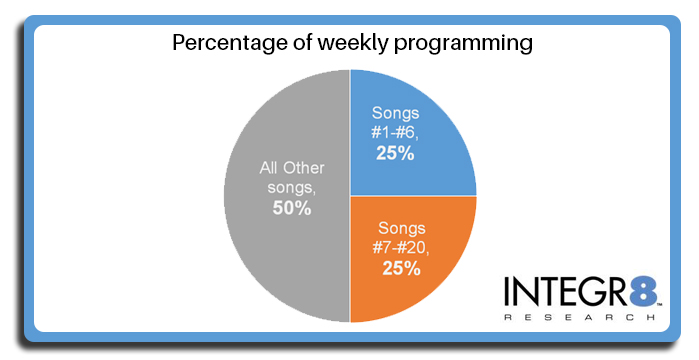
Percentage of weekly airtime for a typical CHR


With so much of your success riding on so few songs, it’s critical you’re testing the right ones.

As a most basic rule, test the songs you play the most. The more often you play a song—and thereby the higher percentage of your airtime that song occupies—the greater impact that song has on your ratings.  Generally, that means 1) Start your list with your currents; 2) Next, test those recent recurrents that still receive significant spins on the station; 3) Finally, choose new titles to test.
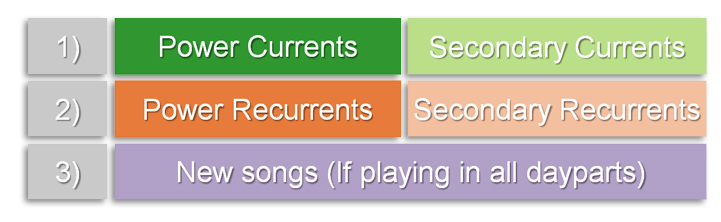
Construct your callout test list to reflect your spin counts


Here are some guidelines for each category:

KEEP MOST-SPUN CURRENTS IN WEEK AFTER WEEK.

It can be tempting to skip a week of testing a song that’s been #1 for weeks. “I know it’s going to be #1 again. Why not use that slot for a checkup on a gold title?”

Don’t give in to this temptation! Listeners’ interest in a big hit can change rapidly.

Think about the typical song of the summer: It’s dependably among your top-testing titles all through Labor Day. But in the immortal words of Exposé, Seasons Change. By late September, that reliable #1 has tanked to #27. Listeners have moved on to fall, a new school year, and seek out a new soundtrack for a new season.

Had you skipped testing that song, you would have missed the moment where listeners moved on.  Don’t skip testing a current simply because it’s been big for weeks. Currents can change quickly.

 

IT’S OKAY TO TEST RECURRENTS, BUT JUDGE THEM SEPARATELY FROM CURRENTS.

The biggest question clients ask us about compiling their test lists is if they can use callout research to test a recurrent. If you’ve recently moved a song from a current to a stay-current or power recurrent category, it’s likely still getting enough spins to warrant continued weekly testing.

What if you want to use an extra slot to make sure your listeners still like an older recurrent, however? Go for it! Test those titles for a week or two and then drop them if you have the room.

However, don’t compare recurrent and gold titles to currents. If a song has made it to a gold category, it’s already hit a home run with your listeners. Meanwhile, your currents are still working their way around the bases.

More importantly, just because listeners still love an older song doesn’t mean they still want to hear it as often as they did when it was new.

TEST NEW SONGS WHEN AT LEAST SOME LISTENERS LIKELY KNOW THEM. 

The second biggest question clients ask us is when it’s okay to start testing a new song. How long does it take for enough listeners to have heard the song to get meaningful data about its appeal from your new music research?

Back in the day, many programmers learned it took 100 spins before a song became familiar.

Today, though, that approach is too simplistic. On the one hand, “Old Town Road” went viral on Tik-Tok and Billie Eilish first became big on Spotify long before receiving airplay. On the other hand, if you’re the only station playing a song, 100 spins may be insufficient for exposing your audience to a new song.

For these reasons, we offer these three guidelines instead of spin counts:

1) Have you been playing the song for at least a couple of weeks in all dayparts?  Overnight and even nighttime exposure no longer reaches most of your station’s cume audience. Unless you’re playing it in middays and afternoons, you’re not really playing it yet.

2) Has a major competitor played the song a lot?  If your competitor is giving significant exposure to a song that you’ve avoided, but you want to take a second look, go ahead and test that song.

3) Has the song become a cultural phenomenon online?  Testing the next “Old Town Road” can tell you if the trend is truly resonating with your audience, or is merely meaningful in its corner of the internet.

Now that we’ve outlined what you should test, our next Callout Summer School class will reveal the one song you should never test in your new music research.



Callout Summer School: BFFs (Benchmarks For Familiarity)

In our last Callout Summer School class, we examined how to use Burn to determine when a song has reached the end of its life as a current hit. In today’s class, we tackle the other end of a song’s life as a hit—it’s beginning—and how to use Familiarity to judge when a song’s appeal is still growing.

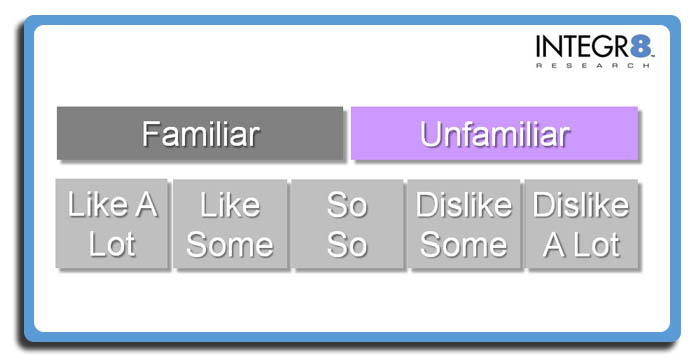
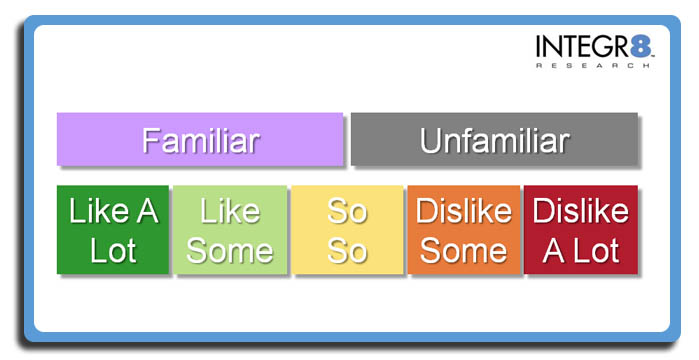
As is standard practice in music testing, Integr8 Research asks listeners if they have ever heard of each song. They don’t have to know the artist or title. They don’t have to recall the words. The song merely needs to ring a bell to be “familiar.”

If a listener can’t recall ever hearing the song, she checks “unfamiliar” and moves on to the next hook.

On the surface, Familiarity is the easiest score in callout to understand: If a song’s Familiarity is 70%, it means 70% of listeners have heard the song—and 30% haven’t.  Some firms report Familiarity (70%). Some report “Unfamiliar” (30%).

Understanding how to make decisions based on a song’s Familiarity is far less cut and dry.

GETTING TO KNOW A SONG IS LIKE GETTING TO KNOW A FRIEND

Think about your friends and acquaintances that you’ve gotten to know over the years. When you first meet someone, you might recognize their face or recall where you met them. (If you’re lucky, you might even remember their name.) However, you likely don’t have a strong opinion of them. “They seem nice,” you might say. In contrast, you likely didn’t consider anyone a “close” friend until after many encounters getting to know them deeply.

Just as you usually don’t get to know someone when you first meet them, people don’t truly “know” songs instantly, either.

If a song is still unfamiliar among a significant portion of your audience, those listeners that do recognize the song likely still don’t know the song very well. That means even listeners who recognize the song likely don’t yet have a strong, set-in-stone opinion about that song.

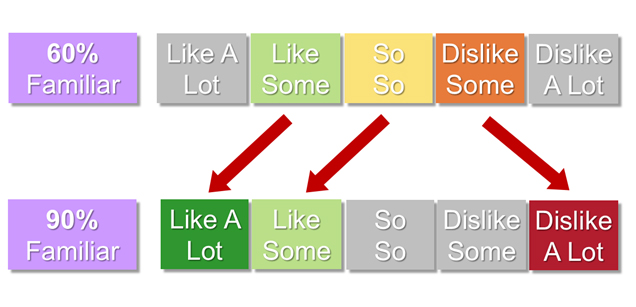
In practical terms, listeners who only barely know a new song will typically rate it in the middle of the scale—they neither love it nor hate it. After hearing the song more and more:

  • That same listener that once rated the song a “4” on a 5-point scale might decide they love it and rate it a “5”.
  • A listener who originally had no opinion about a song (“3”) might grow to like it (“4”).
  • A listener who at first thought the song was mildly annoying (“2) might grow to downright hate the song (“1”).

As songs become more familiar, listeners’ opinions about the song become more concrete

That’s why most songs that are highly unfamiliar also are the least popular songs even among those listeners who know them.

In contrast, songs that almost all of your listeners know are also songs your listeners really know—and they know if they love them or hate them. (After all, you have to know someone pretty well to consider them your enemy).

HOW TO USE FAMILIARITY

Here’s a general rule of thumb for translating how many of your listeners are familiar with a song to how well your audience truly “knows” a song—and how you should treat a song at each familiarity level:

Below 60% – This song is in the very early stages of its development. Even those listeners who do know the song probably don’t have strong impressions of it yet. Expect songs that less than 60% of your listeners know to be near the bottom of your callout ranker—but ignore these early results if you believe the song has hit potential.

Between 60% and 70% – Listeners know these songs better than your newest titles, but are still forming their opinions of them. While you might reject a song that listeners downright hate, songs in this familiarity range still have room to grow more popular.

Between 70% and 80% – The appeal level of these songs is stabilizing and you can now start using appeal scores to weed out songs that aren’t destined to become big hits. Keep in mind, though, that there are listeners who still don’t know these songs when you schedule them.

Between 80% and 90% – Listeners have formed their opinions about these songs are they probably are reaching the peak of their appeal. Furthermore, these songs are well known enough that you can power them.

Over 90% – These songs have become universally known hits, so much so that many of your recurrent-vintage songs will be in this range of familiarity.

The bottom line: Don’t rule out a new song your audience barely knows simply because it scores poorly in callout. Low familiarity indicates that listeners are still getting to know the song—and the song still has room to grow.

WHAT ABOUT SPIN COUNTS?

Many programmers began their careers using spin counts to determine when a song should be familiar enough to power and when a song should be burned enough to move to recurrent. However, what really impacts a song’s development isn’t how often you play a song, but how often your listener hears a song. With so many changes in how listeners consume music, yesterday’s spin benchmarks are no longer reliable metrics for making such decisions.

We do a deep dive in the way to think about exposure in our blog series How Often Do Listeners Hear Your Hits, especially in our post Why Song Familiarity is Like a Leaky Bucket.

In our next Callout Summer School class, we’ll show you how to create your test list for new music research, including common mistakes programmers make when choosing which titles to test.

Integr8’s exclusive Hitcycle® measure precisely tells you where each song is in its development cycle among your listeners—so you’ll have confidence when a new song needs more time to grow and when it’s time to move a song to recurrent. Contact us to learn how Hitcycle is better than Burn and Familiarity for picking the right new music.  

Callout Summer School: Don’t Get Burned by Burn

In our last Callout Summer School class, we examined how listeners’ reactions to songs translate into the five most common scores used to rate how much listeners love or hate a song. Now, we’ll tackle one of the most misunderstood and debated dimensions of how listeners fell about your music: Burn.

What question is Burn really trying to answer?

The idea behind Burn is that even if listeners love a song, they eventually get sick of it if they hear it over and over and over again. In gold-based formats, the stereotypical example is Stairway to Heaven, oft revered as the greatest song ever, but kept off many Classic Rock outlets for years because listeners said they had heard it one time too many.


In contemporary formats, programmers have traditionally used Burn scores to decide when to move a song from current to recurrent. The theory is that listeners have no idea what a “recurrent” is, but they do know when they’ve heard a song one time too many.

There are two fundamental problems with using “are you tired of this song” as a proxy for “should we move this song to recurrent”.

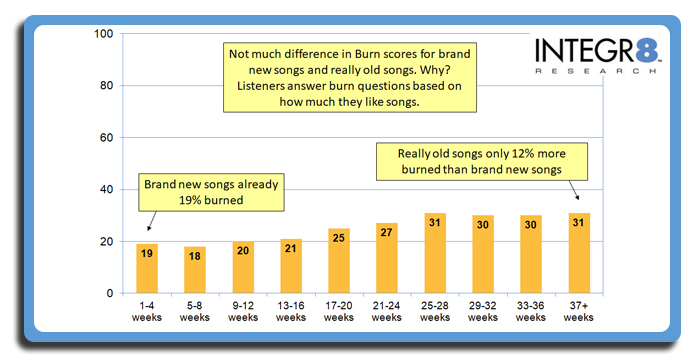
1) Burn often simply reflects appeal: As we explored in a past post, listeners often answer the question not based on how much they’ve heard the song, but instead on how much they personally like the song. If she just told you she loves a song, how could she ever be “tired” of it?  If she hasn’t yet warmed up to a brand new song, however, hearing it just once is one time too many.

Traditional Burn score for the average CHR/Hot AC title (by songs’ vintage on the Billboard Hot 100 chart)

Many veteran programmers and consultants have long understood this problem and recommend ignoring Burn entirely. “Just look at how many listeners love the song and play those songs most often. When listeners stop liking it, stop powering it.”

This approach ignores the second problem:

2) Listeners want contemporary radio stations to play contemporary songs: People turn to a contemporary radio format because they expect to hear music that represents what’s happening right now in popular culture. If you promise your listeners “Today’s Hit Music,” but you mostly play songs that are several years old, that broken promise will ruin your reputation—and with it eventually your ratings.

While many songs run their course, some hits remain highly popular for years. During the last decade, One Republic’s “Counting Stars”, Gotye’s “Somebody That I Used to Know” and Ed Sheeran’s “Perfect” remained among the best-testing titles long after anyone considered them “current”.


Just because listeners still love a song doesn’t mean they consider it relevant.

So what do you do about this conundrum?

How not to get burned by Burn

For our Integr8 New Music Research clients, we developed a proprietary measure called Hitcycle®, which tells you how listeners perceive the momentum of each song, regardless of whether they personally like it or not. Hitcycle provides clarity on when it’s time to move a big hit from current to recurrent.

Unlike old-fashioned Burn measures grafted from gold-testing techniques, Integr8’s Hitcycle is designed specifically for callout—and the need for contemporary formats to understand if a song still represents the “here and now” of popular music.

If your callout research uses an old-school Burn measure, however, here are four tips to use it effectively:

1) Understand how your research asks listeners about Burn:  Although we speak of “Burn” singularly, there are at least four common ways of asking Burn—with each one yielding a different result:

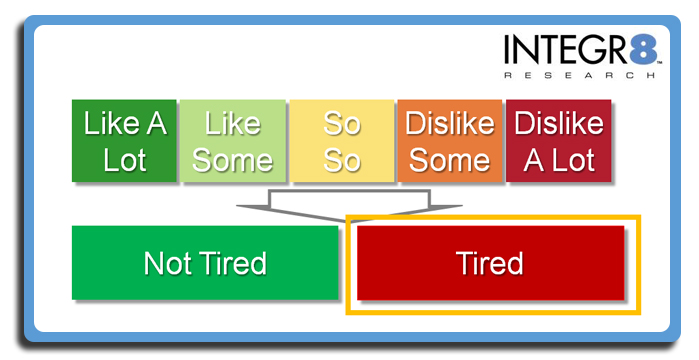
  • Some researchers simply ask if you’re “tired” of hearing a song on the radio. The percentage of listeners who say, “yes”, I’m “tired” of hearing that song is then reported as the Burn score. A Burn score of “30” simply means 30% of listeners who know the song are tired of hearing it.

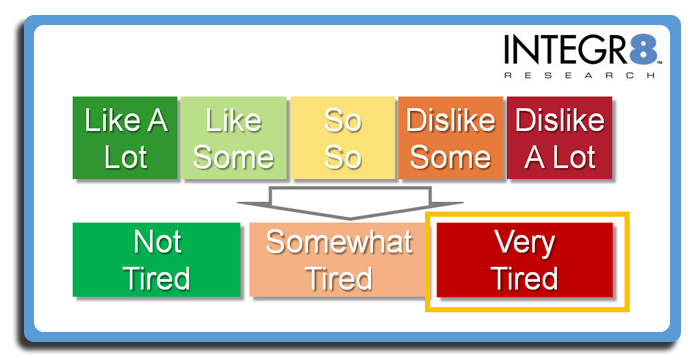
  • Other companies ask if a listener is “very tired”, “somewhat tired” or “not at all tired” of hearing a song, reporting the percentage of listeners who are “very tired” of hearing a song as the Burn score. In this measure, “30” means 30% of your listeners aren’t merely sort of tired of hearing a song, they’re really REALLY tired of hearing a song.

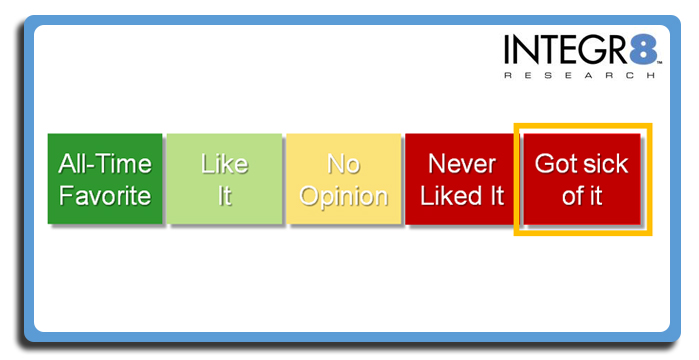
  • While some ask Burn as a separate question from the song rating question, other companies measure Burn by making it an answer in their song rating scale. This approach forces listeners to choose if their weariness of hearing a song outweighs their fondness for that song. Callout vendors that take this approach often call Burn “DDL” or “Developed Dislike”.

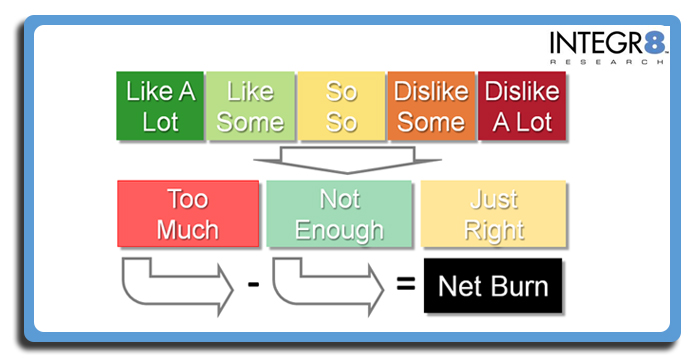
  • Finally, some researchers who think Burn is inherently a negative question put a positive spin on it by asking listeners if they’re hearing a song on the radio “too much,” “not enough, or “just right”. Programmers examine if the “too much” score is higher than the “not enough” score to determine the Burn level.

2) Forget the 30% rule: Many programmers have heard a Burn score of 30 or higher means a song should no longer be a current. However, there’s nothing magical about 30%. If 30% of listeners are “tired” of hearing a song, then 70% of your listeners are not tired of hearing a song (or at least not very tired of hearing it.)

3) Interpret Burn scores with your station’s strategy in mind: What really matters is how important it is to your station’s strategy to be a source for new music. If you’re a rhythmic-leaning CHR whose strategy for dethroning your musically-cautious CHR competitor is to be more on top of the biggest hits, use a lower Burn threshold to move songs more aggressively out of currents. If, however, you’re a Hot AC whose strategy is to play proven hits to an adult audience, allow songs to have higher Burn.

4) Examine how long listeners have been hearing the song: Based on observing the listening patterns of on-demand audio listeners—specifically when listeners who are in control of their music stop playing big hits as often—we offer guidelines on when different formats should move songs to recurrent in our post “When Should Big Hits Become Recurrents?” In making this decision, it’s also vital to understand how often listeners actually hear the hits on your station and in the market overall.

Our next lesson on the Callout Summer School syllabus with tackle the other end of a song’s lifecycle by examining familiarity—specifically how to use familiarity data in callout with brand new titles.


Callout Summer School: The Five Most Popular Song Scores

While going full-on Marie Kondo on my radio career box, I unearthed the very first music test I ever implemented back in 1999. It was a hand-me-down AMT from a large-market Soft AC. The format captain of our new owners had graciously shared it with me—and with it started my journey with music research.

What struck me as I looked at that 20-year-old library test wasn’t all the Phil Collins: It was the simple, hand-written instructions on how to implement the test—play songs with Potential over 70, unless the Developed Dislike was above 20 or if Unfamiliar was too high.

I didn’t know how the research company crunched these numbers or where these benchmarks originated. I only knew the station sounded better after the research hit the air.

Now, after 20 years of implementing music research and then helping clients use music research, finding those notes was a slap in the face: I suddenly remembered just how unintuitive and intimidating all those numbers can be—and how those of us in music research should be making it easier to understand the tools we provide.

After all, research should make you feel more confident in your decisions, not more confused.

That’s why we’re bringing you Callout Summer School. Whether you just got access to music research, or you’ve used it for years and simply want to have a deeper grasp on your results, we’re going to walk you through:

  • What your song scores mean
  • How they relate to your listeners’ reactions to your music
  • How you should—and should not—interpret the various scores

In this lesson, we’ll tackle the most fundamental question a music test should answer: Which songs do listeners like most?

Explaining the Five Most Popular Song Scores

All callout begins with playing the most recognizable snippet of a song (the “hook”). If the listener has never heard the song, she’ll mark it “unfamiliar” and not rate it.

If she does know it, she’ll then say how much she likes or dislikes that song. For example, our Integr8 New Music Research asks listeners to evaluate songs on a scale with five (5) answers.

Different companies use different language and even different numbers of possible answers for their song ratings, but the goal is the same: gauge both listeners’ positive and negative reactions to each song.

Here’s how the percentage of listeners who like and dislike each song translates into the five most popular song scores you’ll see in callout reports:


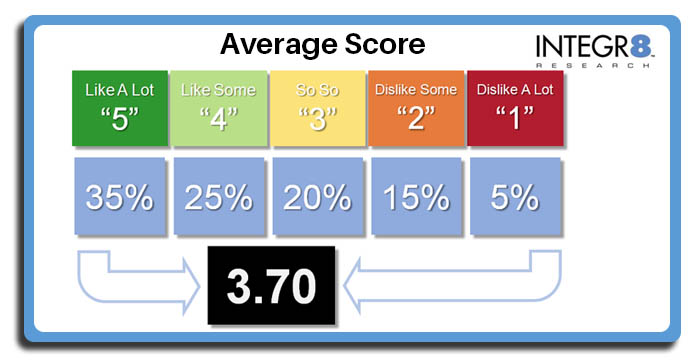
1) Average Score:
The score that shows you the good, the bad and the ugly in one number.

Sometimes called “Acceptance”, an Average score is simply how an average listener rates a song. If your music research uses a typical scale with 5 answers, your Average scores would range from 1.00 (if everyone hates a song) to 5.00 (if everyone loves a song). Typically, a strong average score will be above 3.80.

Advantage of Average scores: they give you the overall reaction to a song: for example, a song with a 4.17 means it’s more popular than a song with a 3.29.

Disadvantage of Average scores: They don’t distinguish between songs that listeners generally feel the same about and songs that are polarizing. If most listeners “like” a song, it might have a 4.00 average score. However, a song lots of listeners “like a lot” but some really “dislike a lot” could also have a 4.00 average score.

The “Average” score tells you how the typical listener rates a song on a scale of 1 to 5. The more listeners “like” a song, the higher the Average score will be. The more listeners “dislike” a song, the lower the score will be


2) Passion Score:  The score that only counts the “crank it up!” reactions

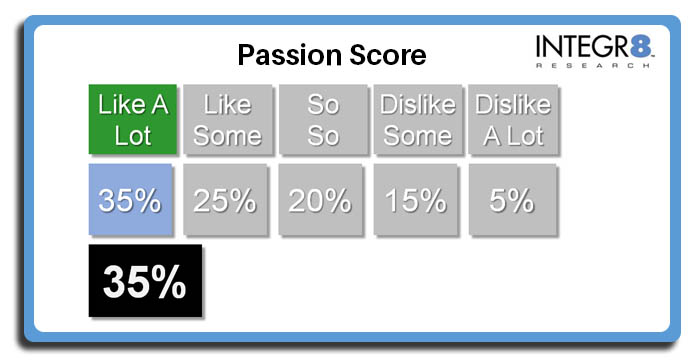
Sometimes called “5 scores”, “Favorite” or “FAV” scores, Passion simply tells you the percentage of listeners who rated the song with the absolute highest score on your scale. Technically, Passion scores could range from 0% to 100%, but high passion scores typically will be in the 40s and 50s.

Advantage of Passion scores: They give you a sense of which songs listeners most passionately love, not simply which songs listeners enjoy.

Disadvantage of Passion scores: For most songs, they ignore how most of your audience feels about the song, since it ignores anyone who dislikes or even merely likes a song.

The “Passion” score simply tells you the percentage of your audience that like a song “a lot”


3) Positive Score:  The songs they love… and merely like

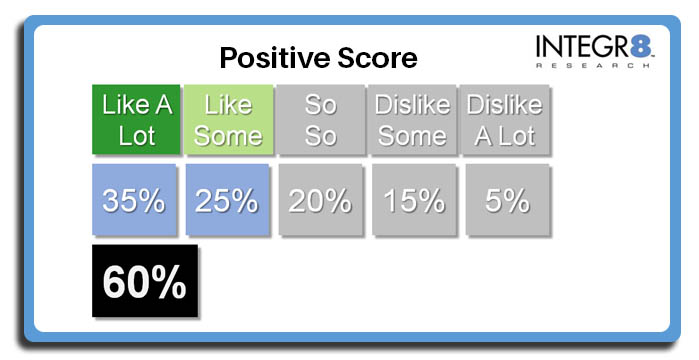
Sometimes called “Total Positive” or “4+5 scores”, Positive scores show how many listeners rate a song positively, whether they love it or merely like it. Positive scores could range from 0% to 100%, but high positive scores typically will be in the 70s.

Advantage of Positive scores: They’re more comprehensive than Passion scores

Disadvantage of Positive scores: They still ignore listeners who don’t like a song, while also blurring the difference between songs listeners love and songs they merely like.

The “Positive” score tells you how many listeners rate a song positively. If 35% of listeners like a song “a lot” and 25% like it “some”, the positive score is 60%


4) Popularity Score: The songs listeners love and know

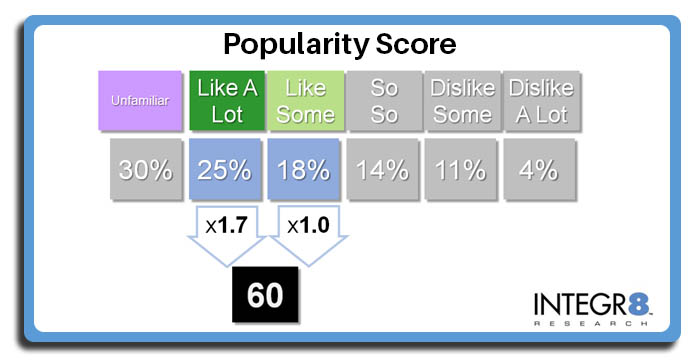
Also called “Weighted Positive Total Base”, “POP” or a “Zap” score, Popularity scores tell you the songs listeners like most, with an emphasis on the songs listeners really like a lot.  Popularity scores can be higher than 100. Typically, 70 or higher is a strong Popularity score.

Advantage of Popularity scores: They offer the advantages of a Passion and a Positive score by “weighting” songs that more listeners “like a lot”, while still counting songs listeners merely “like some”. Plus, they give you this reading among your whole audience—including listeners who don’t know a song and won’t yet have a reaction to it.

Disadvantage of Popularity scores:  They punish songs for being unfamiliar—which means that new songs will almost always sink to the bottom. If you simply played songs with the biggest Popularity scores most often, you’d be a recurrent-based radio station. Furthermore, Popularity scores completely ignore negative reactions to a song.

The “Popularity” score tells you which songs listeners know and love most by “weighting” the 25% of listeners who rate the song “like a lot” by 1.7, then adds in the 18% of listeners who rate a song “Like Some”, for a Popularity score of 60. “Popularity” scores punish songs for being highly unfamiliar.


5) Potential Score: The songs listeners would love if they only knew them

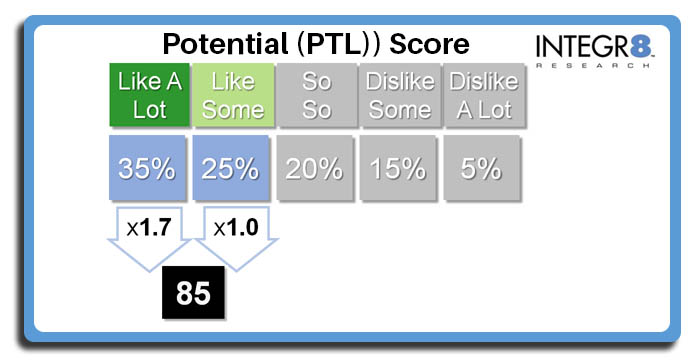
Also called “Weighted Positive Familiar Base” or “PTL”, Potential scores use the same calculation as Popularity scores to emphasize songs listeners really “like a lot”, except they only examine those listeners who are actually familiar with each song. Potential scores tend to be a bit higher than Popularity scores, with 85 or higher typically being a strong score.

Advantage of Potential scores: They overcome the inherent bias against new and unfamiliar songs of Popularity scores, giving a more accurate overall reaction to how popular new songs could be once more listeners get to know the song.

Disadvantage of Potential scores: Just like Popularity scores, they totally ignore how many listeners dislike a song.

The “Potential” score tells you how popular a song could be by “weighting” the 35% of listeners who know the song and rate it “like a lot” by 1.7, then adds in the 25% of listeners who know the song and rate a song “Like Some”, for a Potential score of 85. Potential scores do not punish songs for being highly unfamiliar


So which of these five scores should I use?

You might as well ask a Southern politician about barbecue.

Different programmers have different preferences, and each of these five metrics (and many other custom scores we’ve implemented for our Integr8 New Music Research clients) can help you find the best songs for each category.

The key is to fully understand both the positive and the negative impact of each and every song you play. The ideal song is one that listeners don’t merely like, but one that makes them shout, “OMG I love this song—turn it up!”

However, some songs that generate that level of passion also generate hate—and in radio, people who passionately dislike a song change the station. For those songs, you’ll have to strategically decide if not playing them is worse than playing them.

Regardless of which song score you use as your go-to metric, you should also examine the full range of listeners’ reactions from love and like to dislike and hate. Most callout reports will provide you this information.

In our next Callout Summer School class, we’ll explain Burn scores—and how not to be burned by them.


Should You Program 2019 Like It’s 1989?

Part four of a four-part series on music consumption trends


There are clear signs of a split in musical tastes that radio consulting legend Guy Zapoleon coined The Extremes, a predictable phase during which listeners’ tastes move away from broadly-appealing mainstream Pop songs towards the extremes of R&B, Rock and Country that don’t appeal to the same listeners. With divided musical fan bases who hate each other’s music, CHR finds it difficult to consistently delight a broad audience.

As music guru Sean Ross often points out, CHR performs best when there are plenty of fun, upbeat Pop, Rock and Rhythmic titles that mix well together and appeal to younger and older listeners alike.

If 2019 feels a bit like 1989 to you, you’re not alone.

Seemingly unaware of the Alternative Rock and Hip Hop that would soon burst onto the scene and define youth culture in the 90s, CHR plodded along three decades ago trying to duct tape together its mother-daughter coalition with Chicago’s “Look Away,” “Right Here Waiting” by Richard Marx and Phil Collins’ “Two Hearts”, while hoping younger listeners would stick around for the bones they’d throw them with Bobby Brown, Poison and Milli Vanilli.

Picture it: Your DeLorean’s flux capacitor finally lands you the PD gig at your hometown CHR in 1989. Knowing what you now know about what would come in the early 90s, would you still power those tracks that today power the Soft and Relaxing Favorites revival? Or, would you scrap them for the burgeoning Alternative or Hip Hop songs that were only receiving commercial exposure at WLIR(WDRE) and KDAY back in the day?

Had you become a trailblazer and played Morrissey, The Church, and Janes Addiction along with Public Enemy, Ice T and EPMD, someone might be making a documentary about your station’s cult status. Radio geeks like me would revere you for being “ahead of your time.”

Your station would have also been a ratings disaster.

Here are three things to keep in mind when programming in polarizing times:

1) Polarizing music hurts radio.

As Gen-Xers reach the natural age for nostalgia, many are wistfully recalling the days of pure, wholesome music like “Cop Killer” and “Been Caught Stealing”.

What nostalgia conveniently forgets is how many people downright hated that music at the time—to the point of “No Hard Rock and No Rap” being a positioning statement.

2019 is no different. Many of today’s polarizing songs, particularly Hip Hop perform well on streaming because—as we noted earlier—streaming data doesn’t capture detractors. Only callout can show the love and the hate for a song.

Perhaps in 2044, nostalgic middle-aged millennials will universally look back on XXXTentacion with fondness. In 2019, however, more listeners dislike his music than like it.

2) Today’s hits aren’t always tomorrow’s favorites: Even among teenagers, the music that now comprises the halcyon days of Hip Hop and Alternative were what “the weird kids” liked in 1989. That era wasn’t unique. The songs that stand the test of time are often not the same songs that were big hits in their own time:

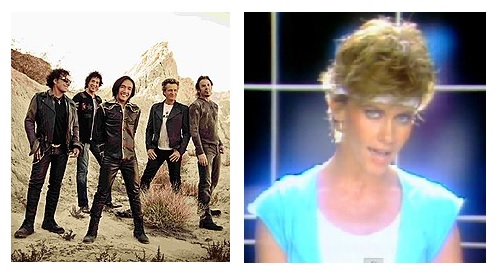
  • While Journey’s “Don’t Stop Believin’” is the most popular 80s song today, it was only a middling hit when new. In contrast, hardly anyone plays the biggest 80s hit in its own time, namely Olivia Newton John’s “Physical”.
  • Queen’s “Bohemian Rhapsody” is the 1970s most-streamed song on Spotify (even before the movie), while Debbie Boone’s “You Light Up My Life” has seemingly—and mercifully—vanished from the planet.
  • Etta James’ “At Last” is a staple of weddings, commercials, and playlists today. When it debuted in 1961, it didn’t even crack the Top 40. 1961’s biggest hit was “Tosssin’ and Turnin’” from Bobby Lewis—I’m likely the youngest person who knows it.
  • Today, only a few Pearl Jam titles continue to test well, while Nirvana has become “Classic Rock” among today’s teenagers.

There’s undoubtedly danger of being out of touch when CHR is too conservative with newly emerging music styles, as many CHRs discovered in the early 90s as they clung to Whitney Houston and Madonna. However, being ahead of the times fails just as much as being behind the times. Successful CHR stations are precisely in the moment.

3) Even in divided times, Pop is the glue that binds us together:  The fact that fans of Foster The People are diametrically different than fans of 6ix9ine undoubtedly makes it harder to create the big-tent Cume magnet that CHR is when it’s on top.


Without a deep bench of broadly appealing R&B and Rock titles, Pop is the glue that binds fans of different music styles together. Songs such as Ed Sheeran’s “Perfect,” “Havana” by Camila Cabello Featuring Young Thug, “Girls Like You” by Maroon 5 Featuring Cardi B and Imagine Dragons’ “Thunder” are appealing, even among listeners who aren’t primarily Pop fans.

Along with Pop-friendly Hip Hop tiles from Drake and Post Malone, these Pop tiles are the only titles that are strong on streaming, sales, and radio. As Coleman Insights discovered in its Contemporary Music SuperStudy, they’re also the songs lots of different listeners like—and few listeners hate.


“Pop clearly has the broadest appeal in our study. It not only is dramatically “over represented” among the Top 100 songs,” notes Coleman’s Warren Kurtzman, “it is significantly represented among the best-testing songs with fans of other genres. It is also the least skewed of the six major genres covered in our study in that it performs well with listeners regardless of age, gender, ethnicity, geography or even how they feel about President Trump.”

So how should you program in 2019?

Unless you’re programming a Hip Hop station targeting African-American and Hispanic listeners, playing the pure Hip Hop tiles that get played often on Spotify and YouTube could destroy the mass-appeal cume audience CHR needs to succeed.

If 2019 is in fact like 1989, however, we could be approaching a seemingly sudden shift in mainstream music tastes in the next few years. Billie Eilish could be a harbinger of a seismic shift in pop tastes on the horizon. A novelty like “Old Town Road” might mark a tumultuous point in Pop music history comparable to “Baby Got Back”’s point in time.

It’s wise to be on alert for such shifts—but also careful not to jump the gun on an underground trend that never goes mainstream.

In the meantime, Ed Sheeran and Ariana Grande might be what a 79-year-old Delilah is dedicating in 2039, but it’s the music that’s binding our divided nation together today.

As Coleman Insights’ Contemporary Music SuperStudy uncovered, in these times of both musical and political divisiveness, the one song Trump supporters and detractors can agree on is Uptown Funk.


Why Country is Missing from Streaming

Part three of a four-part series on music consumption trends

In our last post, we explained why so many pure Hip Hop songs that are massive hits on streaming aren’t big hits for mass appeal radio audiences. Today, we tackle the opposite scenario.

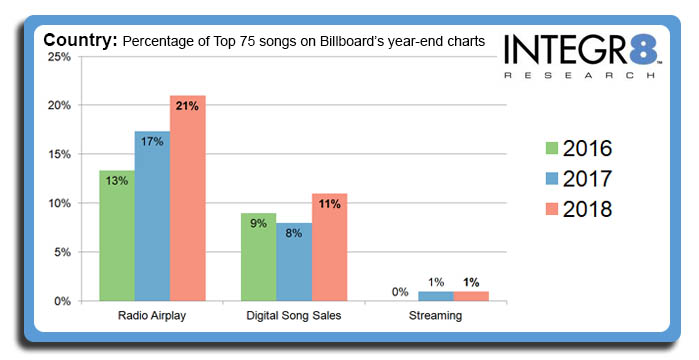
During the past two years, Country’s share of the songs listeners heard most on American radio grew each year, in large part because Americans are listening more to Country radio during the past two years. While this growth is somewhat reflected in digital download sales, Country remains almost non-existent among the Top 75 most streamed songs in 2018, according to Billboard’s year-end charts powered by Nielsen.


Why is Country missing from the top of Spotify and YouTube charts?

Country fans have been slow to adopt streaming.

This phenomenon is partly demographic: Country fans span a wide age range, including many older listeners who haven’t embraced streaming as rapidly as listeners 35 and under have embraced streaming. In contrast, Hip Hop fans tend to mirror the young demo of streaming’s biggest users.

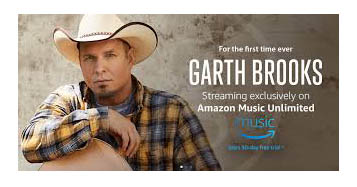
Until recently, neither record labels nor streaming services have  actively promoted strategies to encourage fans to stream their Country favorites. That’s finally changing. In 2017, Amazon Music saw an opportunity to become the preferred service of Country fans, including a landmark deal to be the exclusive streaming partner of Garth Brooks.


Country fans are fans of Country radio
.

While not yet big users of music streaming, Country fans are big users of local FM radio.  Our sister company Coleman Insights uncovered this phenomenon in their recent Contemporary Music SuperStudy, which examined how different listeners react to the most popular contemporary music.

Coleman Insights’ Warren Kurtzman notes, “In the data from our study, Country titles made up a much bigger portion of the Top 100 songs with daily radio listeners than it did with daily streaming listeners. This is what accounts for the discrepancy you describe, along with the fact that Country tends to perform better with older listeners.” 

A big reason may well be that Country radio is highly effective at fulfilling their listeners’ music desires, leaving most Country fans with little reason to buy or stream their favorite songs.  The loyal bond Country music fans have with their local Country station won’t surprise anyone involved with the format.

What Songs Do Listeners Still Buy? 


iTunes’ demise might be inevitable, but today, there are people who still pay to own digital copies of their favorite songs. Many of the songs listeners purchased most in recent years closely mirrors the Pop and Pop-friendly Hip Hop titles most played on radio.

The one genre that stands out as unique among the top songs listeners paid to download is music from film and TV. “How Far I’ll Go” from Moana, Lady Gaga & Bradley Cooper’s “Shallow” from A Star Is Born, “This Is Me” by Keala Settle & The Greatest Showman Ensemble, and “The Champion” by Carrie Underwood Featuring Ludacris, specifically recorded for the opening for NBC’s broadcast of Super Bowl LII.

Why aren’t these songs big on streaming? One reason could be that these songs benefit from big events that spawn sudden mass interest in them—such as the Big Game or the release of a hotly anticipated movie—but don’t sustain strong interest in subsequent weeks that would rack up streaming plays. As we’ve highlighted in previous posts, strong music sales represent new people who want to own a song, but can’t capture how long people want to hear a song after they’ve bought it.

For radio, these songs that suddenly soar to the top of the digital song sales chart might be worth tracking, but some may be a moment to relive on the morning show after the big event—not a song for recurring rotation.

In our final post in Our Musically Divided Nation series, we’ll offer guidance on how you should program your station in polarizing times, with lessons we can learn from the past.


Three reasons Hip Hop soars on Spotify but tanks in your music tests

Part two of a four-part series on music consumption trends

 In our last post, we spotlighted how many of the biggest pure Hip Hop titles on streaming services are absent from radio. If these songs are among the most-played songs when listeners are in control of their music, why don’t they test well with mainstream radio audiences?

As fortune would have it, Integr8 Research’s sister company Coleman Insights recently conducted the Contemporary Music SuperStudy, which sheds light on this very question. The project examined the most consumed songs of 2018 across six of the most popular music genres, as measured by Nielsen – BDSradio. They then used the same methodology they use for their FACT360 library testing to evaluate listeners’ reactions to each song.

We talked with Coleman Insights’ President Warren Kurtzman about the study and asked what it reveals about this gap.

1) Streaming doesn’t measure detractors.

“There are a lot of people who love Hip Hop and there are a lot of people who don’t like Hip Hop,” Kurtzman notes of Coleman’s findings. “Songs coded as Hip Hop/R&B made up the biggest portion of our test list of the most consumed titles of 2018, and when we looked at ‘like a lot’ scores or passion, Hip Hop/R&B came back as the biggest genre. But we also found that there are also a lot of people who don’t like Hip Hop/R&B. Thus, in an evaluation average metric that considers the full range of how people rate the music, Hip Hop/R&B fared notably less well.”
As we’ve noted in past posts, streaming statistics don’t capture how many listeners dislike a song because if you dislike a song, you simply don’t play it.

Kurtzman adds, “Purchases or on-demand streaming are driven only by the positives; you love something, you choose to listen to and/or buy it. But many radio stations are trying to be as mass appeal as possible for their target audience; they care about what their listeners like and they care about what their listeners dislike. So if you’re a Top 40 station, you have to be conscious of the positives and negatives of a polarizing title.”

The only tool that captures both passion and hatred is music research—whether a library test or callout.

2) Hip Hop is big on streaming because streaming is big with Hip Hop fans. 

Take a peek inside any shopping cart at Costco and you’d think Kirkland was the biggest brand in America. If you only shop at Kroger, though, you’ve likely never even heard of Costco’s house brand.

Lil Uzi Vert is to streaming a bit like Kirkland is to Costco.

More than any other genre, Hip Hop fans have consolidated their music consumption on Spotify and YouTube. According to Nielsen Audio’s year end music report, 69% of Hip Hop consumption came from streaming, while only 20% came from paid digital downloads and a scant 11% from physical album sales. Meanwhile, consumption of other genres was more evenly divided between these three media.

Coleman Insights’ findings shed light on this difference: “Hip Hop/R&B titles perform best with younger, ethnic listeners who live in urban areas,” Kurtzman notes. These consumers are the same consumers most likely to embrace streaming.

3) Streaming counts how many times a song gets played, not how many different people play it.  

If 10 different listeners play a song once on Spotify or YouTube, it counts as 10 plays on the streaming chart. If one listener plays a song ten times, it also counts as 10 plays on the streaming chart.

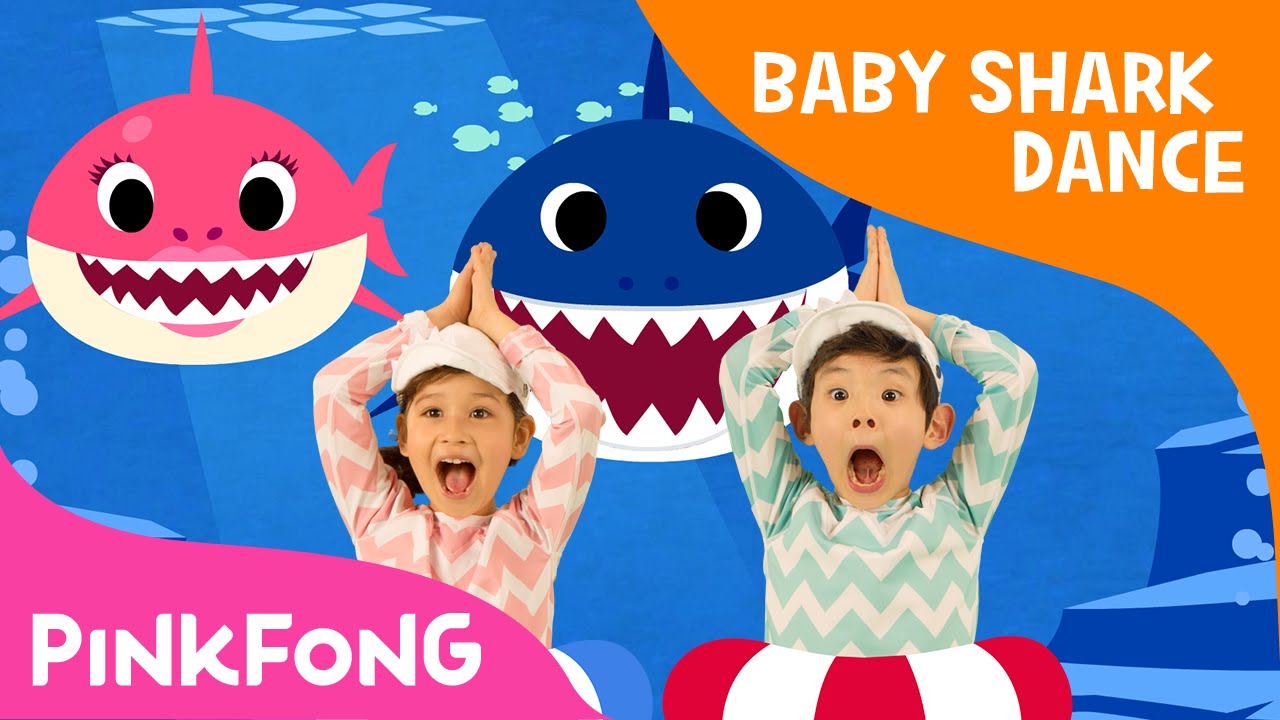
That’s how Baby Shark muscled its way into the Billboard Top 40 last January, garnering 20.8 million streams in a single week and peaking at #16 on billboard’s Streaming Songs chart, according to Nielsen Music.

Nice work, toddlers.

The released streaming data does not indicate how many different people played a song—only how many total times a song was played.

Hip Hop fans presumably aren’t as repetition-happy as preschoolers, but Hip Hop fans may well play their favorite titles frequently given their passion for the genre, their relative youth, and their lack of exposure to the genre on other platforms.

How should your station use streaming?

Do these limitations mean you should ignore streaming data? Hardly. We’ve long advocated for the advantages of understanding what songs listeners are streaming and these advantages continue growing as Spotify replaces iTunes.

Streaming is especially helpful at identifying new songs that fit your format, but might not yet be on your radar. However, you’ll have to use other resources—including your instincts and your own music research—to ultimately decide if a big hit on streaming will be a song your listeners want to hear on your station.
Basing your playlist primarily from streaming data, however, will likely lead you to play songs that a sizable portion of your listeners downright hate.

In our next post, we’ll explore why County is missing from the top of streaming charts, even as the radio audience for Country continues to grow.


Our (Musically) Divided Nation

Part one of a four-part series on music consumption trends

After 2016, our nation has become a divided land: People are in different camps, where the world looks totally different than it does in other camps.

We’re not talking politics. We’re talking music.

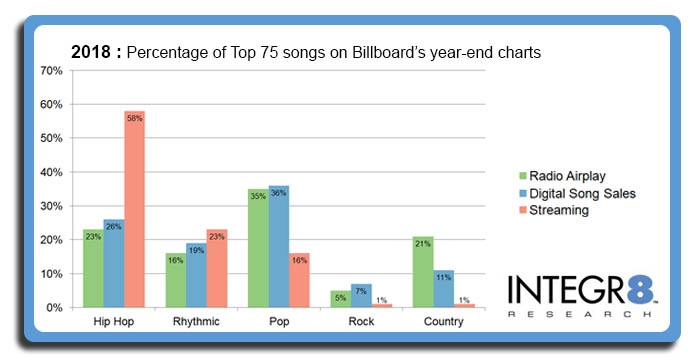
The styles of music people play most on Spotify, buy most on iTunes (yes, people still do that) and hear most on FM radio grew sharply divided in 2017 and remain diverged today.

To quantify this divide, we examined Billboard’s Year-End charts, which use Nielsen data to identify the 75 biggest songs in radio airplay, digital song sales and streaming. We then had our team of new music gurus code each song’s sound style.

Our quantitative analysis confirms what many radio programmers have anecdotally observed:

  • Hip Hop dominates the most popular songs that listeners stream.
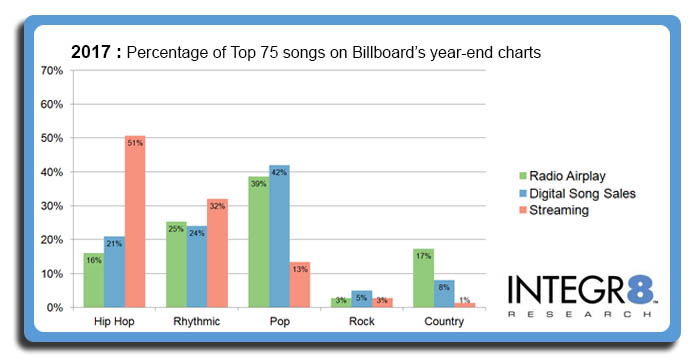
  • Country has grown on FM radio during the past two years, but remains non-existent among the biggest songs on streaming platforms
  • Pop remains the most popular style of music people pay to download

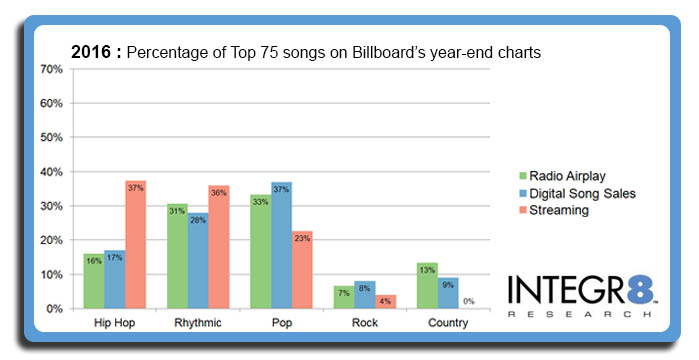
Already in 2016, Hip Hop was twice as popular among the year’s biggest hits on streaming as on radio or digital sales, while Pop, Rock and Country were less popular on streaming.


In 2017, that divide widened sharply: Hip Hop grew to account for over half of the 75 most-streamed songs in 2017. Meanwhile, Pop’s share of 2017’s biggest songs grew on both radio and in digital singles sales, but sank on streaming.


Today, those divisions remain. Hip Hop still rules among streamers, while Pop remains most popular among iTunes buyers and radio listeners.


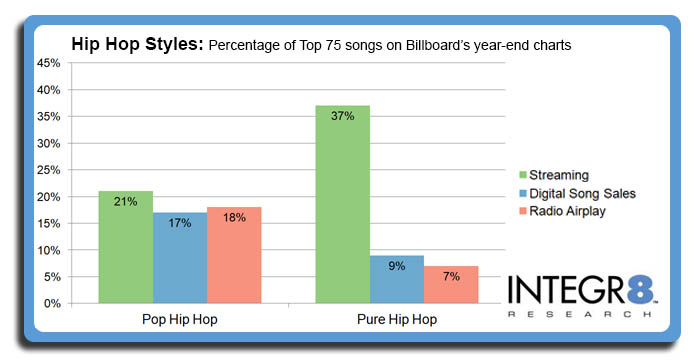
Looking at Hip Hop unilaterally doesn’t tell the full story: When we divide Hip Hop into Pop Hip Hop (think Post Malone’s Better Now) and Pure Hip Hop, Pop Hip Hop is evenly represented among the biggest songs on streaming, digital sales and radio airplay. The divide stems exclusively from Pure Hip Hop, which comprised 37% of 2018’s 75 most streamed songs, but a scant 7% of 2018’s most played songs on FM radio.

Pure Hip Hop songs that were huge hits on streaming, but outside of Urban were largely absent from the radio in 2018, include:

  • Sad! – XXXTENTACION
  • FEFE – 6ix9ine Featuring Nicki Minaj & Murda Beatz
  • Gummo – 6ix9ine
  • This Is America – Childish Gambino

Even songs like Travis Scott’s Sicko Mode and Stir Fry from Migos, which received considerable airplay on CHR after breaking on streaming, generally received mixed results in new music research among mainstream audiences.

Why is there such a discrepancy between how often these songs get played on Spotify and what listeners say they want to hear on the radio? We’ll explain this schism in our next post.

The Alexa Effect: How Radio Can Thrive in a Connected World- Webinar

In this webinar, you’ll learn:

  • How soon smart speakers may outnumber AM/FM radios in your listeners’ homes.
  • Why focusing your smart speaker strategy only on Alexa is a mistake.
  • Which listeners your station should target with its streaming strategy
  • What radio’s unbeatable weapon is for battling Spotify.

The Spotify-Slaying Weapon Radio isn’t using

In 2017, we identified three groups of listeners who were increasingly turning away from radio and towards on-demand services to find out about the latest music releases, namely:

  • Teenagers
  • Listeners who regularly use on-demand services such as Spotify
  • Listeners who have Apple CarPlay or Android Audio in their car.

We warned that radio would completely surrender its function as the first place to learn about new music among these three groups unless it aggressively promoted its role of introducing listeners to the latest music.

Unfortunately, the trend has not changed course. Radio has now lost its leading role in new music discovery among all three of these groups.

Radio loses teenagers

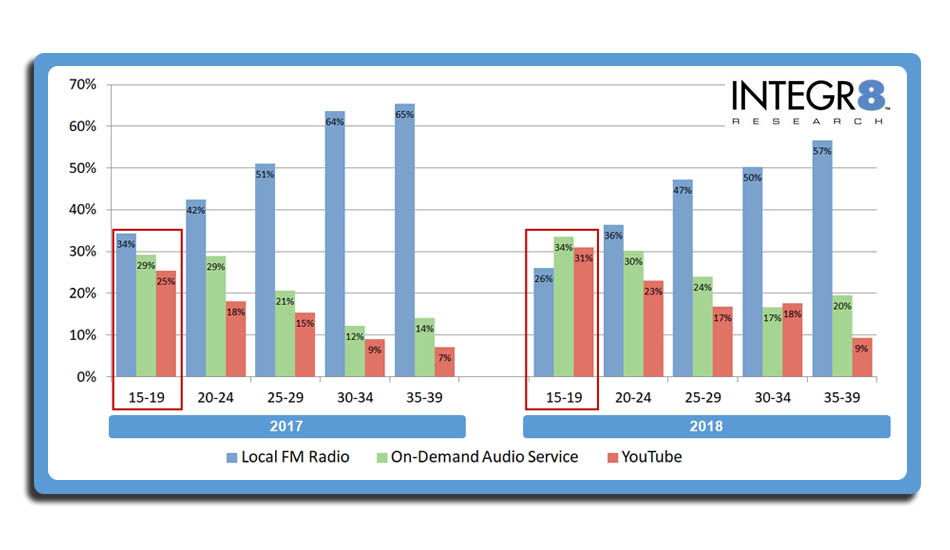
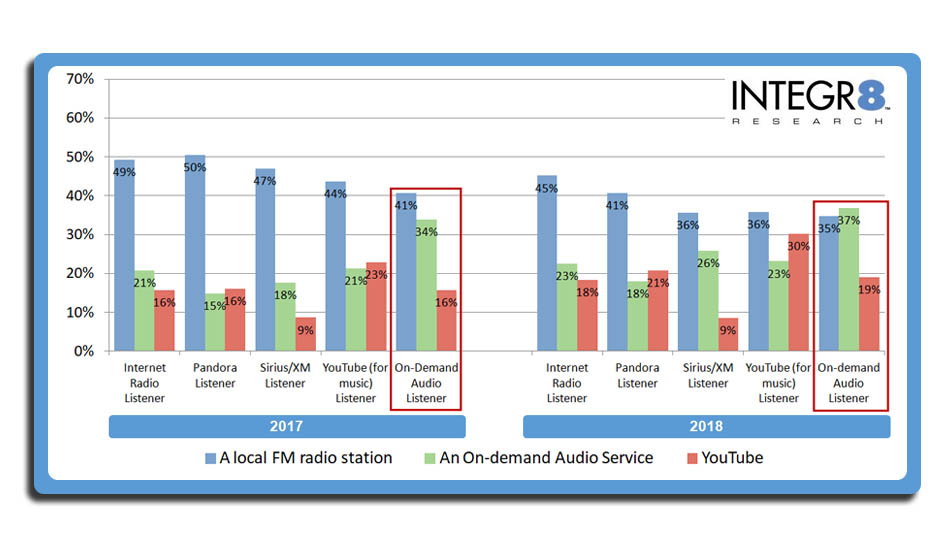
Among 15- to 19-year-old listeners, local FM radio stations now trail both on-demand audio services and YouTube for the place where teens hear new music first.

However, it’s not just teens who aren’t learning about new music form radio. Back in 2017, the majority of listeners 25 and older still heard new music first on FM radio.  Less than two years later, radio now only maintains a solid majority for new music discovery among listeners 35 and older.

Where Listeners Hear New Music First: 2017 vs. 2018

Radio loses connected car owners

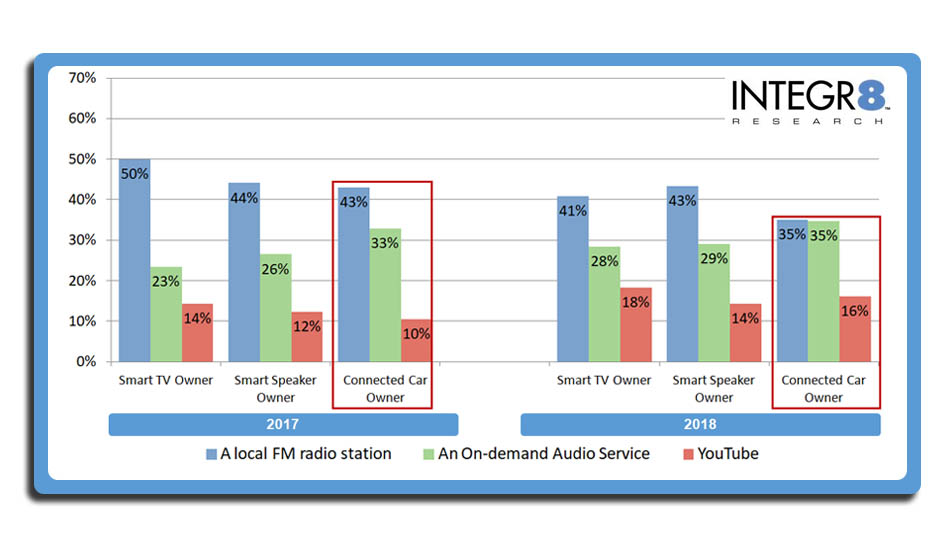
Among listeners who own a car with Apple CarPlay or Android Auto, local FM radio is now tied with on-demand audio services for new music discovery.  While connected car ownership remains low today, the dramatic impact the connected car could have on music consumption as listeners slowly but surely replace old automobiles is arguably the most existential threat to local radio.

… but smart speaker owners still turn to radio for new music discovery

Additionally, owners of Smart TVs such as Roku, Amazon Fire and Google Chromecast are also decreasingly finding out about the latest new music first from local FM radio. Among the smart devices we examined, only smart speaker owners remain as likely to learn about new music from radio today as they were in 2017:

Where Listeners Hear New Music First: 2017 vs. 2018

Radio loses on-demand users

Finally, Spotify and similar services have now succeeded in usurping radio’s new music discovery role among their regular users. The most troubling part of this development is the rapid growth of Spotify and similar services. Sixty-three percent (63%) of 15- to 39-year-old listeners are already using on-demand audio regularly.

Where Listeners Hear New Music First: 2017 vs. 2018

Should radio even care if people use our stations to discover new music?  Aren’t we better off just playing the songs listeners already know and love and let Spotify sort out the hits for us? 

For CHR, Urban, Alternative and Country stations, you absolutely should care if listeners think of you for exposing them to new music. In focus groups, listeners consistently cite keeping up to date on the latest music as a key reason they choose a contemporary music station. Perceptual research spotlights that contemporary stations that neglect new music discovery develop bad reputations for being stale and out of touch—negative images that ultimately hamper their long-term ratings performance.

The paradox herein is that, in the moment, listeners usually show more interest in the song they already know and love than for the new song they’re hearing for the first time. As anyone with callout research can tell you, the recurrents rise to the top of the ranker, while the new songs usually debut closer to the bottom. Similarly, M-score, the tool that uses PPM data to identify songs that cause above-average tune-out, commonly shows that listeners are more likely to switch away from an unfamiliar song than from a well-known one.

Back in the diary days, radio was proud of the new music it debuted for its listeners. “Smash or Trash” features ruled nighttime shows and gave listeners a way to engage with the station’s music. Personalities routinely teased an upcoming spin of a brand new song from a core artist. In direct format battles, stations even trash-talked competitors for being slow to add specific titles.

Then came PPM. When stations initially discovered that new songs could cause in-the moment tune-out, we hid them: We played new releases coming out of stop-sets. We buried them in long music sweeps. We stopped teasing new songs. We told our personalities not to talk about new songs. We hoped listeners wouldn’t even notice the new songs we played.

Unfortunately, we got our wish.

Listeners no longer notice the new music they hear first on the radio. On-demand audio services are aggressively pursuing music discovery with new music playlists and features—and listeners are changing their perceptions of these brands because of these efforts—at radio’s expense. Spotify and its clones have already overtaken radio as the place to discover new music among several key listenership groups and, in combination with YouTube, now threatens to overtake radio among everybody under 35.

However, radio has a weapon Spotify will never have—personality:

  • A radio personality can tell you the backstory of a breakthrough artist that makes you want to hear her work.
  • A radio personality can point out that crazy line in the second verse to stay tuned to hear.
  • A radio personality can engage you to smash or trash a song on the station’s social media.
  • A radio personality can give you the chance to be among the very first to hear a new song by a star artist.

A radio personality can add context that will make listeners excited to hear a song that otherwise would simply be weird and unfamiliar. It’s a deeply personal and emotionally engaging weapon no algorithm can match. When we stifle their voices and their role in introducing new music simply to avoid potential tune-out, we might win a few tenths of a point in the PPM battle, but we will lose the new music war to Spotify.

How do you think radio’s personalities could engage today’s listeners with new music?  Let us know in the comments or on Facebook.

Watch The Alexa Effect Webinar