Tag Archives: Integr8 Research

Radio, She’s Just Not That into You.

Part four of a five-part blog series, “The Alexa Effect: How Radio Can Thrive in a Connected World”

Somewhere between your first impassioned teenage crush and the mundane joys of adult relationships, you realized it. Your love life is ultimately a lot more fulfilling when your beloved is actually into you. You might think pursuing the one who blows you off is “adventurous” when you’re young and dumb. By adulthood, however, most folks know Rob Base was right: “It Takes Two to make a thing go right.”

No, I haven’t hijacked the Integr8 Research blog to process my college dating life—or lack thereof.

We’re talking about radio listeners. And Radio, some of the listeners you’re chasing just aren’t that into you.
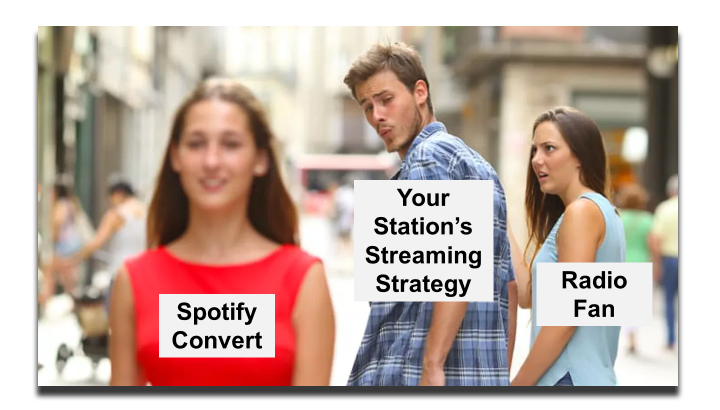
“If she just had a radio, she’d love me!”

“Everyone wants to listen to the radio—but the barrier to listening beyond the car is having access to a device that plays radio programming.”

Following this belief, you might assume that listeners who don’t own an AM/FM radio at home would be more likely to stream their local FM stations using all those new connected devices that replaced their radios.

Unfortunately, that’s not at all what’s happening. As we noted in our last post, listeners who don’t own an AM/FM radio at home are actually less likely to own a smart speaker, partly because they’re younger—and younger listeners own less stuff in general.

However, there’s something more fundamental going on.

Listeners who don’t own a radio beyond their cars are the least likely listeners to stream a local radio station than any other segment we examined.

Which listeners are most likely to stream a local FM station when they’re in the mood for music?  Ironically, listeners who still own a regular radio beyond the one in their cars, whether at home, at work or a portable radio.
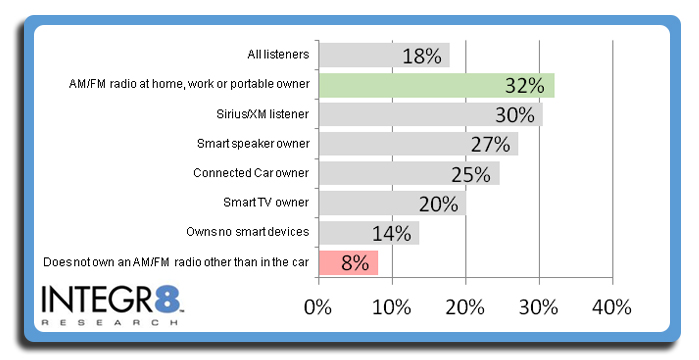
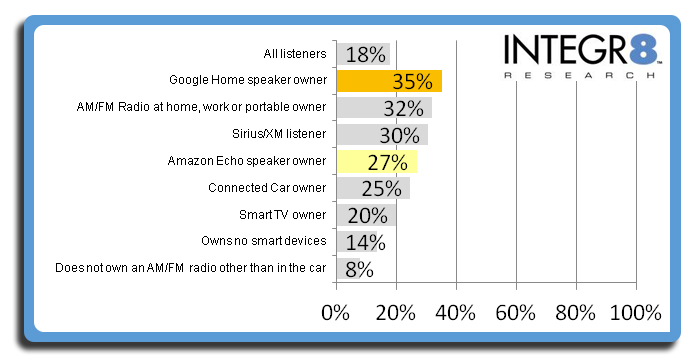
Who Streams local FM Radio?

Why are the listeners who could most easily listen to the radio over the air the most likely listeners to stream their favorite local stations?

If you believe people don’t listen to the radio because they don’t have a radio, this finding makes no sense.

However, if you instead believe that people who are most passionate for radio programming will find the easiest ways to listen, it makes perfect sense.

People who don’t own radios simply aren’t that into radio. 

Not only are listeners without radios beyond their car less likely to listen to local FM radio—both terrestrial and streaming—they’re also less likely to use the iHeartRadio and TuneIn platforms, Sirius/XM (whether via satellite or online), online-only internet radio stations and even Pandora.

In contrast, people who do still own a radio beyond their cars are four times more likely to stream a local FM station.
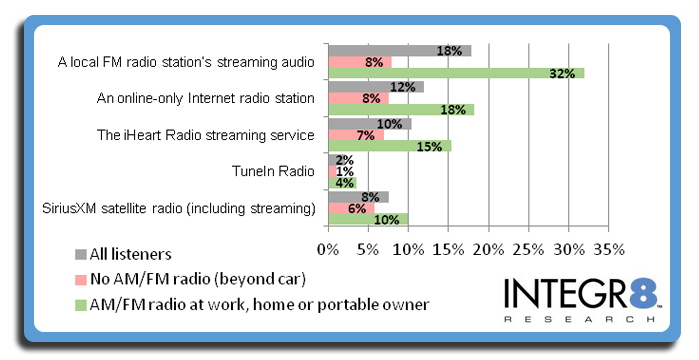
Services listeners use for music

The second most likely group to stream a local FM station regularly are those listeners who pay to hear radio—namely, Sirius/XM subscribers.

“Who Loves You, Baby?”

Some people who aren’t into radio simply aren’t that into music. Others want total control over what they hear. Both groups existed long before Spotify did.

Listeners who use radio do so because—they really like radio! They appreciate that we pick out the songs they want to hear, not just because it’s convenient, but because of the shared experience. They count on us to introduce them to new songs we think they’ll love. They appreciate the entertainment and companionship we offer beyond the music. Finally, at our best, radio fans feel like their favorite radio station is a club where they belong.

These radio fans seek out radio, whether on the old clock radio they still have on the nightstand, or on the new Amazon Echo they have in the kitchen.

Instead of trying to win over the self-curation control freaks, or conversely the listeners who don’t care that much about music in the first place, radio should seek to maximize listenership from folks who already love radio.

Emphasize that a real person curates the music for them.

Promote the personalities who share the music with them.

Showcase new music so listeners can feel excited that they heard it first.

Most of all, make listeners feel they’re among their tribe whenever they tune in.

Stop trying to please the listener who is never going to think you’re enough. Instead, focus on the listener who loves you for—you!

Make great radio for people who love great radio.

We’ll show why using our personalities to make great radio is especially critical to the future of contemporary formats in our next post.
Watch The Alexa Effect Webinar

Are Smart Speakers Really Replacing Radios?

Part three of a five-part blog series, “The Alexa Effect: How Radio Can Thrive in a Connected World”

After coming to grips with the reality that clock radios, boom boxes, Walkmans (“Walkmen”?) and stereos weren’t a part of the 21st century home, radio programmers assured themselves that today’s connected devices would simply replace those old radios as the utility people use to play their stations. In a perfect world, listeners would ask Alexa or Google to play their favorite local station, seamlessly transitioning from our terrestrial signal to our stream.

Is that actually what’s happening?

To find out, we examined different devices that 15- to 39-year-old contemporary radio format partisans own—including smart speakers and traditional radios—as well as all the different ways folks listen to music.

YES, smart speakers could outnumber radios by 2020

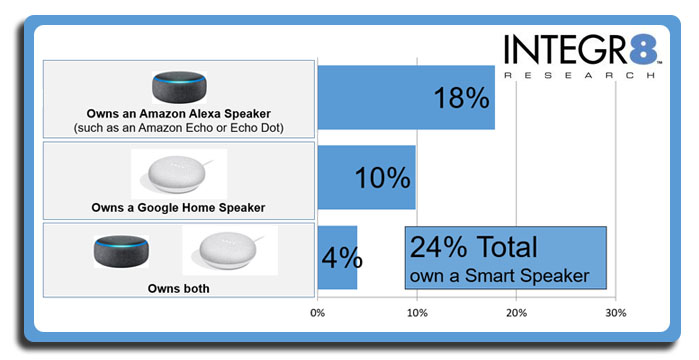
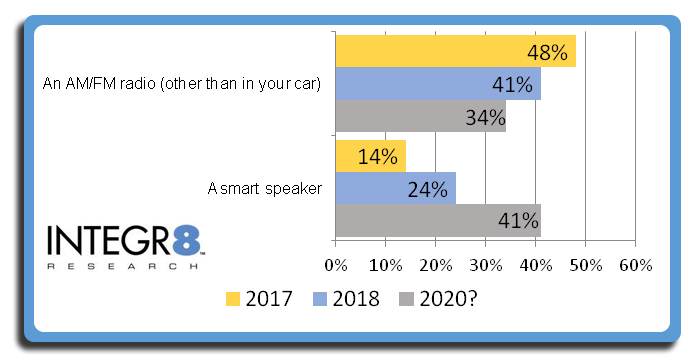
Beyond the car, regular radios are indeed vanishing. Only 41% still own a radio at home, at work, or a portable, down from 48% in 2017.  Unsurprisingly, smart speaker ownership has grown conversely, from 14% to 24%.

What Devices Do You Own?

At this rate, it is easily foreseeable that sometime in 2020, more 15- to 39-year-old listeners will have a smart speaker in their home than will own an AM/FM radio.

BUT, listeners who don’t own radios also don’t own smart speakers

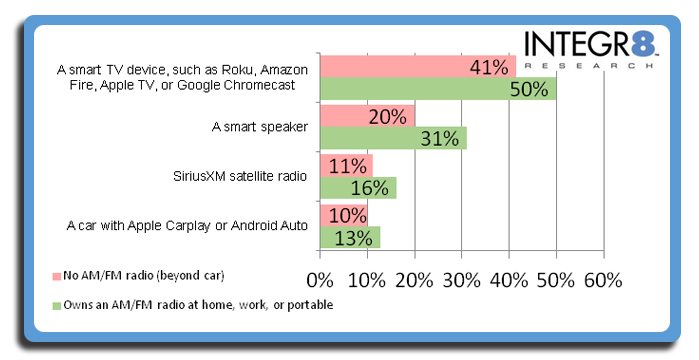
Right now, however, there’s a big problem if smart speakers are our plan for replacing clock radios: Listeners who don’t own radios beyond their cars are actually less likely to own all kinds of smart devices compared to people who still do own radios at home. That includes Smart TVs like Roku, Connected Car systems like Apple CarPlay, and yes—smart speakers such as Amazon Echo and Google Home.

What Devices Do You Own?


A big reason is that these listeners tend to be younger—and young people don’t yet have as much money to buy stuff—including smart speakers.

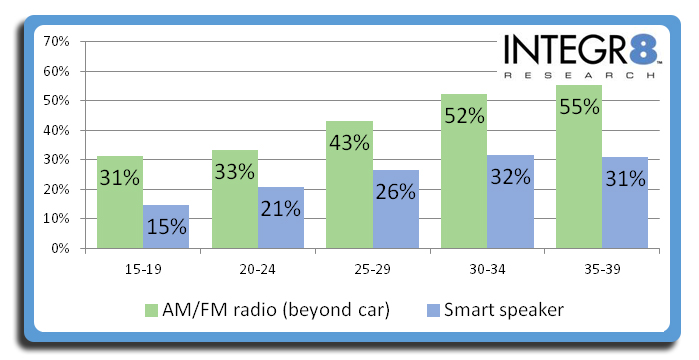
What Devices Do You Own? (by age)

“But even younger listeners will have smart speakers soon, and then they’ll play our station on it…right?”

AND, younger listeners prefer on-demand to radio

Just as younger listeners are less likely to own a radio at home, younger listeners are also the most likely listeners to prefer on-demand services where they control what they hear, while those older listeners who are most likely to own radios and smart speakers are also the most likely listeners to like services that offer curated, hosted music programming—or as we like to call it—radio.

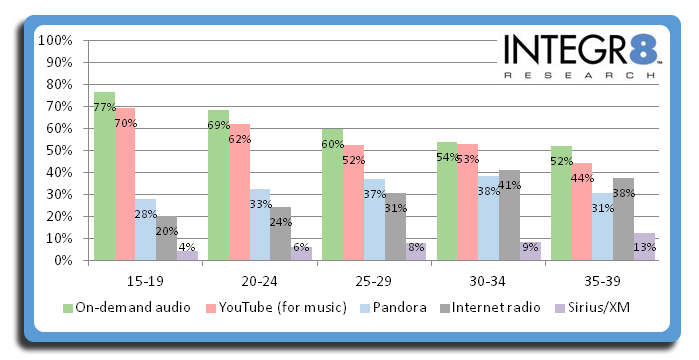
Services Listeners Use for Music (by age)

It’s probably inevitable that younger people will eventually spring for smart speakers—but what they ask those smart speakers to play is far from inevitable.

So if today’s under 25 listeners simply prefer picking their own music on Spotify and YouTube to services that curate music for them, is there any hope for terrestrial radio to hang on to younger listeners?  Should radio try to emulate on-demand services to make our stations more appealing?

We’ll explore why your station might be pursuing the wrong kind of listener in our next post.

Watch The Alexa Effect Webinar

Why Radio Shouldn’t Ignore Google Home

Part two of a five-part blog series, “The Alexa Effect: How Radio Can Thrive in a Connected World”

“Alexa! Alexa! Alexa!!”

Listen to any radio station’s smart speaker promos and you’ll almost certainly hear about Alexa. We inform listeners about the station’s new Alexa skill. We demonstrate the correct way to address “she who shall not be named.”

Far less common is hearing a radio station promote listening on the Google Home platform, the solid second place contender in the smart speaker battle.

Could you really blame Google Home for feeling like the Jan Brady of smart speakers?


Focusing on Alexa would seem to make sense, given that more people own an Amazon Echo than any other smart speaker. Isn’t it safe to assume all Amazon and Google owners use their devices exactly the same way?

Turns out… no.

On the one hand, although usage of both is growing at a similar rate, Amazon Echo users nearly double the number of Google Home users.


On the other hand…

Google Home owners are 30% more likely to regularly stream a local FM station than are Amazon Echo owners. 

As we noted in our last post, among the 15- to 39-year-olds who are partisans to a contemporary formatted radio station, 27% of those listeners who own a smart speaker regularly use a local FM radio station’s stream to listen to music. Among owners of Amazon Echo devices, 27% also regularly stream FM radio.

However, 35% of Google Home users stream local FM radio regularly—30% more than do Echo owners.

In fact, of all the devices we examined, Google Home users are the biggest streamers of local FM radio.

Who streams local FM radio?


Google Home owners are big into all kinds of radio

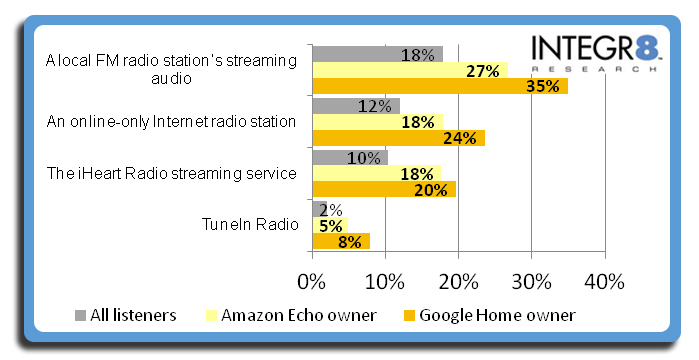
Google Home users are also more likely than Amazon Echo owners to listen to other radio-style services, including online-only internet radio and to use iHeartRadio and TuneIn.

What services do you use to listen to music?


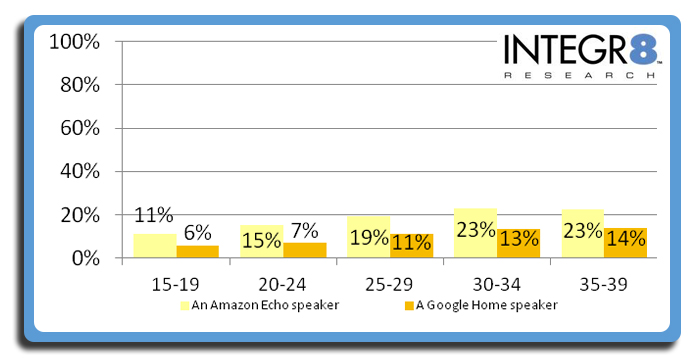
Google Home users’ penchant for radio-style programming is not a function of age, either. Their age profile mirrors Amazon Echo owners.

Smart speaker ownership by age

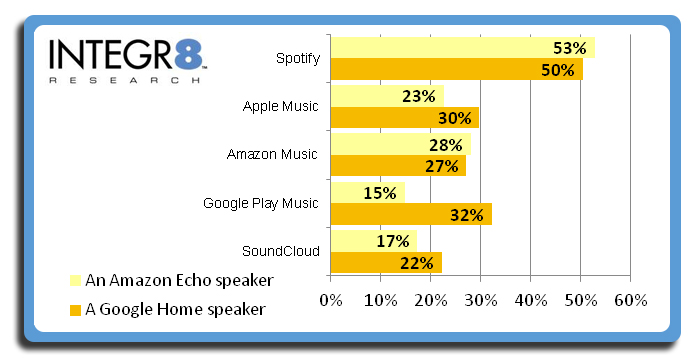
Instead, the people who choose the Google Home platform have fundamentally different audio usage patterns than do Amazon owners. Not only do they exhibit greater interest in radio-style programming, they are also more likely to choose second-tier on-demand platforms instead of Spotify than are Amazon Echo users, including—ironically—Apple Music.


What services do you use to listen to music?

The bottom line: Ignoring Google Home users ignores the group most interested in streaming your station.

In our next post, we’ll examine if the rise of the smart speaker is indeed bringing radio back into homes where radios have vanished.

Watch The Alexa Effect Webinar

Alexa, Are My Station’s Smart Speaker Promos Working?

Part one of a five-part blog series, “The Alexa Effect: How Radio Can Thrive in a Connected World”

When smart speakers appeared, savvy radio programmers instantly saw the potential for these audio-oriented devices to bring their programming back into listeners’ homes, especially as traditional AM/FM radios become endangered species.

We’ve told listeners precisely what to say to get their A.I. lady to stream our station.

We’ve invested in Alexa Skills to ensure listeners can ask for our stations by name.

Are all those on-air promos paying off with increased streaming of local FM stations by smart speaker owners, especially as smart speaker ownership grows?

Not exactly.

More people own smart speakers, but fewer smart speaker owners are streaming local radio

Back in 2017, when we first talked with 15- to 39-year-olds who are partisans to contemporary-formatted radio stations, only 14% of listeners owned smart speakers. By the end of 2018, 24% owned smart speakers.

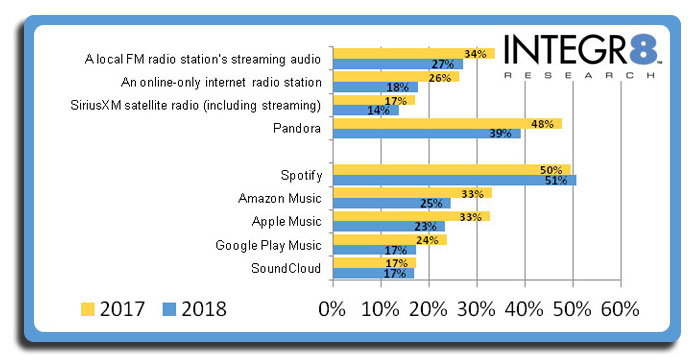
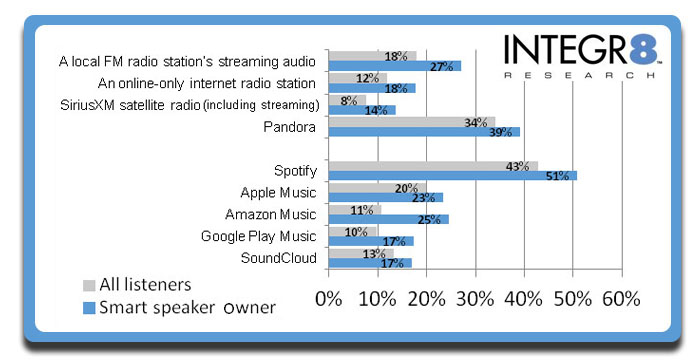
Although there are more listeners with smart speakers today, fewer are streaming local FM radio. In 2017, 34% of smart speaker owners regularly used a local FM station’s streaming audio to listen to music. Today, the percentage of smart speaker owners who regularly stream local radio has fallen to 27%.

What services do smart speaker owners use to listen to music?

That decline sounds discouraging, but don’t panic. There are three reasons this decline doesn’t signify a smart speaker disaster.


#1: Smart speaker owners are 50% more likely to stream their local stations
First, smart speaker owners are still 50% more likely to stream a local FM station than listeners overall.

What services do you use to listen to music?


#2: Smart speaker owners are the biggest streamers of local radio
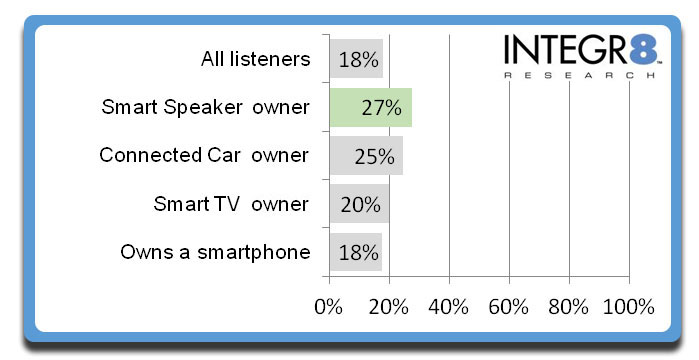
In fact, smart speaker owners are more likely to stream local radio than owners of any other smart device we examined.

Who streams local FM radio?


#3 Smart speakers are becoming mainstream products
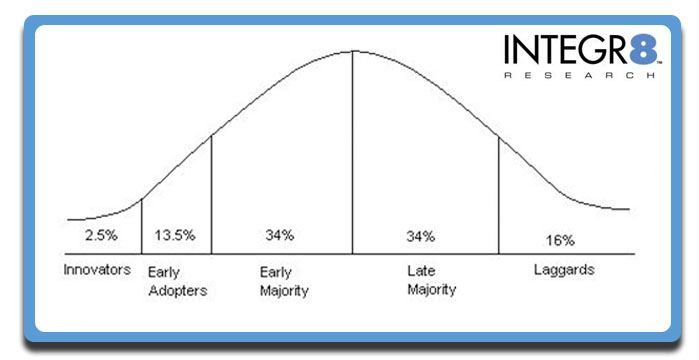
In 2017, Amazon Echo and Google Home were still “early adopter” products. The same listeners who were first to embrace all kinds of new online music services were also the first listeners to bring Alexa into their bedrooms. Today, smart speakers have grown to the “Early Majority” stage, where buyers look more like everyday music consumers instead of rabid fans.


The Product Lifestyle Curve


Today’s smart speaker owners are significantly less likely to be regular users of second-tier on-demand streaming services. Amazon Music and Google Play Music* (*Still existed at the time) all declined more than streaming of local FM radio.

The only music service that today’s smart speaker users are more likely to use now than in 2017 is on-demand market leader Spotify.

While these results may suggest using Alexa as the new AM/FM radio isn’t exploding because of our efforts, they do also confirm radio is on the right track by focusing on smart speakers. Focusing on this one device will prove more effective than trying to educate listeners about every possible device that can stream our stations.

However, if you assume the smart speaker is synonymous with Alexa, you’re making a mistake.

We’ll show you why in our next post.

Watch The Alexa Effect Webinar

Five Lessons We Can Still Learn From Mike Joseph

You may not have heard of Mike Joseph, the radio consultant who recently died at age 90. If you’re in CHR, you owe a debt of gratitude to Mr. Joseph for your format’s existence, especially if 1980s CHR got you hooked on this crazy business.

By the late 70s, many thought Top 40 was toast. Listeners were abandoning legendary AM hit music stations for Album Rock, Disco, and Adult Contemporary stations with a minimalist, “more music” presentation on FM. Playing hits from different genres, with a high-energy jingle-laden presentation, seemed passé.

However, that’s exactly what Mike Joseph helped his clients create with his “Hot Hits” format. Most famously on WCAU-FM Philadelphia, Joseph’s “Hot Hits” stations played tight playlists of only the biggest currents in rotations even heavier than today. “Hot Hits” played no recurrent or gold titles. “Hot Hits” played pop, rock, R&B and even country, ranging from The Sugarhill Gang’s “Apache” to Alabama’s “Love in the First Degree.”

Already a 30-year radio veteran, many ignored Joseph at first. What could this guy seemingly stuck in 1962 know about attracting today’s listeners?

Then the ratings came in. The success of early “Hot Hits” adopters played a key role in CHR’s revival on FM in the early 1980s.

Almost 40 years after his biggest successes, there are still five lessons radio can learn from Mike Joseph.

1) Being different works. Joseph’s approach seemed woefully out of date to many radio programmers. To the average listener however, his high-energy approach sounded different than the laid-back minimalist sound common on FM at the time. Whether it’s a brand new programing approach or a revival of a forgotten technique, listeners notice stations that stand out.

2) Being local works. Joseph’s Hot Hits stations shared imaging and formatics, but they didn’t share a playlist. Joseph relied on local music research to pick the music for his clients, including carefully monitoring singles and album sales in each market. He also spent considerable time on the ground in his markets. “Hot Hits” personalities not only mentioned different towns, streets and high schools in their listening area, they understood the nuances that made each one special.

3) Name dropping works. Plenty of personalities name-drop the stars they meet, but how many personalities name drop everyday listeners? Hot Hits stations featured contests such as “Family Fortune,” in which listeners won when they heard their own name on the air. Nothing makes a listener loyal for life like making her feel like a celebrity.

4) Playing the hits works. There are eras when different music styles attract a more cohesive audience than in other eras. The lack of cohesion of late 80s pop, rock and R&B ultimately cooled the 80s CHR revival Joseph’s “Hot Hits” helped launch. Even in musically divisive times, however, people have an emotional need to feel connected to contemporary culture. CHR is at its best when it fulfills listeners’ basic human need to connect with what’s “in” in music. With a carefully researched playlist of only the most popular currents, “Hot Hits” fulfilled that need without exception.

In a 1982 interview with Billboard, Joseph summed up his programming philosophy. “Playing the hits, having fun generating excitement through promotion, contests and name-dropping—giving the people what they want to hear, when they want to hear it. The standard of show-business is to program the happening acts.”

Even if you don’t program a hit-based format, there’s another lesson anyone in radio can learn from Mike Joseph.

5) Having fun works. “I still get a tremendous charge out of working with new people to bring forth a fresh sound,” Joseph told Billboard when he was 54. “My feeling is that there’s fresh air around every corner.” When radio professionals are having fun, we create radio stations that are fun for our listeners.

Programming tactics may come and go, but fun never goes out of style.

When Should Big Hits Become Recurrents?

In our last post, we examined why traditional burn scores can burn you in new music research. Specifically, they can give you false positives on newer songs that listeners simply don’t like yet, while giving you false negatives on highly popular, but aging, hit songs.  Our dissatisfaction with the ability of traditional burn scores to help our clients decide when it’s time to move a big hit from currents to recurrents inspired us to develop Hitcycle®, our proprietary measure that gives clear guidance on what should and should not still be in power rotation.

What if your station simply isn’t in a position to conduct custom new music research in your market?

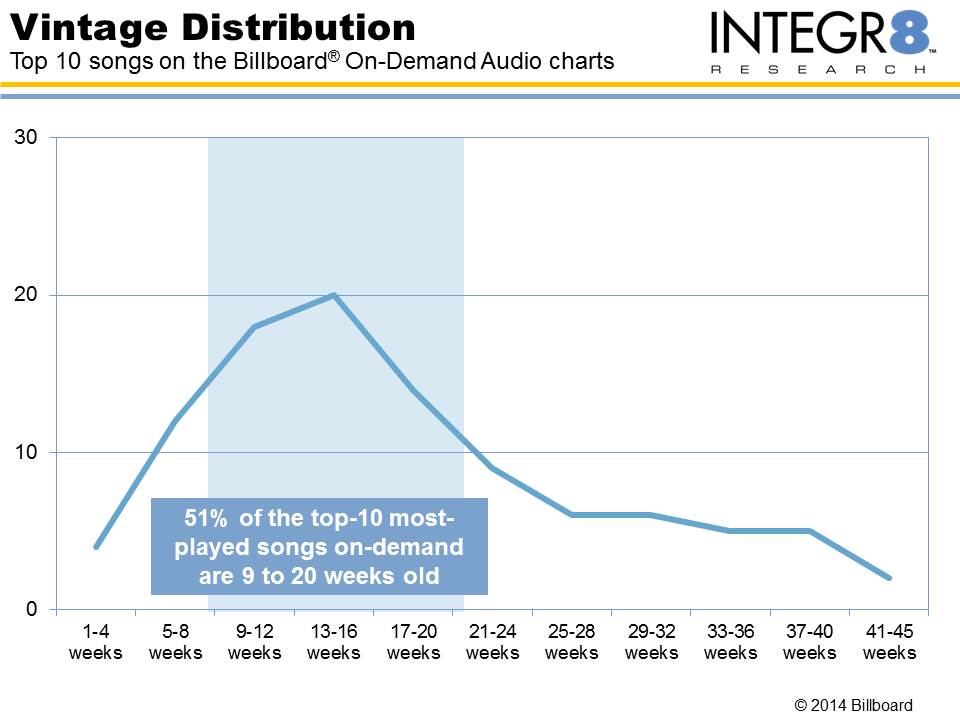
We’ve examined our own research to understand how listeners’ attitudes about songs change over time. We also examined the Nielsen Audio powered Billboard on-demand audio charts to see what songs listeners are playing most when they’re in control of their music.

Based on the big-picture trends revealed in our analysis, here are four tips to guide you on moving songs out of power rotation at the right point in their life cycles:

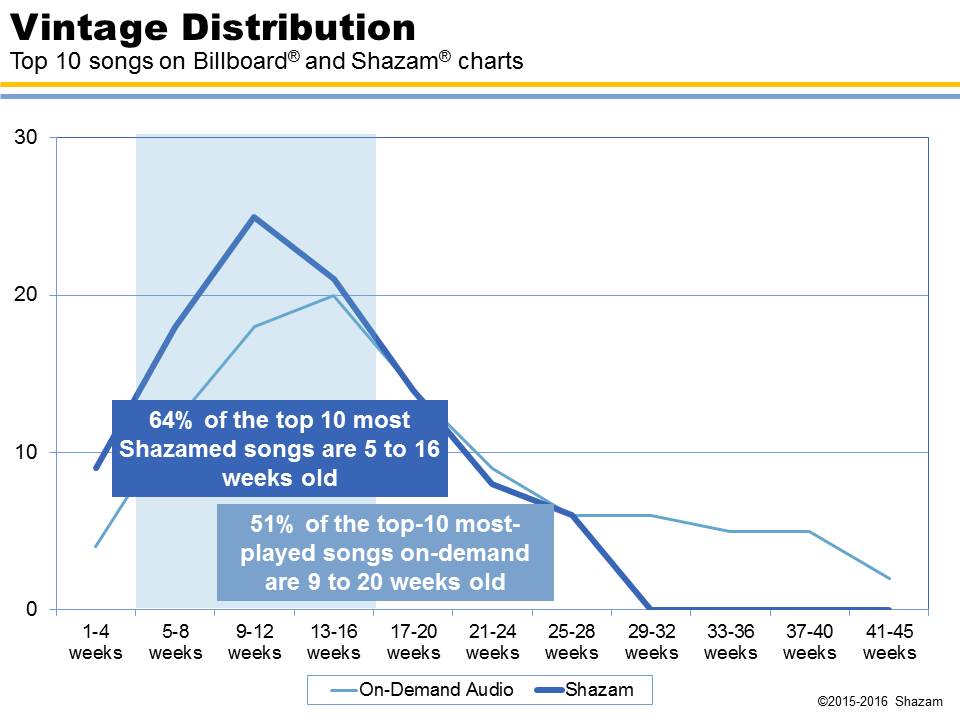
  • For stations in the CHR universe, move songs out of power rotation when your audience has heard them for 24 weeks. While every song in every market is different, a typical song in the CHR universe (including Adult CHR, Rhythmic CHR and Urban) remains a top 10 hit for 20 to 28 weeks from the time listeners started hearing it That’s the point where listeners not only lose interest in songs in callout. That’s also when songs typically fall out of the top 10 most-played songs on Spotify, YouTube, and other on-demand audio services. While you won’t nail it for every song, moving songs from current to recurrent after 24 weeks of consistent exposure in every daypart in your market is the point where you’re most likely making the right move.

Slide4

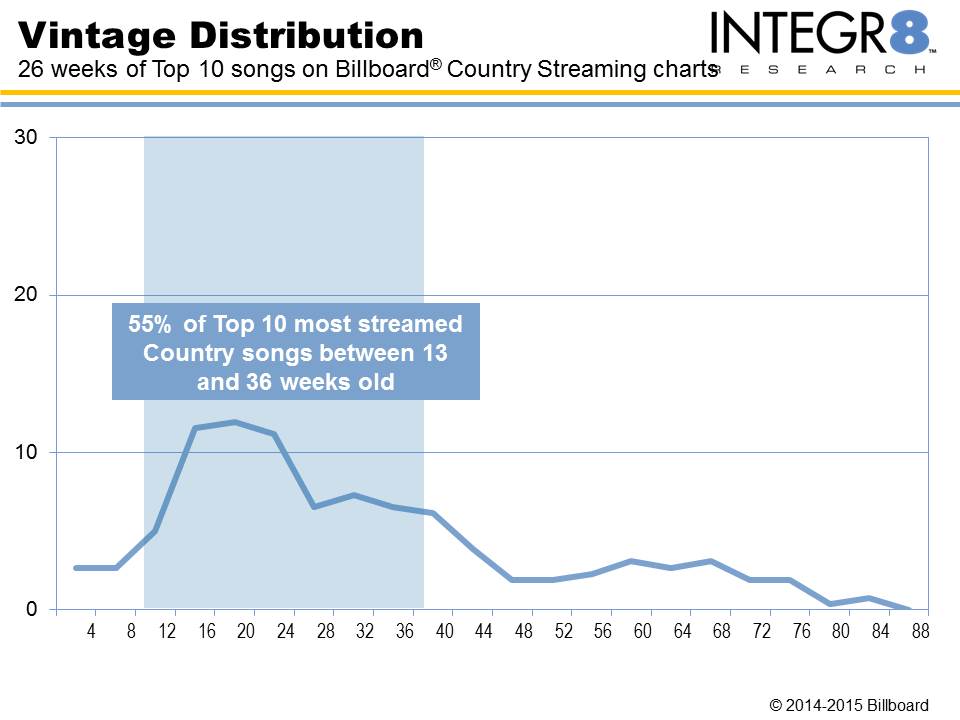
  • For Country stations, move songs out of Power rotation after 36 weeks. Country listeners typically take longer than CHR listeners to warm up to new songs and they typically want to hear the biggest hits for a longer time, too. It typically takes 28- to 44 weeks for country listeners to want to hear a big hit song less often, as indicated not only by listeners’ reactions in callout, but also their on-demand streaming behavior. For most songs, 36 weeks is your best bet for moving the song into a recurrent category. If you want to learn why Country isn’t CHR, review our blog series and webinar on the subject.

Slide5

  • Examine on-demand audio usage to confirm when their users are playing a song less often. There are limitations to what streaming data can tell you (we cover that topic here). However, streaming data can provide insight into when listeners’ appetite for a song is slowing down because it tells you how many times they actually played it. If you see a song falling on the on-demand audio charts, it may be time for your station to stop playing it as often, too. If you’re going to examine streaming data for Country, learn why recurrents are different for Country than for CHR here. For some country megahits, streaming data could lead you astray.
  • Do NOT use Shazam data to move a song to recurrent. Shazam is a great tool for spotting new songs that are catching listeners’ ears. Keep in mind the reason people Shazam songs, however—to learn the artist and title of a song. Once listeners know the name of a song and who sings it, they have no reason to Shazam it. When Shazams for a song decline, it simply indicates that listeners now know who sings it, not that they’re tired of hearing it.  You can learn how to use Shazam to help predict hits in our webinar here.

Slide6

Naturally, you should consider these four suggestions within the context of your station’s strategy and position in your market. If you’re the Hot AC that distinguishes itself from the CHR by always playing a song your adult listeners know and love, your listeners may still have a strong appetite for a song that the CHR P1 listeners already consider yesterday’s news. In your case, holding on to well-known and well-liked currents longer makes sense.

Conversely, if you’re in a CHR battle and your strategy is to be newer and more cutting edge than your competitor, you should be quicker to move older hits into recurrent categories.

Finally, a key indicator of when it is time to move a song to a lower rotation is when you have a stronger song ready to replace it.

Learn the five reasons Integr8 New Music Research can give you confidence you’re picking the right new music.


How Burn Scores Can Burn You

“Do you like ice cream?” “Like it,” you say, “I love it!”

“Are you tired of ice cream?”  “How could I ever be tired of ice cream?”

If your employer decided to host a day-long “team-building “ exercise that required eating copious quantities of ice cream all day long, you would likely be very tired of it long before lunchtime.  By next week, however, you’d probably be back on board with Ben & Jerry.

“Do you like anchovies?” “Ew, yuck!”

Are you sick of anchovies?” “Just thinking about them makes me sick!” When you think about it, though, you can’t remember if you’ve ever even had anchovies.

Herein lays the problem with traditional burn questions in new music research.  In our mind as programmers, we want to know when it’s time to move a popular song to recurrent. So, we ask the seemingly logical question, “Are you tired of hearing it?”

A real listener simply doesn’t interpret the question in a way that tells us what we want her to tell us. In her mind, if she just told you she loves a song, she can’t get enough of it. If she doesn’t care for a brand new song, however, hearing it just once is one time too many. That’s why burn scores often reflect the song’s appeal more than your audience’s exposure to that song. Even if we ask her to specifically think about how often she hears the song on the radio, typical listeners simply aren’t mentally keeping track of your rotations.

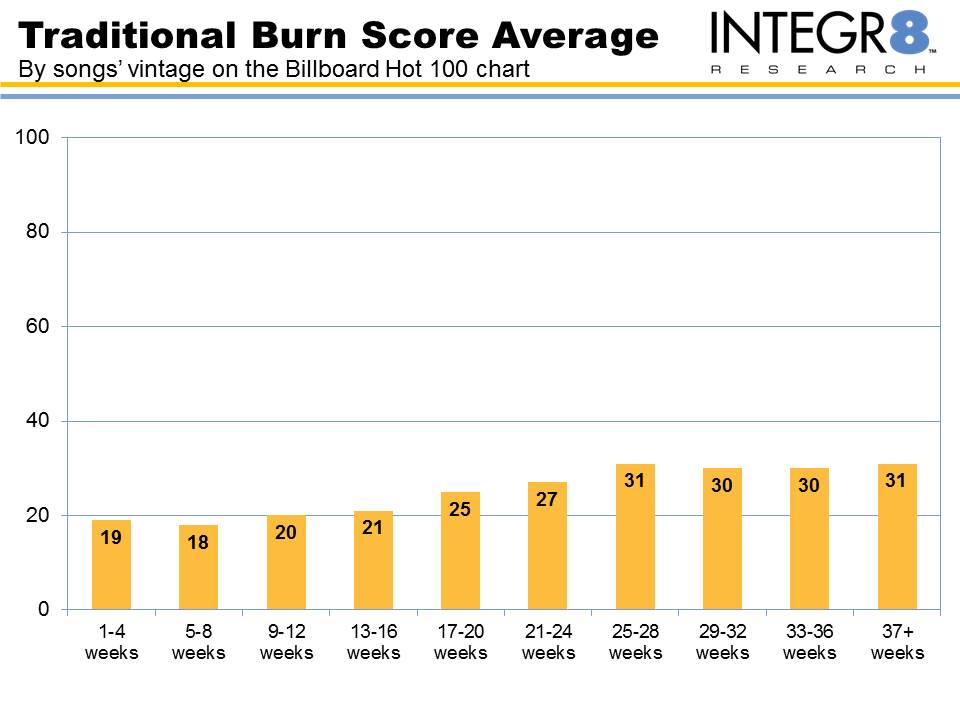
To quantity this problem, we examined the percentage of listeners who said they were very tired of hearing a song in their new music research for a variety of CHR, Hot AC and Rhythmic CHR stations.  Even for songs that were less than a month old, 19% of listeners were already tired of hearing them. Once those songs became more well-known over the next few weeks, their burn scores actually went down. Meanwhile, only 30% of listeners were very tired of hearing songs that were 25 weeks old—and that burn score typically doesn’t grow as songs get even older.

Slide1

Some veteran programmers and consultants have long understood this problem and recommend ignoring burn entirely, “Just look at how many listeners love the song and play those songs most often.” For songs that listeners only like during their run as current hits, this recommendation is fine. However, there are those few songs that listeners continue to love for years after they’re no longer new, but that doesn’t mean they want to hear those songs several times a day.

So what do you do about this conundrum?

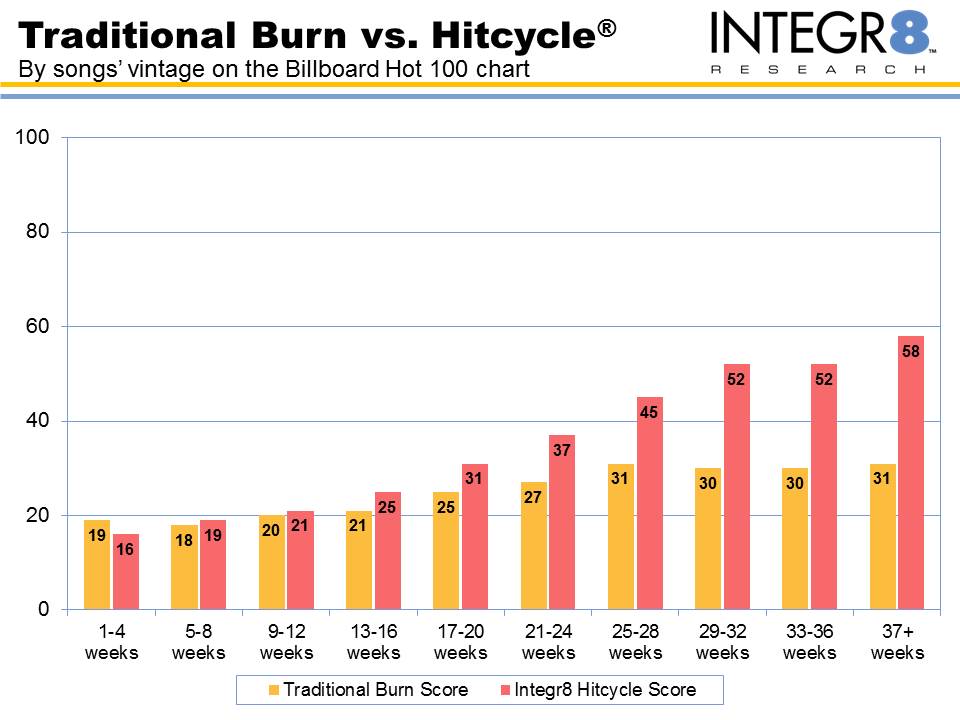
For our Integr8 New Music Research clients, we developed a new proprietary measure called Hitcycle®. Instead of simply giving you another number that confirms your listeners love or hate a song, Hitcycle tells you how listeners perceive the vintage and the momentum of each song, regardless of whether they personally like it or not so you know when it’s time to move a big hit from current to recurrent. (You can learn more about Integr8 New Music Research here.)

Slide2

What do you do if you’re simply not in a position to have custom new music research for your market, however?  We’ll give you some tools you can use in our next post.

WEBINAR: Alexa and the Vanishing AM/FM Radio

Here’s our October 26th, 2017 webinar about how new devices and new listening options impact radio’s role in new music discovery:


Check out our related blog posts:

Alexa and the Vanishing AM/FM Radio

Do People Really ask Alexa to Play Local Radio?

The Three Threats to Radio’s Role in New Music Discovery


The Three Threats to Radio’s Role in New Music Discovery

This post is the third in a series exploring how changing technology impacts radio listening, music consumption, and radio’s role at introducing listeners to new music.

Our last post showed how people who own smart speakers, such as the Amazon Echo and Google Home, are indeed more likely to stream local FM stations, but are also more likely to use on-demand streaming services such as Spotify, Amazon Music, Google Play and Apple music. Overall, they are higher consumers of music in general.

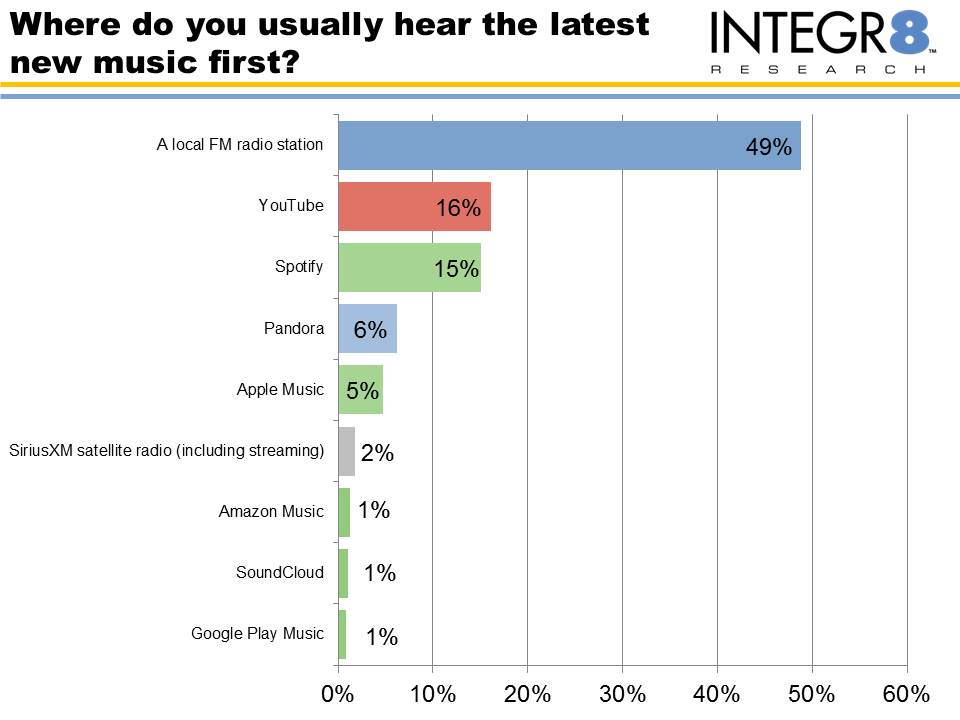
What impact do new devices such as smart speakers and new ways of listening to music like Spotify have on radio’s long-standing role of introducing the latest new music to listeners?  Do smart speaker owners now turn to Alexa to find out what’s new instead of their local CHR personality?

We talked with 3,140 15- to 39-year-olds who are partisans to a local CHR, Rhythmic CHR, Urban, Alternative, or Country station to find out.

What we uncovered is both encouraging and sobering for radio broadcasters.

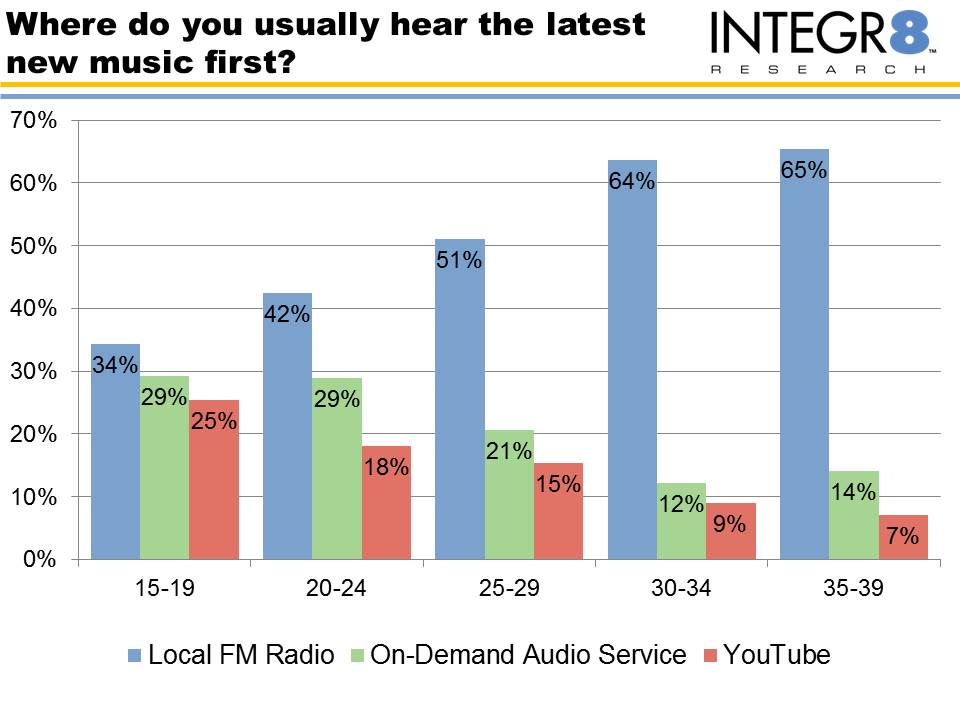
The good news is that local FM radio stations remain the leading source for 15- to 39-year-old listeners to learn about new music. Unfortunately, radio no longer wins that by a landslide as other music listening options are catching up.Slide1

There are three factors that most threaten radio’s role in new music discovery:

1) Being young: For listeners over 30, radio remains the dominant way the majority of listeners learn about new music. Among teens, however, only 34% typically hear the latest new music first from a local FM radio station, while almost as many hear new music first from an on-demand audio service or YouTube.

Slide22) Subscribing to an on-demand service: When listeners regularly use Spotify or one of its clones, the on-demand service takes on a much bigger role in new music discovery. Only 41% of weekly on-demand audio users hear new music first on FM radio, while 34% hear new music first on an on-demand audio service.
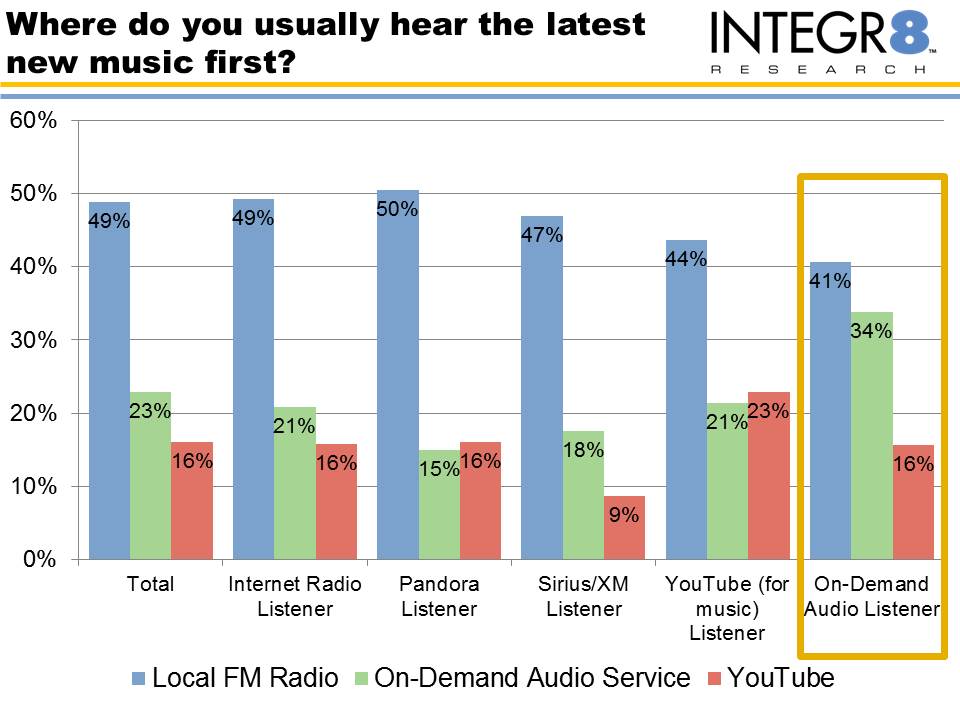
On-demand services have had a more significant negative impact on FM radio’s role in new music discovery than all the other new ways of consuming music that came before it—including Pandora, Sirius/XM, internet radio*, and even YouTube.

Slide4

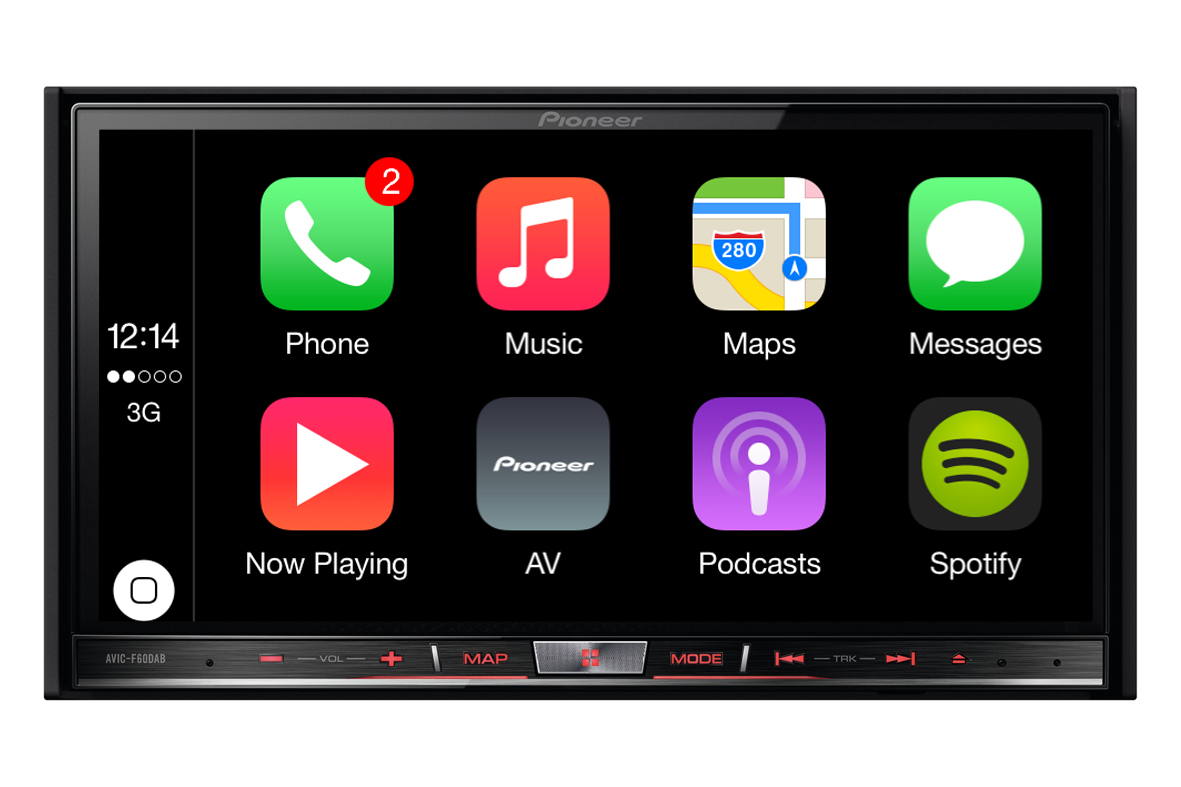
3) Owning a connected car:  When listeners acquire a car with Apple CarPlay or Android Auto, their music consumption behavior and FM radio’s role in new music discovery both change dramatically.

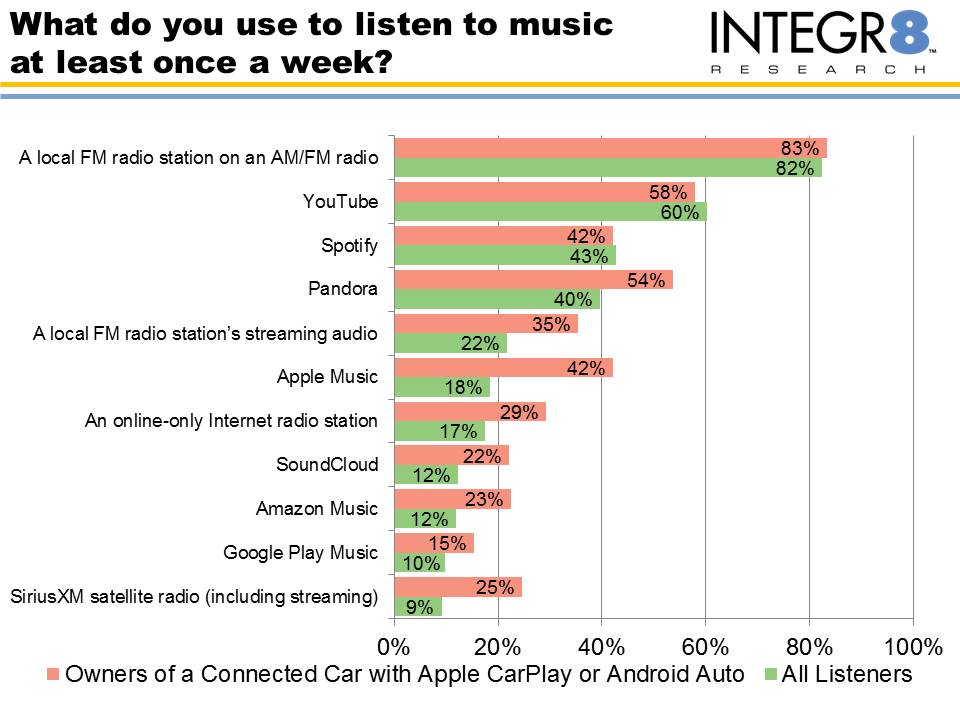
Like all listeners, connected car owners are most likely to spend time with a local FM station. However, they are also far more likely to be weekly users of a wide variety of alternatives to traditional radio, from Pandora, Sirius/XM, and online-only internet radio, to Amazon Music and Soundcloud. By far, however, the biggest increase goes to Apple Music. 42% use Apple Music weekly, compared to only 18% of all 15- to 39-year-olds.

Slide4

With connected car owners using so many alternatives to FM radio, their perception of radio’s role in new music discovery also changes significantly. Only 43% of connected car owners say they hear the latest new music first on FM radio, while 33% hear new music first on an on-demand audio service. That shift is bigger than for any other device examined.
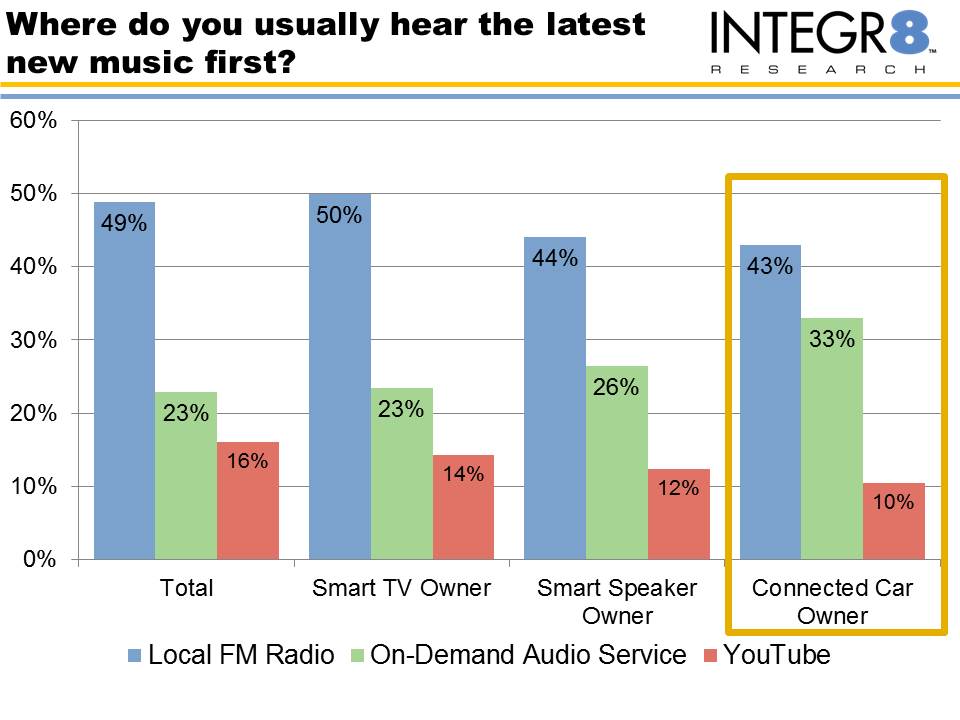
Slide3

Today, only 8% of 15- to 39-year-olds own a car with Apple CarPlay and Android Auto, but automotive experts predict that by 2020, three-fourths of all cars sold worldwide will be connected cars.

If new owners of connected cars behave similarly to current owners, radio’s role in our biggest listening environment—the automobile—could be seriously endangered.

AppleCarplay

Should you be pessimistic in light of these trends? No. Radio is the sole proprietor of a secret weapon it can deploy to remain the new music discovery king.

Join us for our webinar on Thursday, October 26th at 2:00 P.M. EDT / 11:00 A.M. PDT to learn how to launch it.  In the webinar, you’ll also learn:

  • Why the disappearing AM/FM radio at home is a serious problem—and whether Amazon Echo is the solution
  • The popular smart device radio is ignoring that can bring local station back into living rooms today.
  • The one thing radio stations can do today to grow listening on smart devices
  • PPM’s role in undermining radio’s new music discovery role.
  • The one tool radio has that none of its competitors have—and how your station can use it to remain the new music discovery king.

register-button-green-i4

REGISTER NOW

* – For our purposes, “internet radio” includes anyone who listens to a local FM radio station’s stream, an online-only station, the iHeartRadio streaming service, or the TuneIn radio app.

Do People Really Ask Alexa to Play Local Radio?

This post is the second in a series exploring how changing technology impacts radio listening, music consumption, and radio’s role at introducing listeners to new music.

Our previous post revealed that the majority of 15- to 39-year-old radio listeners* no longer own a radio outside of their cars. Furthermore, listeners that don’t own radios are also less likely to own an Amazon Echo or Google Home, which means they can’t use them to play radio programming.

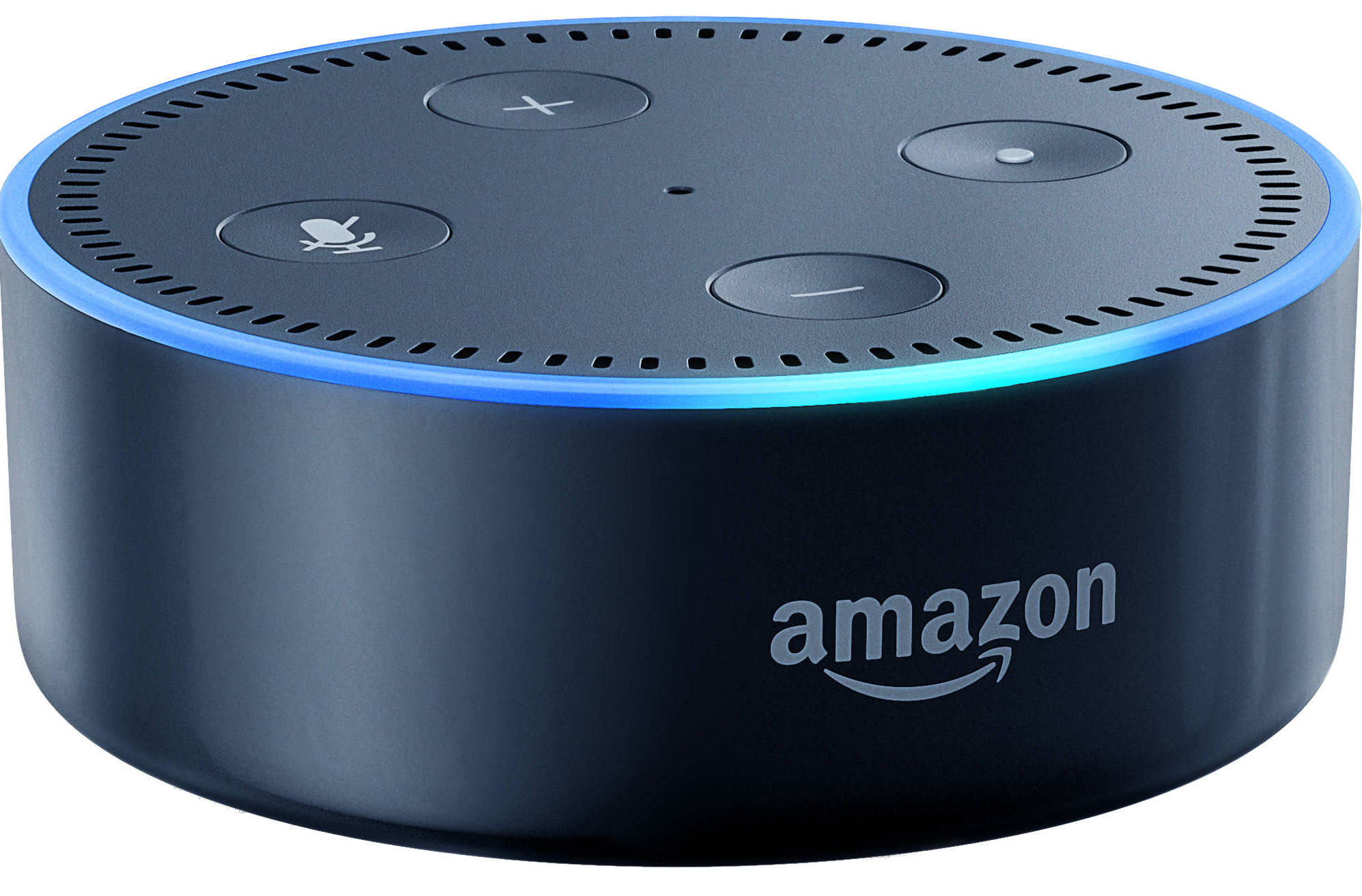
While only 14% of the 15- to 39-year-old radio listeners* we interviewed own a smart speaker today, adoption of voice-powered devices is growing rapidly. As more people welcome Alexa, Google and soon a Siri smart-speaker into their homes, are we correct to assume users will ask Alexa and her AI friends to play our radio stations?

What we found is both encouraging and challenging for radio broadcasters:Amazon Echo Dot cropped

Smart speaker owners are indeed more likely to listen to local FM stations’ streaming, but they also listen to a lot of on-demand audio. They’re heavy music consumers in general, using a deeper offering of services to play music compared to listeners who don’t own smart speakers.

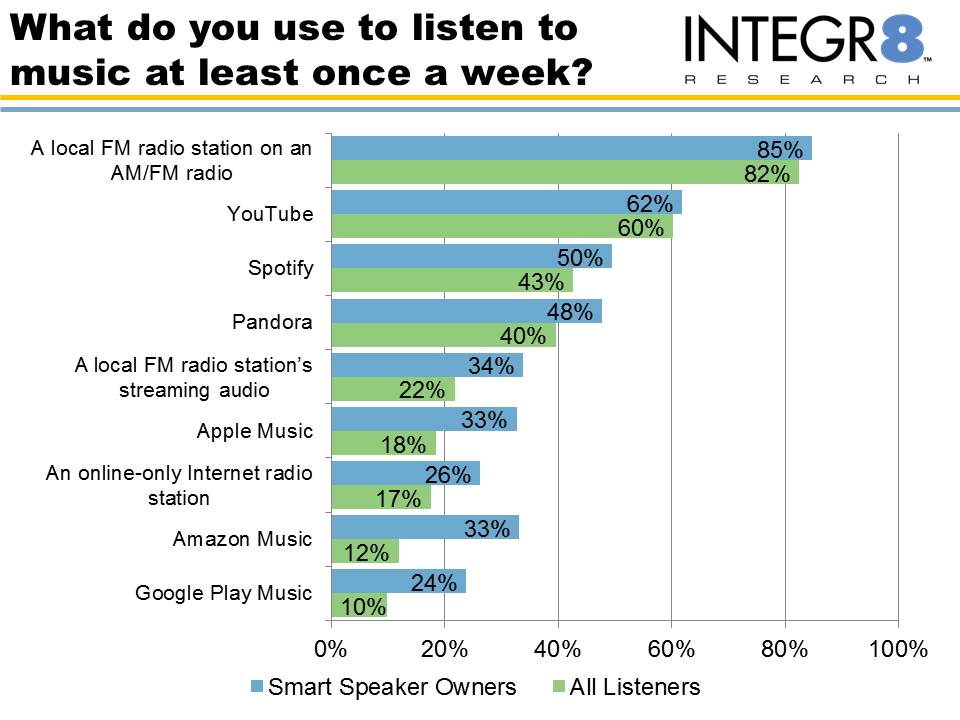
First, among the radio listeners we surveyed, smart speaker owners are also heavy radio listeners on traditional radios. 85% of smart speaker owners listen weekly to music on a traditional AM/FM radio, three percentage points higher than listeners in general.

What about the audio services that you can actually ask Alexa and Google to play, including local FM radio stations’ streams?

Smart speaker owners are indeed more likely to listen to a local FM station’s streaming audio. Among all 15- to 39-year-olds, 22% listen to a local FM station’s streaming audio, but 34% of smart speaker owners do. They’re also more likely to use other radio-styled programming options, including Pandora and online-only stations.

These findings suggest that smart speakers are indeed well suited to the “set it and forget it” convenience of traditional radio programming, as well as the ease of verbally requesting a familiar local FM radio brand.

At the same time, smart speaker owners are also more likely to listen to on-demand audio services. They use Spotify more, but are also significantly more likely to use Amazon Music, Google Play, and Apple Music.

Graph Listenerhsip among smart speaker owners

The bottom line: Local FM radio stations are wise to secure their place in the smart speaker ecosystem, but they face stiff competition for listeners’ ears on the platform.

Since Integr8 Research specializes in helping radio stations pick the right new music, we’ve wondered how radio’s role in introducing new music is changing. Do Amazon Echo owners start turning to Amazon Music instead of the local CHR station to find out what songs are new?

Generally, the answer to that question is, “no.” However, there is one device that does radically change listeners’ behavior and radio’s role in new music discovery.

We’ll tell you what that device is in our next post.

* Our sample included 3,140 15- to 39-year-olds who are partisans to a local CHR, Rhythmic CHR, Urban, Alternative, or Country station.