Tag Archives: Integr8 Research

Alexa and the Vanishing AM/FM Radio

This post is the first in a series exploring how changing technology impacts radio listening, music consumption, and radio’s role in introducing listeners to new music.

As clock radios, stereos, and Walkmans disappear, The Amazon Echo and Google Home have given new hope to programmers for bringing local radio back into listeners’ homes.  While screen-driven smartphones and tablets have proven well-suited to the endless exploration Spotify and YouTube enable, smart speakers seem perfectly suited to radio:

  • Because they’re powered by voice-commands, listeners have to know what they want to hear and how to ask for it. In theory, that gives strong local radio brands a head start. There isn’t a screen filled with endless competing choices.
  • Since they’re designed to play in the background while users do other things, smart speakers also seemingly pair perfectly with radio’s hands-off, hassle free approach to providing listeners a music soundtrack.
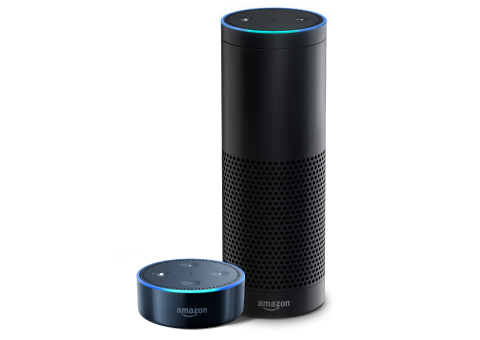
Amzzon Echo Image

Are the bets we’re placing on Alexa and her friends actually supported by what people are doing?

Furthermore, how are these new technologies and listening options changing listeners’ relationships with their local radio stations, especially in introducing listeners to new music?

To explore this topic, we conducted 3,140 online interviews with 15- to 39-year-olds who are partisans to a local CHR, Rhythmic CHR, Urban, Alternative, or Country station. It’s not a representative sample of all Americans, but it is a solid snapshot of the radio listeners most relevant to new music radio stations. We then asked them about what devices they own, what services they use to hear music, and where they hear new music first.

Before tackling the question of whether or not smart speaker owners are using them as modern-day radios, let’s quantify the problem of people no longer owning traditional radios outside of their cars.Tabletop RadioHere are three reasons why the problem is worse than you thought:
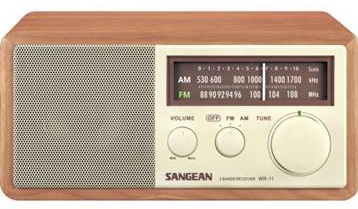
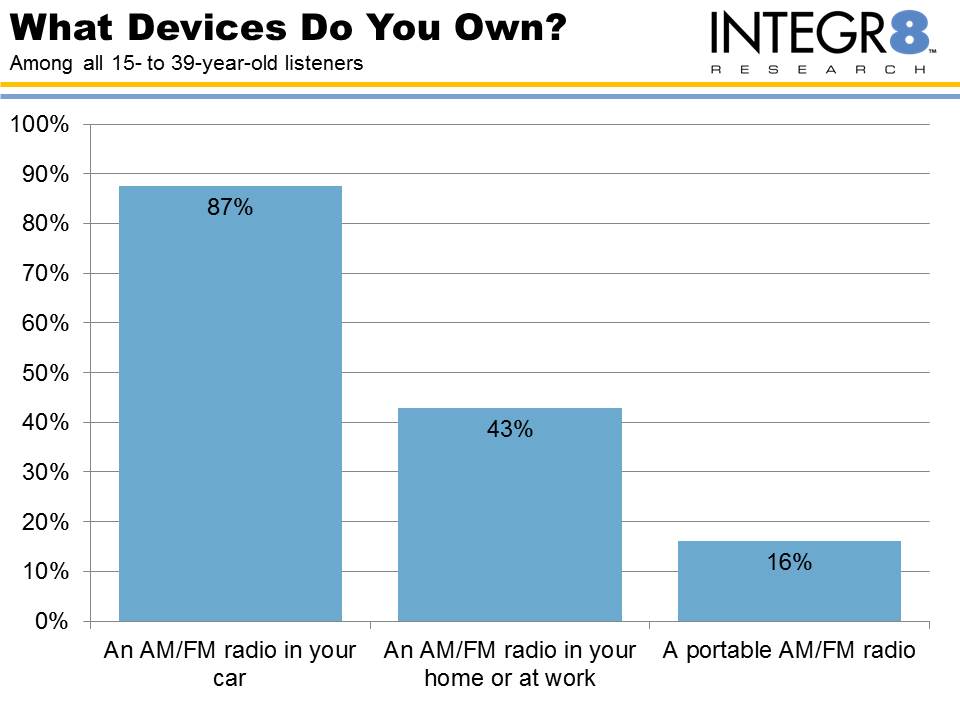
1) AM/FM radios really are vanishing. While traditional AM/FM radios remain ubiquitous in almost every vehicle, several studies have noted that traditional radios are no longer stock items in the homes of many younger consumers. How bad is it? The vast majority (87%) of the 15- to 39-year-olds we interviewed own a car with an AM/FM radio. However, only 43% have a traditional radio at home or at work and a scant 16% own a portable radio. Together, only 48% still own a radio other than in their car.
AM-FM Radio Ownership Graph

2) People who don’t own radios are less likely to stream local stations. Many broadcasters assumed that as traditional radios disappeared, listeners would simply use their smartphones as 21st century transistor radios, whether through a station’s own app or aggregators such as TuneIn and iHeartRadio.

Unfortunately, that’s not happening.

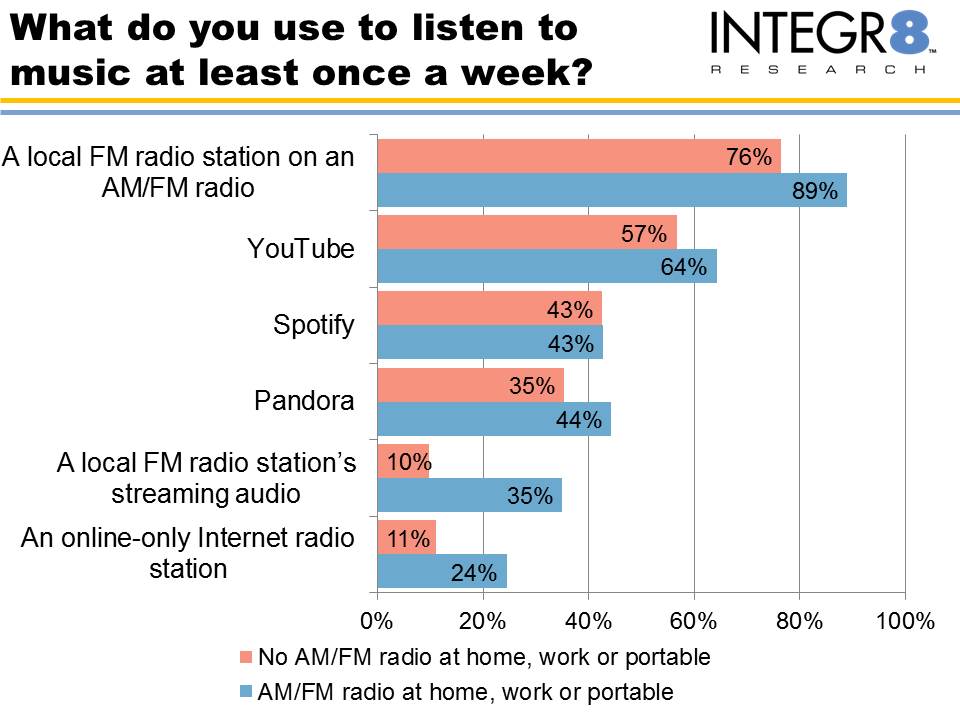
The good news is that listening to a local FM station on a traditional radio remains the most common way listeners consume music, whether they still have a radio at home or not. YouTube, Spotify, and Pandora remain competitive but subordinate choices among these listeners.

The bad news is that while 35% of those listeners who still own an AM/FM radio outside of their car also listen to a local FM radio station’s streaming audio, a scant 10% of listeners who don’t own a radio beyond their car regularly stream a local FM station. Listeners who don’t have radios outside of their cars are also less likely to stream online-only internet radio than people who still own regular radios.

When radios aren’t present in people’s homes and workplaces, people are less engaged with radio-style programming on all platforms. Spotify is the only listening option that is as popular among people who don’t own radios outside of their car as it is among people who do.
Service Listenership by Device Ownership Graph

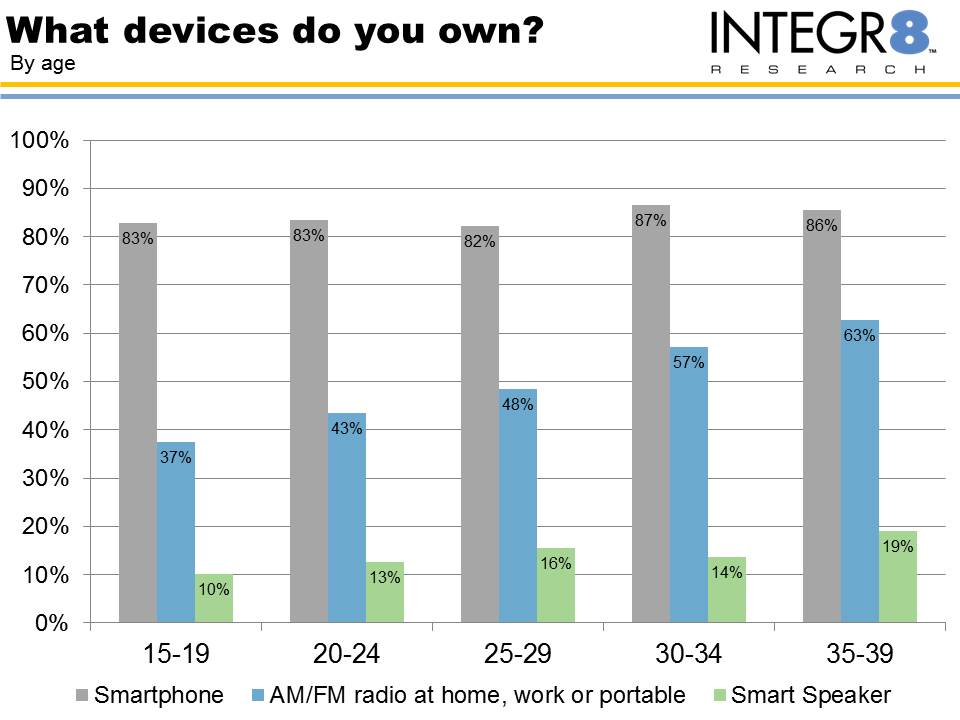
3) People who don’t own radios are also less likely to own smart speakers. That’s because the youngest listeners are least likely to own any of these devices. Among listeners in their late 30s, 63% still have a radio outside of a car, while 19% own a smart speaker. Among 15- to 19-year-old teens, however, only 37% still have a radio outside of a car. Only 10% of these same teens own a smart speaker.

There is only one smart device that listeners from their teens to their 30s are all highly likely to own—a smartphone.

People don’t get excited about smartphones now that everyone owns one. For radio programmers seeking to reach listeners on the hardware they are most likely to own, however, the smartphone remains the one device most people have and have with them most of the time.
Device Ownership by Age Graph

Okay, so in 2017, smart speakers are still mostly owned by early adapters, but that’s changing quickly. One firm is already predicting 75% of American households will have one by 2020. What can radio expect when more homes actually own smart speakers? Do people indeed ask Alexa to play their favorite local radio station?

We’ll answer that question in our next post.
Context is King

For a few hours on August 21st, 2017 was 1983 all over again, much to the horror of Soft AC radio veterans everywhere. That day’s total eclipse of the sun sent millions of Americans searching for the perfect song to accompany the astrological wonder—and they found it in Bonnie Tyler’s 1983 #1 hit Total Eclipse of the Heart.

Just how much did listening spike during the total eclipse compared to Americans’ normal appetite for the Delilah-esque power ballad?

  • 2,859% increase in Spotify plays in the U.S.
  • 4,136% increase in spins on Pandora for the week
  • 500% increase in digital download sales

It was also the #1 song on iTunes and the most-played song on YouTube during the peak of the eclipse. Creedence Clearwater Revival’s Bad Moon Rising, Len’s Steal My Sunshine and Pink Floyd’s Eclipse also topped YouTube.

It doesn’t take a once-in-a-century astrological wonder to increase interest in a song or artist:

  • When Donald Trump called Hillary Clinton a “nasty woman” during the 2016 Presidential campaign, it boosted streaming of Janet Jackson’s “Nasty” on Spotify by 250%.
  • When an artist headlines the Super Bowl halftime show, such as Lady Gaga, Beyoncé or Coldplay, they typically see their streams increase by several hundred percent.

While not every event has the power of the Super Bowl or a solar eclipse to make music relevant, these events do highlight that listeners’ interest doesn’t exist in a vacuum based solely on musical merits: Songs have meaning to listeners because of their context.

Sometimes the context is a communal event.

Sometimes, it’s highly personal, such as the song you played at your wedding.

Sometimes, it’s practical, like your workout playlist or your kids’ naptime music.

Sometimes, it’s far more mundane, such as that song that sounds great on rainy days or keeps you from flipping off other motorists in traffic jams.

Radio is uniquely capable of providing context for the songs they play every day because—unlike every new way to hear music—radio has real people playing it. For brand new songs, radio personalities can tell listeners the story that inspired the song, or some catchy line in the 2nd verse to listen for. Air talent can tell listeners how a brand new artist was discovered and help listeners relate to the artist. Giving listeners context for new music gives them a reason to care about a song they would otherwise simply find unfamiliar and unwelcomed.

For older songs, radio personalities can tie the song to current events in unexpected ways to breathe new relevance into a song, giving listeners a new reason to care about it for at least one more spin.

Context keeps listeners tuned in when they might otherwise tune out.

Neither Pandora’s algorithms nor Spotify’s playlists can match a human being’s ability to tell a story or to find a surprising contextual connection. Arguably, providing real human context to music is radio’s real weapon against online competitors, even more than being live, local, or convenient.

Ten years ago, PPM® scared many stations away from all kinds of talk content. Even then, the reaction was short-sighted: The content that drove away 5% of the audience in the moment might have been a key reason 20% of the audience tuned in. Today, as radio battles online on-demand competitors, it is essential we re-deploy our best weapon.

For music, context is king. And radio personalities are the kings and queens of context.

Three Things Callout Can’t Tell You

In our last post, we spotlighted four things you can only learn from callout. However, there are things even the most sophisticated and statistically reliable new music research can’t tell you.

1) Callout can’t predict which songs will become huge hits in the future

For most radio programmers, there’s something deeply satisfying about discovering a song before it becomes a big hit. Spotting tomorrow’s hits today has led many programmers to track Shazam. (We analyzed how effectively Shazam can help you predict hits in our recent blog series and webinar.)

While callout can definitely tell you how early adapters of a song are responding to it, callout cannot tell you how listeners will ultimately feel about a brand new release once they’ve heard it enough times to warm up to it (a topic we explored here), or the impact of cultural events on a song’s relevance.

Last September, Rae Sremmurd’s “Black Beatles” was receiving airplay on Urban radio, but wasn’t charting particularly well or garnering much interest from mainstream CHR. Then in late October, the Mannequin Challenge became an internet sensation making “Black Beatles” a viral hit along with it. The song quickly became Rae Sremmurd’s and Gucci Mane’s first #1 hit on the Billboard Hot 100 chart. “Black Beatles’” appeal also shot up quickly among mainstream CHR listeners, as our Integr8 New Music Research clients saw firsthand.

Before the Mannequin Challenge, there was no sign in callout that “Black Beatles” was a future #1 hit. Even if you had known “Black Beatles” would become a sensation, would CHR listeners have embraced the song in September before the Mannequin Challenge made it culturally relevant in October?

Playing a song listeners will love tomorrow won’t help you if listeners aren’t in love with it today.

2) Callout can grow your TSL, but it can’t attract new cume listeners by itself

By design, effective custom new music research focuses on your weekly cume audience, with an emphasis on those listeners that have the greatest impact on your ratings. A carefully crafted sample will give you guidance on songs that your heaviest P1 listeners love, but are a turn-off for your lighter listeners. The goal is to help you consistently delight your biggest fans, while also getting your lighter listeners to spend more time with your station.

If someone isn’t already listening to your station, however, it’s usually a waste of your research money to find out what they think of your music. Since they don’t listen to your station, they’re not going to hear you play that song they love anyway.

If your station’s ratings woes stem from a subpar weekly cume audience, you’ll need an external marketing plan to get new listeners to try your station before a well-researched playlist can help you keep them listening longer.

3) Callout can’t tell you if you are the right format

Sometimes, programmers try to gauge the health of their format by studying how passion levels for their test list ebb and flow over time. Attempting to use callout to gauge the market’s interest in your format is both capricious and dangerous.

First, well-designed music research programs focus on people who love—or at least like—your station’s style of music. If someone hates your format, they shouldn’t be in your callout. By design, callout can’t compare the appetite level for your music against other music styles because it only looks at people in your camp, not all the other camps.

Secondly, even if listeners do have less passion for the songs that are big hits this month than they had for the hits a few months ago, that doesn’t necessarily mean your listeners have developed higher passion levels for completely different styles of music. A Country P1 might not be as gung ho about today’s hits as they were about last year’s hits, but that that doesn’t mean they’re defecting to Rhythmic CHR.

Music research simply isn’t the right tool for making a “big picture” decision about the best format opportunity for your signal. Only strategic perceptual research can answer that question.

Unlike callout, a well-designed perceptual study examines a broad range of listeners in your market with a variety of music preferences, so you can see what styles of music are most popular in your market, as well as how deeply the stations in your market are satisfying those music appetites. Perceptual research can also tell you if misconceptions or negative feelings about your station are keeping people from listening who might actually like your playlist if they did.

If you’re unsure about your station’s format, spend money on a perceptual study before you invest in new music research. Your perceptual research is a strategic tool that will help you choose a successful direction for your station. Your new music research is a tactical tool that will help you stay successful with your strategy. (For the record, Integr8 Research doesn’t do strategic perceptual studies, so we have no financial interest in promoting them.)

Callout is like GPS—it can tell you the best way to reach your destination, but it can’t tell you where you should go.

If picking the right new music is vital to your format’s success, learn the five ways Integr8 New Music Research is different from old-fashioned callout.

Four Things Only Callout Can Tell You

In past months, we’ve explored the benefits and shortcomings of various measures radio programmers use to gauge the popularity of new music, including Shazam®, sales and streaming data. It’s only fair to apply the same scrutiny to custom new music research, the tool we provide the radio industry. (Colloquially, most folks still call it “callout,” even though we long ago stopped playing hooks for listeners over landlines).

Obviously, we can’t be totally unbiased: If we didn’t passionately believe that custom new music research is the most comprehensive tool you can use to pick the right new music, we wouldn’t make it our business. However, there are things callout can tell you that no other music appeal measure can tell you. There are also things even the best new music research can’t tell you.

The obvious advantage of custom new music research is that it focuses on people who actually live in your market and listen to your station and your relevant competitors. Market-specific sales, streaming and Shazam data can focus on your town, but can’t zone in on people who use your radio station or like your specific format.

Beyond this primary benefit, here are four things you can only learn from callout:

1) Callout can show you both the positive and negative reaction to your music.

Some tools, such as sales and streaming data, can give you a sense of how many people love a song, but can’t tell you anything about how many people hate a song. After all, if someone hates a song, it doesn’t stop anyone who loves it from playing it over and over on Spotify.

Other tools, specifically Mscore, can give you a sense of what songs might cause listeners to leave your station, but don’t tell you anything about what songs caused them to tune in to your station in the first place.

Customized new music research is the only tool that tells you both how many listeners will react positively to each song and how many listeners will react negatively.

Consider D.R.A.M.’s “Broccoli”: Streaming and sales data accurately reflected that lots of people love that song. Many stations that tested it in our Integr8 new music research also saw that a significant percentage of listeners liked it. However, we also clearly saw that a lot of mainstream CHR listeners hated that song. Knowing a song is polarizing can help you decide if the listeners you’ll delight are worth the listeners you’ll annoy. If you do decide a polarizing song is worth it, you can schedule it between more universally appealing titles.

2) Callout can show you how passionate listeners are about your music

There are songs that listeners like. There are other songs that make listeners crank up the volume when they come on your station. There are songs listeners find “meh”. There are other songs they detest so strongly that they change the station the second they hear the first note.

Customized new music research separates the songs listeners merely enjoy from the songs listeners really love, and the songs that simply don’t engage your listeners from the songs that enrage your listeners. This level of passion—either positive or negative—isn’t evident from examining sales or streaming, which merely show the raw number of times consumers purchase or play a song.

3) Callout can show you how different camps within your audience respond to each song

Streaming and Shazam data are both available for local markets. While these new measures, along with sales data and mScore, let you drill down to your specific city, they don’t let you parse a song’s popularity by age, gender, ethnicity, or radio listening preferences. Sometimes, men love a song, but women hate it. In other cases, listeners under 25 are already sick of a song that listeners over 25 are just getting to know. Other tools also can’t isolate listeners who are most important to your ratings from less influential listeners.

Understanding how different segments of your audience feel about a song can help you make the most confident decision about whether or not to play it.

4) Callout can show you where each song is in its lifecycle as a hit

It can be tricky to know when it’s time to move a song out of current rotation. It can also be tricky to know when a new song will never catch on, or if it just needs another week of exposure for listeners to fall in love with it.

At the beginning of a song’s life, callout can tell you what percentage of your audience is familiar with a song alongside how many of those listeners who know it like it, so you can decide if it needs more exposure. With other measures, you can’t be sure if listeners are rejecting a song, or if they simply don’t know it yet.

At the end of a song’s life as a current hit, new music research has traditionally relied on burn to help programmers decide when listeners are growing tired of a song and that it’s time to move a song from current to recurrent.

At Integr8, we’ve developed a more reliable way to help programmers know where each song is in its lifecycle as a hit. We call it Hitcycle®. It’s a proprietary measure that not only gives programmers confidence about when a song is ready to move to recurrents, it also helps them see when songs are still in their growth phase.

While other measures can tell you how many people are buying or streaming a song, those metrics can’t definitively tell you when awareness of a new song is still building, or when fatigue for a big hit is setting in. Only callout can tell you this dimension.

There are some things even the best new music research can’t tell you. We’ll cover the limitations of callout in our next post.

Resolving Radio’s Music Discovery Crisis

When the 2017 Infinite Dial study revealed that AM/FM radio is no longer the #1 source for keeping up to date on new music among Americans 12 and older, alarm bells sounded for radio professionals. Even more alarming, radio now trails YouTube, Spotify and Pandora among the sources that 12- to 24-year-olds use to keep up with new music.

Introducing listeners to brand new music has always presented radio programmers with a dilemma long before there was competition for it: Research finds listeners don’t fall in love with most new releases right away, while Mscore often confirms that tune-outs are fewest for established, highly familiar songs. As Garth Brooks noted at CRS 2017, “how many songs have you hated the first time you heard it, then played it at your wedding?”

On the other hand, listeners routinely tell focus groups that they expect their favorite radio station to introduce them to the coolest new songs. Perceptual research tells us stations that stick too closely to tried and true recurrents can ruin their credibility as sources of new music, while also developing harmful reputations for playing stale music.

Playing brand new songs can cause listeners to tune out now, but not playing new releases can cause them to not tune in tomorrow.

Many stations straddle this dilemma by drawing as little attention to new songs as possible. They schedule new releases immediately after stop sets. They bury them in music sweeps with no commentary from air talent. They hope listeners won’t notice them. The Infinite Dial results suggest we’re getting our wish: Listeners don’t notice the new songs radio helps them discover.

It wasn’t always this way…

Lessons from Radio’s Past

There was a time when radio made a big deal about new releases:

Boss Hitbounds: In the 60s, legendary 93/KHJ Los Angeles programmer Bill Drake advertised brand new songs on the air with a special “Boss Hitbound” jingle. He also played hitbounds as frequently as the biggest currents. This approach not only helped listeners become familiar with new releases quickly, it also gave KHJ a hip image that helped the station dominate ratings for years.

Smash or Trash: In the 80s, many nighttime shows regularly played a brand new song and asked listeners to call in saying if they loved it or hated it. Not only would listeners engage in rating the song, they’d eagerly await fellow listeners’ verdict on whether the song was “a smash”—or “trash”. The feature pioneered gamification for new music discovery long before people called it gamification.

Hottest Record In The World Right Now: From 2003-2015, BBC Radio 1 legend Zane Lowe gained a reputation as a tastemaker, highlighted by his nightly song debut feature, “The Hottest Record In The World Right Now.” His reputation for breaking new music drove Apple to lure Lowe to lead Beats1.

While these relics from radio’s past might not be effective today, they spotlight several principles of how radio could effectively showcase new music today:

  • Listeners get excited about new music when you’re excited about new music. A key advantage radio has over streaming services is that we have music gurus who can tell listeners why they should care about a new song. Radio personalities provide the context that gives listeners a reason to pay attention to a new song that would otherwise just be some strange song they don’t know or like. Whether it’s a regular feature with your music director, or simply structuring your clocks so air talent can intro brand new songs, listeners are most likely to care about a new song when we tell them why they should care about it. This concept isn’t new, but it’s one radio seems to have forgotten in our PPM® driven quest to eliminate clutter.
  • Involve and engage listeners in discovering new music. Yesterday’s “smash or trash” phone-in bit could easily be transformed into an interactive texting or social media feature that would both generate listener reaction and increase engagement with the station. Gamifying the feature gives listeners a reason to care about whether the new song is accepted or rejected, even if they don’t like the song. Finally, such a feature gives stations a strong image for playing new music first, even if the station doesn’t actually debut that many new songs. To succeed today, however, the feature must air in a daypart when lots of listeners will actually hear it, such as afternoons.
  • Play new songs frequently enough that listeners get to know them. Playing a new song in low rotation—or relegating it to evenings and overnights—ensures a new song won’t catch on with your audience. Unless other stations in town or other music sources make that song a hit for you, your audience will never get to know it well enough to ultimately decide if they like it. You’re better off betting big on a few new songs and giving them enough exposure to become familiar hits fast than you are hedging your bets and playing a lot of new songs infrequently.

Should your station care about music discovery?

For some formats in certain competitive situations, new music discovery simply isn’t strategically relevant. If you’re an adult-oriented Hot AC, letting the crosstown CHR sort out which songs are real hits means you can always be playing a song your audience knows and loves when they tune in. After all, those songs teens are already sick of hearing are often still a new songs to adults. While radio as a medium should worry about losing its reputation for new music discovery, that doesn’t always mean your specific station should be.

Even though people now have endless ways to listen to music, radio remains uniquely qualified to introduce listeners to the new songs most worth discovering. What are some ways you think radio could regain our role in music discovery? Share your thoughts and ideas below.  

Why Music Listening Is Different From Music Sales

Our recent blog series explained why radio should still look at sales data alongside streaming data to help pick the right new music. We noted that buying music isn’t the same as listening to music, a difference we examined in detail in 2015 when Integr8 was a part of Coleman Insights. Here’s a recap of that analysis: 

Music buying and music listening patterns are fundamentally different. When you understand why they’re different, you’ll also understand how making new music decisions based on sales data could lead your station astray.

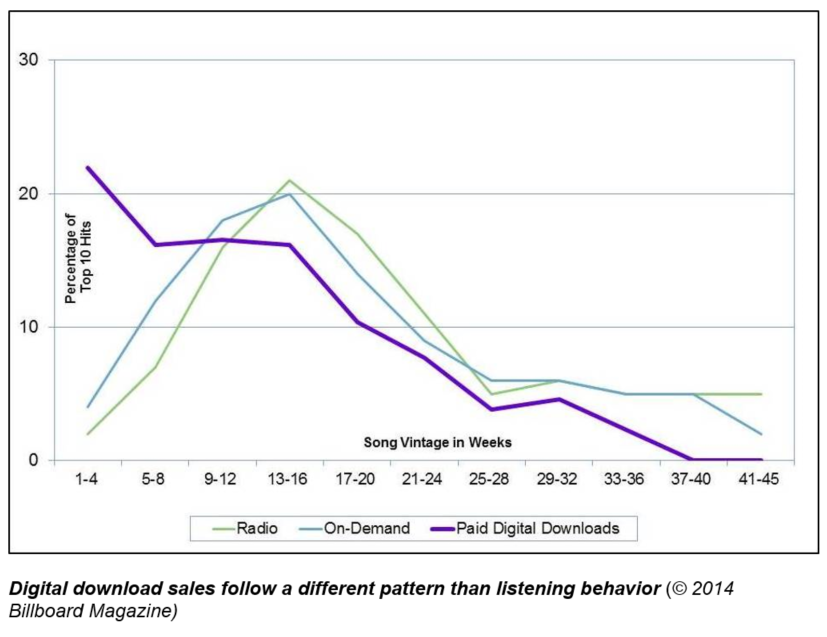
We analyzed 26 consecutive weeks of the Billboard® Top 10 Digital Songs chart, which ranks the biggest paid digital download singles in online stores such as iTunes, as well as Billboard’s Top 10 songs for Radio exposure and On-Demand streaming during the same period, to understand how listeners consume new music from each source.

1st integr8 blog graph 2.28.17

While the majority of songs listeners hear most on the radio and play most on on-demand streaming services are between 9 and 20 weeks old, the majority of songs listeners buy most are 12 weeks old or less.

Why are buying and listening patterns so different?

Just because people stop buying a song doesn’t mean people stop playing it. Think about your own music collection. You probably own some songs that you forgot about almost as soon as you got them, as well as songs you’ve listened to regularly for years. When a song’s sales decline, it means fewer new people want to buy it—it doesn’t mean the people who already bought it stopped playing it.

If you exposed new music on your radio station solely based on how well a song was selling, you’d play songs most frequently when a lot of your listeners still don’t know the song. Even those listeners who have heard it once or twice haven’t heard it enough times to warm up to it yet. That’s why songs that have already become bestsellers often score poorly during their first week in your callout research.

If you stopped playing a song as soon as its sales started slipping, you’d likely be dropping the song at the moment your audience was most interested in hearing it. After all, the people who already bought the song may well still be playing it a lot, too.

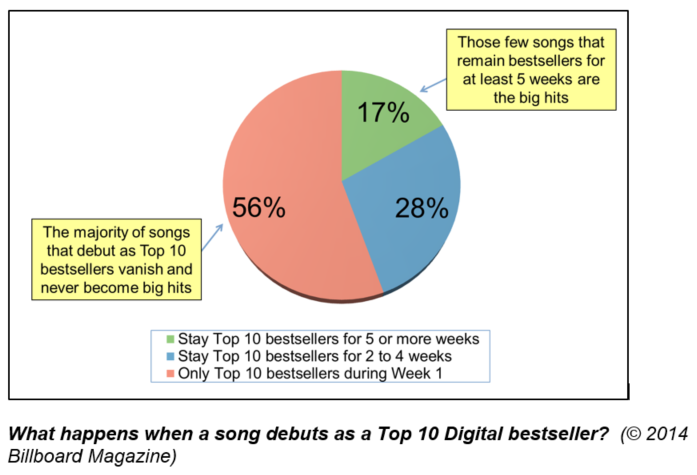
Furthermore, unlike radio exposure and on-demand streaming behavior, song sales in the CHR universe do not build over time. In fact, over half of all songs that will ever become Top 10 bestselling digital downloads debut as Top 10 bestsellers in their first week on the charts. (Country follows a different pattern, as we explored in Why Country Isn’t CHR.)

Since the best-selling songs are significantly newer than the biggest songs on the radio and the songs listeners play most on on-demand services, you might assume you could use today’s song sales to predict tomorrow’s hits on your radio station. However, our analysis also shows only one in six songs that debut as Top 10 bestsellers go on to become big hits on radio or on-demand.

What separates the hits from the stiffs?  The hits don’t merely debut as top 10 bestsellers; the hits stay top 10 bestsellers for at least five weeks.

2nd integr8 blog graph 2.28.17

Ariana Grande & Big Sean’s “Best Mistake”, Shawn Mendes’ “Life of the Party” and four different tracks from 5 Seconds of Summer all debuted as Top 10 digital bestsellers, but these songs were among the 56% that were only Top 10 bestsellers during their debut week. Die-hard fans may have eagerly purchased these artists’ latest releases, but few others wanted to buy or hear them thereafter.

During the same time, Ariana Grande & Iggy Azalea’s “Problem”, Ariana Grande & Zedd’s “Break Free” and Maroon 5’s “Maps” were among the 17% of songs that debuted as Top 10 bestsellers and remained Top 10 bestsellers for at least five weeks. These songs were also among 2014’s biggest Top 10 hits on radio and on-demand.

In fact, the biggest hits of 2014, including MAGIC!’s “Rude”, Iggy Azalea’s “Fancy” and John Legend’s “All Of Me” are notable not because of how strong they debuted, but how well they kept selling week after week. While most songs are no longer Top 10 bestsellers after 12 weeks, these #1 smashes are among those rare songs that remained Top 10 bestsellers for 17 to 36 weeks.

Undoubtedly, many of the people who bought these songs on iTunes week after week did so because they loved hearing them on your radio station.

Bottom line:  Don’t look at what songs are selling well this week. Look for songs that keep selling week after week.

Integr8 New Music Research helps you pick the right new music for the listeners that matter most to your ratings.

Do Your Format’s Fans Stream or Buy Their Music?

We’ve recently been examining whether you should rely more heavily on streaming usage or sales data when picking new music for your station. Our first post suggested that both sales and streaming data remain relevant to radio, at least for now. Our second post showed how streaming users are typically younger than music purchasers.

In this post, we’ll examine which styles of songs are most popular among streaming users, music purchasers, and radio listeners. For this analysis, we examined Billboard’s 2016 year end charts to find out:

  • Which songs listeners played most on the Streaming Songs chart on services such as Spotify and YouTube
  • Which songs listeners paid to download most often on the Digital Songs chart on services such as iTunes
  • Which songs listeners heard most on the Radio Songs chart

We then had our team of music experts code each song’s music style. Here’s what our analyses revealed:

blog graph 2 for 2.22.17

Hip Hop is huge on streaming

Listeners stream Hip Hop significantly more on streaming services than they buy it or hear it on the radio. Thirty-seven percent (37%) of the most streamed songs were Hip Hop, compared to 17% of the biggest paid digital download songs and 16% of the songs played most on radio.

The most striking difference comes from the appeal of Pure Hip Hop compared to Pop Hip Hop. Both genres are more popular among streamers than among buyers or on radio. However, Pure Hip Hop (such as Kevin Gates’ “2 Phones”, D.R.A.M.’s “Broccoli” and Yo Gotti’s “Down in the DM”) comprises 21% of the past year’s most streamed songs, but only 8% of the biggest paid digital downloads and 4% of the most played songs on the radio.

In contrast, Pop Hip Hop by artists such as Drake, Rihanna and Flo Rida, were almost as well represented in radio exposure as they were in streaming popularity.

For Country fans, buying is still king

Unlike Hip Hop, Country titles are completely absent from the 75 most streamed songs of 2016. However, Country fans are still paying to own their favorite songs: Nine-percent (9%) of the biggest songs in digital singles sales were Country titles. Country music is biggest of all, however, on radio. Thirteen percent (13%) of the most played songs on the radio in 2016 were Country songs, bigger than both sales and streaming.

Adult Pop songs are better represented in sales

While mainstream pop’s biggest hits were big on streaming, sales and radio, pop songs with greater adult appeal were largely absent from streaming’s biggest songs. James Bay’s “Let It Go,” Adele’s “When We Were Young” and Meghan Trainer’s “Like I’m Gonna Lose You” were all big hits on radio and sold well, but were absent from the 75 most streamed songs last year. Ruth B.’s surprise hit “Lost Boy” was the 24th most purchased song in 2016, but was absent from both radio and streaming’s biggest hits of the past year.

Other differences include:

  • Club Dance is a bit bigger on streaming than in digital sales or radio airplay
  • Alternative isn’t as big on streaming as it is in sales and radio exposure
  • Rhythmic Pop/R&B is smaller in sales than it is in radio airplay and streaming plays

These differences make sense, given that streaming usage is strongest among 13- to 24-year-olds, while digital download purchasers are more likely to be between 25 and 54 years of age.

Before you align your playlist with streaming or song sales data, keep in mind these three important differences in how listeners consume music on each medium:

  • Streaming statistics count how many times people play a song, not how many different people played it. If a rabid teenage fan plays a song 10 times a day on Spotify, that counts the same as 10 different people playing that same song once a day. Streaming statistics don’t tell you how many fans a song has; they tell you how many times users played a song. For radio, it’s not merely enough to play songs with a few huge fans. Radio needs songs that a large percentage of its audience loves.
  • Song sales tell you how many new people bought a song, not if people who already bought it are still listening to it. Unlike streaming, sales statistics can give you a sense of how many different people like a song since you only need to buy a song once. However, song sales don’t tell you how long each song remains popular after listeners already bought it. When song sales decline, it doesn’t mean people no longer like the song. It simply means fewer people who didn’t already own it decided they wanted to buy it.
  • Haters don’t hurt streaming or sales figures—but they do hurt radio. No matter how many people hate a song, they have no impact on streaming or sales figures as long as enough people love the song enough to stream it or download it. However, when your radio station plays a song some listeners hate, there’s a good chance they’ll change stations. Before adding a song that’s performing well on streaming or in sales, assess the potential negative reaction your audience might have to that song.

For additional information on using different resources to pick the right now music, check out our previous blogs on How Streaming Data Can Help Radio Pick New Music, The Limitations of Using Streaming Data to Pick New Music, and How Shazam Can Help You Pick Hits, as well as how our Integr8 New Music Research can help you pick the right new music.

Are Sales or Streaming Data More Relevant to Your Station’s Music?

In our last post, we concluded that even though on-demand streaming services such as Spotify are rapidly replacing paid digital downloads at online stores such as iTunes, song sales data is still a relevant metric for radio programmers to examine when considering new music for airplay.

While there’s merit in examining both streaming and sales data to gauge which new songs are popular, should you give more weight to one or the other for your specific station? That depends, in part, on how well your station’s format aligns with who uses Spotify and YouTube to consume new music versus who buys songs on iTunes.

We asked Russ Crupnick at MusicWatch about the differences in who uses on-demand streaming compared to who still pays to download and own their music. Here’s what we learned from their AudiocensusSM study from this past fall:

Capture integr8 blog chart 2017 02

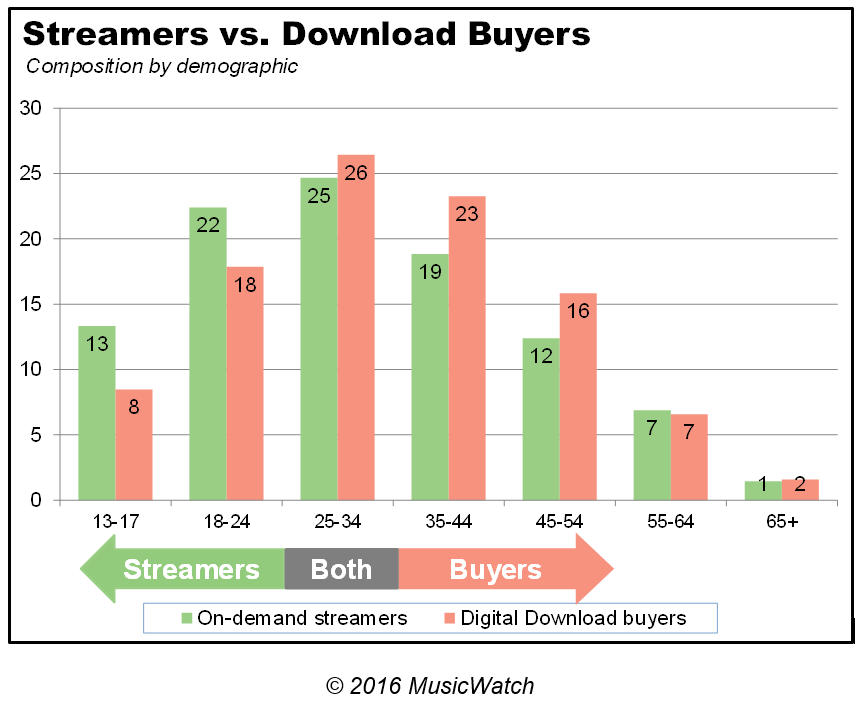
Streaming data is more heavily representative of teens and adults under 35. Of the people who routinely use on-demand streaming services, 60% are between 13 and 34 years of age and 35% are between 13 and 24 years of age. In comparison, only 26% of regular download purchasers are 13 to 24 years of age. That means on-demand streaming charts tend to favor the tastes of listeners under age 35.

Digital download sales data is more heavily representative of adults 25 and older. Fewer teens and young adults are purchasing digital music, and about half of the people who do still routinely buy digital music are between 25 and 44 years of age. That means that digital song sales charts tend favor the tastes of “money-demo” adults.

Among adults in their late 20s and early 30s, streaming and sales are equally representative. About a quarter of people who regularly use on-demand streaming and who regularly pay to download music are between the ages of 25 and 34.

Men and non-Caucasians are also both slightly more represented among streamers than downloaders. However, these differences are nominal compared to the differences between the age groups.

These demographic variances would suggest:

  • If your ratings are most heavily dependent on the tastes of 13- to 24-year-olds, pay closer attention to streaming than sales.
  • If your ratings are most heavily dependent on the 25- to 54-year-old demo, pay closer attention to sales data.
  • If your ratings depend on 25- to 34-year-olds, pay close attention to both.

However, demographic differences are only a small part of the picture when it comes to which music consumers are using on-demand streaming and which consumers are still buying their favorite music.

In our next post, we’ll break out exactly which styles of music are most popular among on-demand streaming users compared to digital download purchasers, and how both streaming and song sales compare to the music that radio plays most.

Are you sure you’re picking the right new music?  Integr8 New Music Research can help. 

Should Radio Still Care About Song Sales?

Last November, The Chainsmokers’ “Closer,” topped Billboard’s Digital Song Sales chart for the 12th week in a row. While “Closer” got a lot of press for how long it stayed #1, less noted was how few people actually bought it. A scant 84,000 paid to download “Closer” through iTunes and similar digital media providers during that week. It was the fourth time in 2016 when fewer than 100,000 people paid to download the #1 bestselling song—something that never happened during the period from 2007 to 2015.

You have to go back to Hinder’s “Lips of an Angel” in 2006—a year before Apple gave us the iPhone—to find fewer people spending 99-cents to download the #1 bestselling song.

In contrast, U.S. Spotify users alone played “Closer” over 8.2 million times that same week—that’s 98 plays for every 1 purchased download.

Back before callout existed, sales of 45’s at local record stores was the primary way in which radio measured what songs listeners most wanted to hear. Today, even with advanced new music research, Mscore, streaming data, and Shazam, radio still closely monitors which songs people buy. However according to a study done by MusicWatch, when compared with last year, Americans who purchased digital downloads now spend 14% less time listening to the library that they already own. The same study indicates that 9% of Americans stopped listening to their digital purchase library altogether. Meanwhile, Nielsen reports audio streaming grew 83% from 2014 to 2015, while video streams of songs soared by 102%.

As iTunes sales fade and Spotify and YouTube plays soar, should radio still use song sales data to help pick the right new music?

We believe the short answer is yes—for now at least.

It’s true that Spotify’s U.S. paid subscribers alone doubled from 20 million in June 2015 to 40 million in September 2016. Ignoring the tastes of those 40 million Americans using Spotify and other on-demand music services would be a mistake.

On the other hand, 77 million Americans still regularly listen to the songs they paid to download and 30 million Americans still routinely buy songs on iTunes and similar services, according to MusicWatch. Furthermore, only about 1 in 3 of those music consumers who routinely buy digital music also pay for a subscription to Spotify, Apple Music, or another on-demand streaming service.

In other words, there’s a Spotify camp and an iTunes camp and not a lot of overlap between those two groups. Ignoring either on-demand streaming users or digital download purchasers ignores a large swath of music consumers.

While 40 million Spotify users and 30 million download purchasers are significant groups of music fans, they both pale in comparison to the 265 million Americans who listen to radio each week, according to Nielsen. Focusing on the tastes of radio listeners, particularly your most relevant listeners, remains the most reliable metric for gauging new music. Despite the song’s anemic sales last November, our Integr8 New Music Research CHR clients knew that The Chainsmokers’ “Closer” was still firmly a #1 hit with their audiences.

In our next post, we’ll take a closer look at who is using Spotify and who still buys songs on iTunes, what it means for your station, and whether or not you should pay closer attention to streaming or songs.

Why Song Familiarity is Like a Leaky Bucket

The five factors that predict how quickly your listeners get to know new music.

Have you ever played a song for weeks, only to learn that many of your listeners still don’t know it? Meanwhile, other songs became familiar seemingly overnight.

Back in a simpler time, programmers often heard that a song should be familiar once they played it 300 times. In an era of infinite media choices, declining TSL for terrestrial radio and hit songs spanning multiple formats, simply examining how many times your station has played a song is too simplistic.

We examined how quickly various songs became familiar in our Integr8 New Music Research compared to market exposure of those songs. Our analysis revealed five different factors that determine how quickly listeners become familiar with new music.

The best way to contemplate these five factors is to think of familiarity as a leaky bucket:

1) Have you been playing the song frequently each week? Think of familiarity as a bucket with a slow leak in the bottom of the bucket. If you add water often, the bucket will eventually be full. Wait too long between adding more water, however, and you’ll always start with an empty bucket. Making listeners familiar with a song is like filling a leaky bucket. Thirty (30) spins a week for ten weeks and 100 spins a week for three weeks will both get you 300 spins. However, if listeners go too long between exposures, by the time your listener hears the song a second time, they’ve already forgotten hearing it the first time

2) Have you been playing the song long enough? When you’ve been playing a song every few hours for several weeks, it’s hard to imagine how listeners still don’t know that song. You’re already sick of hearing it. As we examined in our blog series comparing spins to exposures, even your P1 listeners may have only heard the song a few times. It’s not how often you play the song that matters; it’s how often your listeners hear the song. In your mind, you’ve poured gallons into the familiarity bucket, but for your listeners, it’s only been a couple of cups.

3) Are you playing the song in all dayparts? In the past, evenings were a great daypart to test out new songs: Teens tuned in while they did their homework and were quick to hit up your request line with their reactions to your adds. While in-car usage remains as strong as ever, at home listenership has declined as traditional radios vanish from young listeners’ bedrooms. Relegating exposure of a new song to evenings and overnights is like missing the bucket when you pour—most of the water spills outside the bucket and only a few drops go in. If you want listeners exposed to new songs, you have to play songs in dayparts when a significant portion of your audience tunes in. For stations that want to “play it safe” during at-work listening hours by dayparting unproven songs, afternoons is the new evenings for exposing brand new releases.

4) How much exposure does the song get elsewhere? For most formats, when several stations in your market are playing a song, listeners will hear it more often than they’ll hear a song only your station is playing. A Rhythmic CHR or an Alternative station might find that the songs it shares with CHR become familiar faster than the titles that are unique to their station, even if they play those format-exclusive titles more frequently. If a song is in a TV commercial, featured in special events such as an award show, or otherwise receiving exposure in mass appeal arenas, it’s going to catch on much faster than a song that only gets exposed to your market on one radio station. A listener’s familiarity bucket fills up much faster when many sources are filling it up. If your station is the only source pouring a new song into the bucket, it’s going to take longer for it to reach the rim of universal familiarity.

5) Are you still playing the song a lot? Some songs become such big hits that you’ll never forget them, even when you desperately wish you could. (Hey, Macarena?) For these huge hits, it’s as if the bucket freezes over and listener familiarity with those songs never leaks away. The fact is, most new songs never achieve that level of appeal. The more time passes without exposure to them, the less likely listeners will remember them. The water (familiarity) will eventually leak out of the bucket if you don’t keep topping it off by playing the song.

What’s the practical implication of these findings?

You’re better off betting big on a few new songs and giving them enough exposure to become familiar hits fast than you are hedging your bets and playing a lot of new songs infrequently.

Playing a new song in low rotation—or relegating it to evenings and overnights—ensures a new song won’t catch on with your audience. While the exact number of spins per week varies, depending on each station’s listenership and market dynamics, there is a minimum threshold where playing an unfamiliar song is simply a waste of a spin. Unless other stations in town or other music sources make that song a hit for you, your audience will never get to know it well enough to ultimately decide if they like it.

Legendary 1960’s Boss Radio programmer Bill Drake played 30 currents in equal rotation, meaning the #1 song played just as often (every three hours) as brand new “hitbound” songs. While rudimentary today, this system gave the same exposure to brand new releases that it gave to the biggest current hits, which helped new songs become familiar fast. It also helped Drake’s flagship station, 93/KHJ, gain a strong reputation for playing hip, cutting edge new music.

BOTTOM LINE:  If you believe in a new song, bet big on it. Give it enough spins to win. Then, if it’s destined to fail with your audience, it will fail fast and you can move on quickly.