Tag Archives: Integr8 Research

How Streaming Data Can Help Radio Pick New Music

While many radio programmers use sales, Shazam and Mscore alongside their new music research to gauge which songs are most popular with their audience, examining what songs listeners are streaming isn’t as commonplace—and we think it should be.

The fact is, music sales are declining, both for physical CDs and for digital downloads on services such as iTunes, while streaming continues to grow.  As more listeners choose to rent music with a Spotify premium subscription instead of buying songs on iTunes, streaming data is becoming an increasingly bigger piece of the puzzle for determining which songs are most popular.

Here are three reasons why streaming data should be a metric you examine to help pick new music for your radio station:

1) Streaming data shows you what songs people play when they’re in control of their music.  Unlike streaming, most of the secondary tools programmers typically examine to determine which songs are popular don’t actually measure people listening to music.

  • Sales data tells you how many people are buying a song they don’t yet own, but not how often people who already bought the song are listening to it. Just because people stop buying a song doesn’t mean people stop playing it. In fact, sales of a song usually taper off around the time radio listeners are becoming most interested in a song
  • Shazam tells you when people want to know the artist or title of a song, but not what songs they actually want to hear right now. (Learn more in our recent blog How Shazam Can Help You Predict Hits)
  • Mscore can give insight into which songs cause listener tune-out, but provides no insight into which songs listeners tuned in to hear in the first place.

In comparison, Streaming data shows which songs people are actually choosing to listen to right now. While it can’t give you the complete picture of your core listeners’ reaction to your music the way custom new music research can, streaming data is the most analogous measure to how listeners consume music on the radio because it actually measures how often people are playing a song.  Furthermore, on-demand streaming data, which includes Spotify and YouTube, tells you which songs listeners chose to play for themselves, not songs someone else played for them.

2) In the CHR universe, Streaming data can tell you when listeners are losing interest in a song.  There are some huge hits that remain among listeners’ favorites for many months after they’re new. Ask a listener what she thinks of those songs in your new music research and she’ll tell you it’s one of her all-time favorites. However, that doesn’t mean she still wants to hear it as often as did when it was new.

Because streaming data shows actual music listening, it can be helpful to determine when listeners are playing a song less often than they used to play it.  While declines in streaming plays are common for CHR hits, there are limitations for other styles of songs. The most popular Country songs often don’t exhibit this drop in streaming for songs that new music research reveals have high burn. Novelty songs, video memes and kids favorites also remain big in streaming long after many listeners are sick of them. For a typical mainstream CHR pop hit, a drop in streaming can provide further evidence that it’s time to move that song to recurrent.

3) Streaming data can help you spot songs that aren’t on your radar. While the songs that break first on streaming are the exception rather than the rule, there are still some big hits that first became big on streaming. Bryson Tiller, Fetty Wap, and Tove Lo are all artists that first found fans on streaming. Only a handful of new artists have broken out first on streaming,  however, as more people abandon buying songs on iTunes and CDs in favor of renting music on Spotify, we can expect more artists to achieve their first taste of fame on streaming. For those artists, you won’t find out about them on Shazam: As we outlined in our blog on using Shazam to spot new hits early, these songs won’t show up on Shazam because listeners already know the artist and title from their streaming apps. If you’re only using Shazam for early hit detection, you’ll miss these streaming hits.

While we believe streaming data should be a part of your toolbox, there are also important limitations to what you can learn from streaming data.  We’ll outline those potential pitfalls in our next post.

Where to find streaming data

Streaming data is compiled by Nielsen and published each week in the Streaming Songs chart, which includes a wide variety of audio and video streaming services such as YouTube, Spotify and Slacker (but not Pandora), and the On-Demand chart, which focuses on audio-only on-demand services such as Spotify.  You can access these charts at Billboard.com or from the Nielsen’s BDSRadio service.
Three Tips for Effectively Using Shazam

Now that we’ve quantified Shazam’s track record of predicting hits, including its positives and its possible pitfalls, here are three specific recommendations on how to use Shazam alongside your new music research and other music popularity measures in your programming arsenal:

1) Use Shazam to spot potential hits that are on the edges of your format.

For CHR, Shazam isn’t going to give you an early read on mainstream Pop songs from well-known artists, but for EDM and Dance-oriented tracks, songs that are big in other formats, and other songs that are sonically different than your average hit song, Shazam  can help you spot songs that will ultimately catch on with your audience

2) Don’t rely exclusively on Shazam to spot potential hits.

Shazam can help spot some future hits, but not all of them. In addition to examining similar stations’ playlists and sales data, be sure to also look for songs that are big on streaming to find potential hits. Songs that break first on streaming aren’t going to show up early on Shazam.

3) Don’t look to Shazam to tell you which songs listeners still love.

When listeners stop Shazaming a song, it doesn’t mean listeners are tired of hearing it, it simply means they learned what they wanted to learn about the song from the Shazam app. Now that they know the artist and title, they no longer need to Shazam it. Dropping a song because fewer listeners are Shazaming it would be a huge mistake. It still remains that the most reliable tool to tell you when your audience is ready for you to move on to something new is customized new music research.

Want to go deeper into our analysis of Shazam’s track record of predicting hits, and learn hands-on tips you can use immediately as a part of your new music programming toolbox?  Watch our Webinar “How Shazam Can Help You Predict Hits.”

Which Hits Shazam Doesn’t Spot Early

How Shazam Can Help You Predict Hits: Part 3

In our previous post, we spotlighted the styles of songs Shazam can consistently help you predict. Now, let’s examine situations where Shazam may not give you a heads up on tomorrow’s hits.

Songs that are typically pure Pop CHR, especially by established artists

While Shazam has a proven track record of helping spot hits outside of CHR’s typical sound, Shazam doesn’t perform nearly as well at helping programmers spot Pop and Pop Rock hits from established CHR artists.

Walk the Moon’s “Shut Up And Dance,” Taylor Swift’s “Blank Space,” Ellie Goulding’s “Love Me Like You Do” and Rachel Platten’s “Fight Song,” actually didn’t show up on Shazam’s Top 10 until a week or two after they were already Top 10 on Billboard’s Hot 100.

If you had avoided these pure Pop songs because they weren’t big on Shazam, you would have been late in adding some of 2015’s biggest hits.

So why was Shazam late in predicting some of radio’s biggest hits? The reason lies in why people Shazam a song in the first place—they not only Shazam a song because they like it, they Shazam a song because it’s new and intriguing and they want to know the artist and title. Taylor Swift is one of the most easily recognizable and highly promoted Pop singers today, which is also why she spends relatively few weeks in Shazam’s Top 10:  People know Taylor and her hits, therefore, they don’t need to Shazam them.

Songs that first become big hits on streaming

The reason people use Shazam—to discover the artist and title of a song they don’t know—also explains why Shazam doesn’t register songs that break first on streaming. If you want to hear a song on Spotify or YouTube, you have to type in the title or artist to hear it. Even if you hear a song you didn’t personally choose, through a streaming app like Pandora, Spotify, or a radio station’s streaming app, the artist and title are right there on the app screen. There’s no reason to Shazam songs you hear on these services.

In 2015, many of the hits that first broke on streaming were Hip Hop and R&B hits:

  • Fetty Wap’s “Trap Queen” was the 36th biggest song on radio, but was the #1 most streamed song. However, “Trap Queen” didn’t become Top 10 on Shazam until the same week it went Top 10 on the Hot 100.
  • Fetty Wap’s “679” only achieved #61 on the Billboard Top 100 but was 11th in streaming and also wasn’t early on Shazam.
  • Wiz Khalifa’s “See You Again” and The Weekend’s “Earned It” were among the biggest hits on both streaming and on radio. Both songs went Top 10 on Shazam no earlier than they went Top 10 on Billboard.

It’s likely that listeners only Shazam these songs when they start hearing them on the radio. That would explain why songs that were huge on streaming but not on radio, such as Silentó’s “Watch Me” (#3 in streaming in 2015) and T-Wayne’s “Nasty Freestyle” (#21 in streaming in 2015), never entered Shazam’s Top 10.

The fact that these songs are Hip Hop songs isn’t what’s relevant: It’s the fact that these songs first broke on streaming, where artist and title information is front and center, making Shazam unnecessary.

Songs that Shazam said would become Top 10 hits…and didn’t

As our first post noted, 73% of songs that reach Shazam’s Top 10 ultimately become Top 10 hits on the Billboard Hot 100. What about the other 27%?  Most of those songs aren’t duds.

  • 21% reach the Top 30 on Billboard, including several songs that were relevant Currents to CHR radio, such as Ellie Goulding’s “On My Mind” and Demi Lovato’s “Cool for the Summer.”

Other songs that reach Shazam’s Top 10 don’t achieve massive crossover appeal, but are still big hits in specific formats.

  • Post Malone’s “White Iverson” and Rich Homie Quan’s “Flex” were both highly relevant to Urban radio.
  • Empire of the Sun’s “Walking On A Dream”, originally from 2008, is having a second run on Alternative radio after appearing in a Honda commercial.

There are a small number (6%) that reach Shazam’s Top 10 and never become real hits, but they’re generally not the kind of songs you’d expect to become big hits for radio anyway.  Examples include:

  • Macklemore, Ryan Lewis and Ed Sheeran’s “Growing Up (Sloane’s Song)” which caught listeners’ attention with interesting lyrics (in this case, an ode to parenting), but isn’t the kind of song people ultimately want to hear on the radio.
  • Album cuts, such as the title track from Alabama Shakes’ “Sound & Color”.   

Spotting the 6% of Top 10 most Shazamed songs that never chart at all on the Billboard Hot 100 is usually easy because of the songs themselves; however, these songs are also easy to spot because they only stay in Shazam’s Top 10 for one week.

Next week, we’ll wrap up our How Shazam Can Help You Predict Hits series by giving you three tips for effectively using Shazam.

Which Hits Shazam Can Help You Spot Early

How Shazam Can Help You Predict Hits: Part 2

In our last post, we examined Shazam’s track record of predicting hits, finding that 94% of the songs that rise to Shazam’s Top 10 ultimately become at least Top 30 hits. However, we also found a wide variation in exactly how early Shazam can spot tomorrow’s huge hits.

In this post, we break down which kinds of songs Shazam can help your station spot early: Compared to the biggest songs on American radio in 2015, as tallied on Billboard Magazine’s Radio Songs Year End 2015 chart, which songs specifically did Shazam predict would become hits? Below are examples of songs that emerged on Shazam’s Top 10 weeks before making it to the Billboard Hot 100’s Top 10.

ELECTRONIC DANCE MUSIC (EDM), DANCE & BEYOND

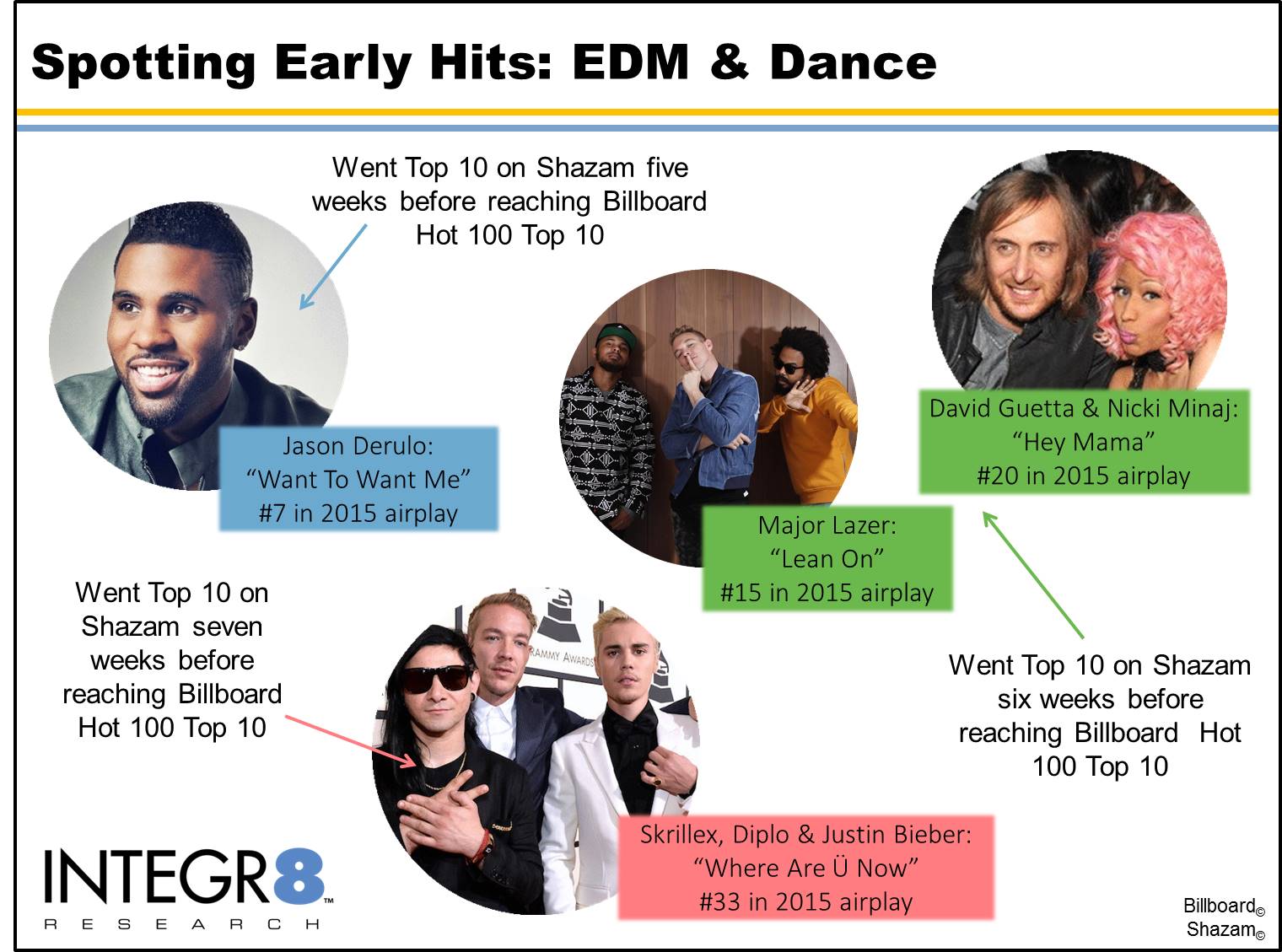
Based on its track record in 2015, Shazam can help spot hits that are sonically at the edges of CHR’s typical sound. Shazam is particularly effective at helping spot EDM/Dance-oriented songs well over a month before they become big hits on traditional charts:

Blog 2 EDM and Dance image

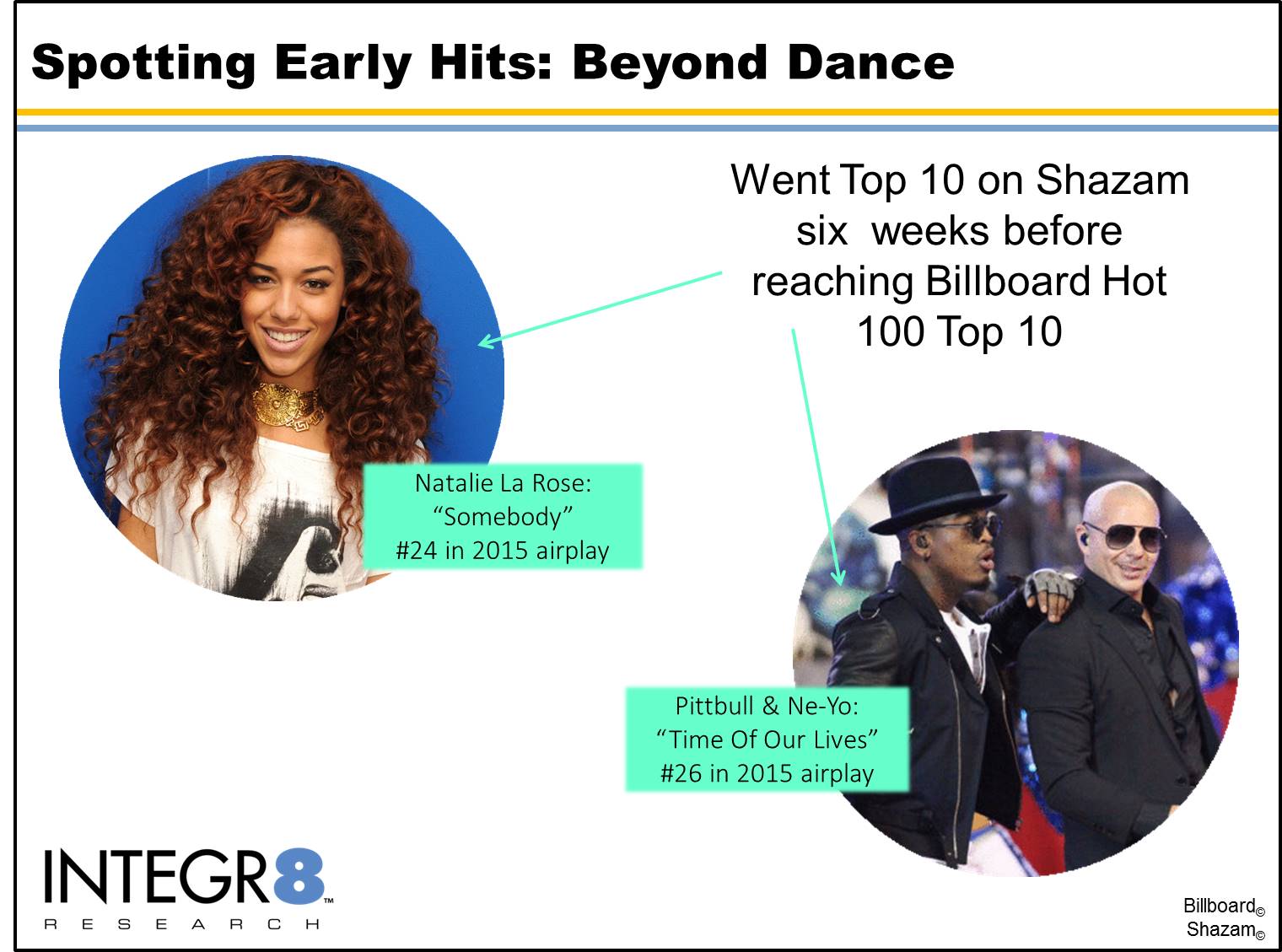
Shazam can also spot hits beyond Dance, outside CHR’s sonic norm:

Blog 2 beyond Dance

CROSSOVER HITS

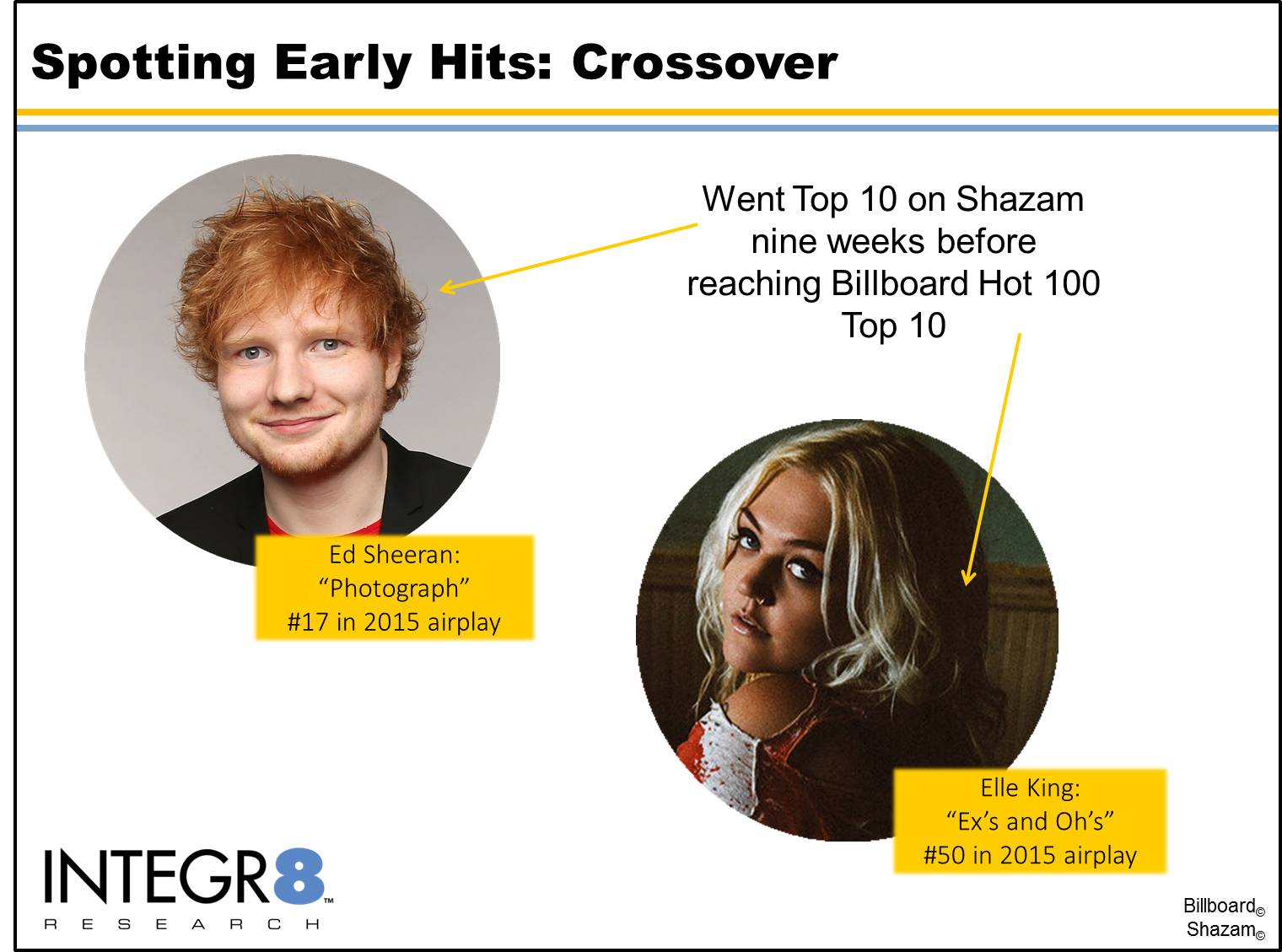
Shazam can also help spot cross over hits from other formats, especially Alternative and Hot AC:

Blog 2 Crossover

HITS IN 2016

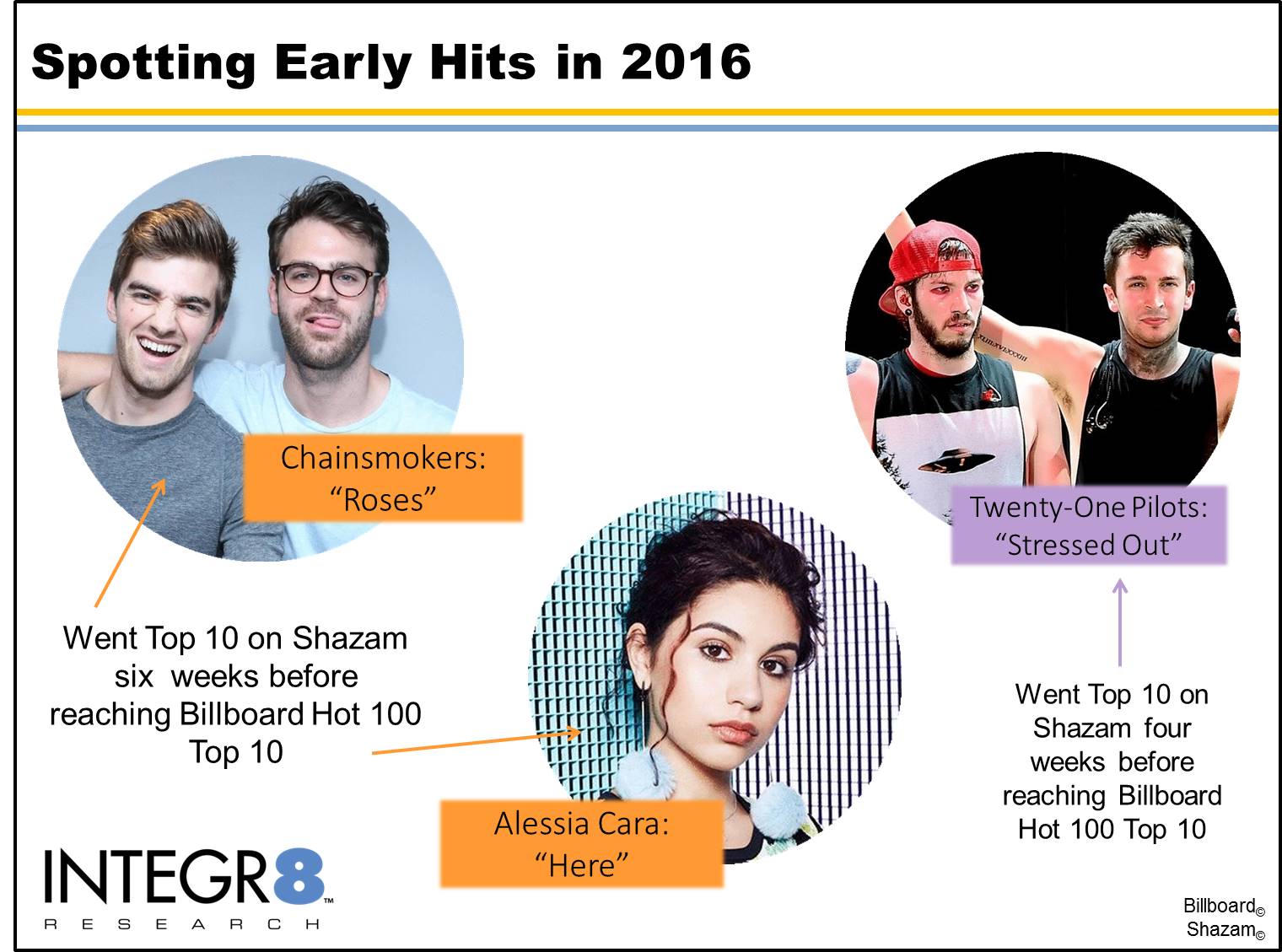
So far in 2016, Shazam has been able to spot several early hits that fall into these categories of being outside of CHR’s typical pop-oriented sound:

Blog 2 2016

WHY DO PEOPLE SHAZAM SONGS?

To understand why Shazam spots the early hit potential of these specific songs, it’s important to understand why people Shazam a song in the first place. People Shazam a song because they want to know the name of a song and who performs it. For EDM and Dance tracks where the DJ is the star, it is often impossible to identify them based on the vocals, whereas a well-known Pop star may be easier to identify by ear. A big Shazam response for a song only airing on Alternative or Hot AC can indicate a song has broader appeal beyond the format that introduced it, particularly if it’s a new artist.

The key thing to keep in mind is that people don’t Shazam a song because they want to hear it; they Shazam a song because they want to know the artist and title of the song.  Once listeners know a song’s name and artist, they stop Shazaming, no matter how much they love the song.  That’s why Shazam cannot tell you when a hit song has run its course with your audience the way customized new music research can. This distinction not only explains why Shazam is effective at spotting certain styles of songs early, it also explains why Shazam fails to detect other styles of songs just as early.

In our next post, we’ll examine what kinds of songs Shazam doesn’t spot early, as well as discuss why relying on Shazam as your only way to spot big hits early could be a mistake.

How Shazam Can Help You Predict Hits

How Shazam Can Help You Predict Hits:Part 1

How good is Shazam at predicting hits? When Shazam® emerged a few years ago, radio programmers quickly saw its potential as a hit-predicting oracle, and since then Shazam has grown so large that Mediabase® recently added market-specific Shazam data.

Shazam has a vested interest in fostering the perception that it predicts hits. Selling detailed data to record companies to guide their sales and windowing strategy is one of Shazam’s revenue streams.  Shazam’s former chief technologist Jason Titus once claimed, “Sometimes we can see when a song is going to break out months before most people have even heard of it.”

It’s not hard to find anecdotal examples of artists that Shazam spotted first, which is why we’ve always encouraged our Integr8 New Music Research clients to use Shazam in conjunction with sales, streaming, format airplay and their own custom new music research to decide which new releases deserve the most exposure. However, no one has quantified how early and how often Shazam can spot tomorrow’s hits, or which future hits Shazam is most helpful at predicting.

So we did.

We examined which songs became Top 10 most “Shazamed” songs in the United States each week during 2015 and early 2016 and tracked which songs ultimately became hits on the Billboard® Hot 100 chart. The Hot 100 tracks physical and digital music sales, on-demand and pre-programmed streaming, and terrestrial radio airplay, which makes it the most complete metric of American’s music consumption to use for comparison with Shazam. We then analyzed:

  • How many Top 10 Shazam songs went on to be Top 10 hits on the Hot 100—and how many didn’t?
  • On average, how soon can Shazam spot a song’s potential before it becomes a Top 10 hit?
  • Are there any particular kinds of hit songs Shazam does or does not spot early?

Here’s what we learned:

If a song reaches Shazam’s Top 10, there’s a 94% chance it will be a hit. 

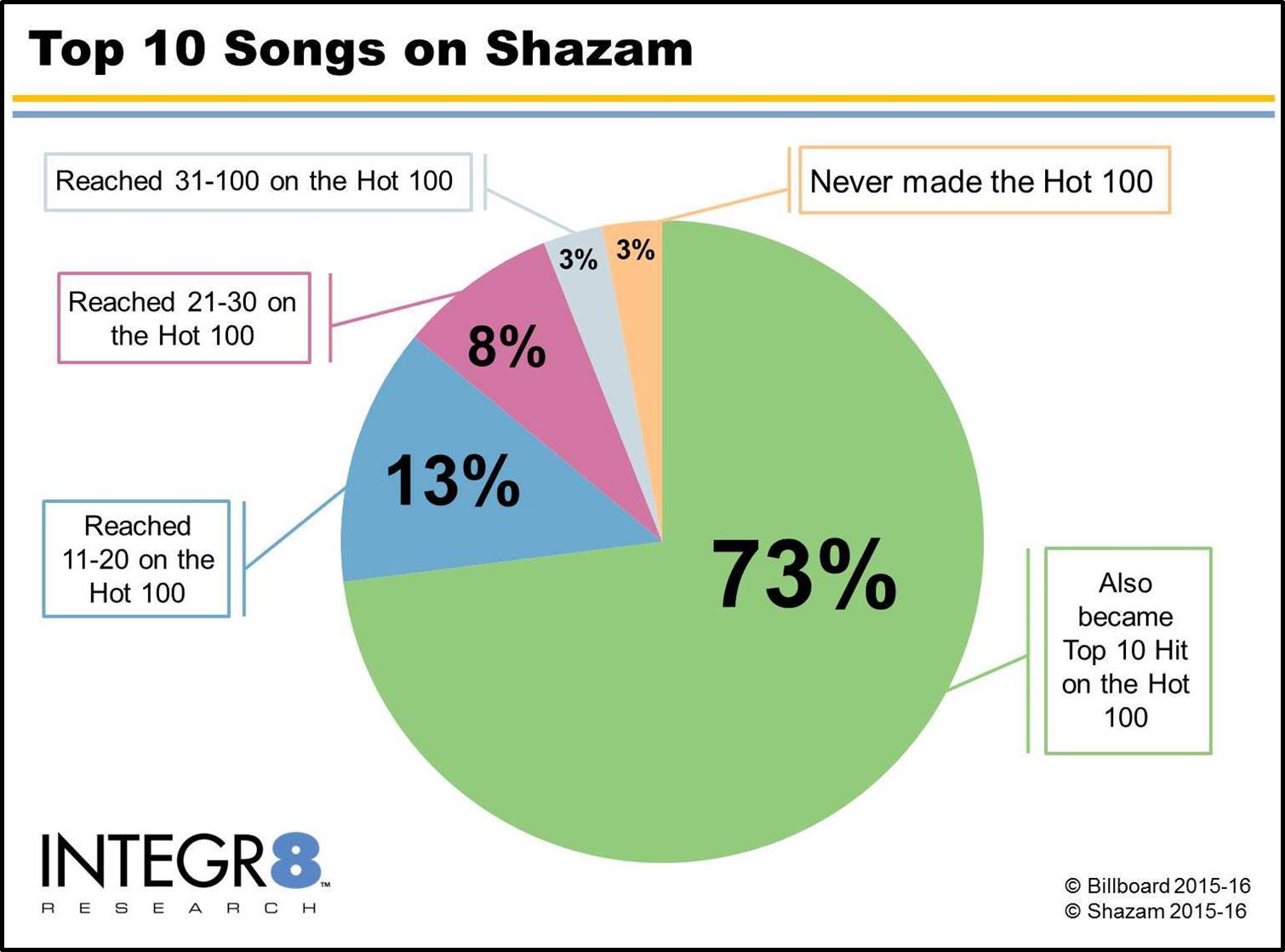
The vast majority of America’s Top 10 most Shazamed songs ultimately become hit songs, with the majority becoming big hits.  Seventy-three percent (73%) of the songs that reach Shazam’s Top 10 also become a Top 10 hit on Billboard’s 100.  Another 13% will reach the Top 20 and an additional 8% will become Top 30 hits on the Billboard Hot 100. Only 6% of songs that reach Shazam’s Top 10 never become Top 30 hits.

Integr8 graph1 blog 1

On average, Shazam predicts Top 10 hits two weeks early

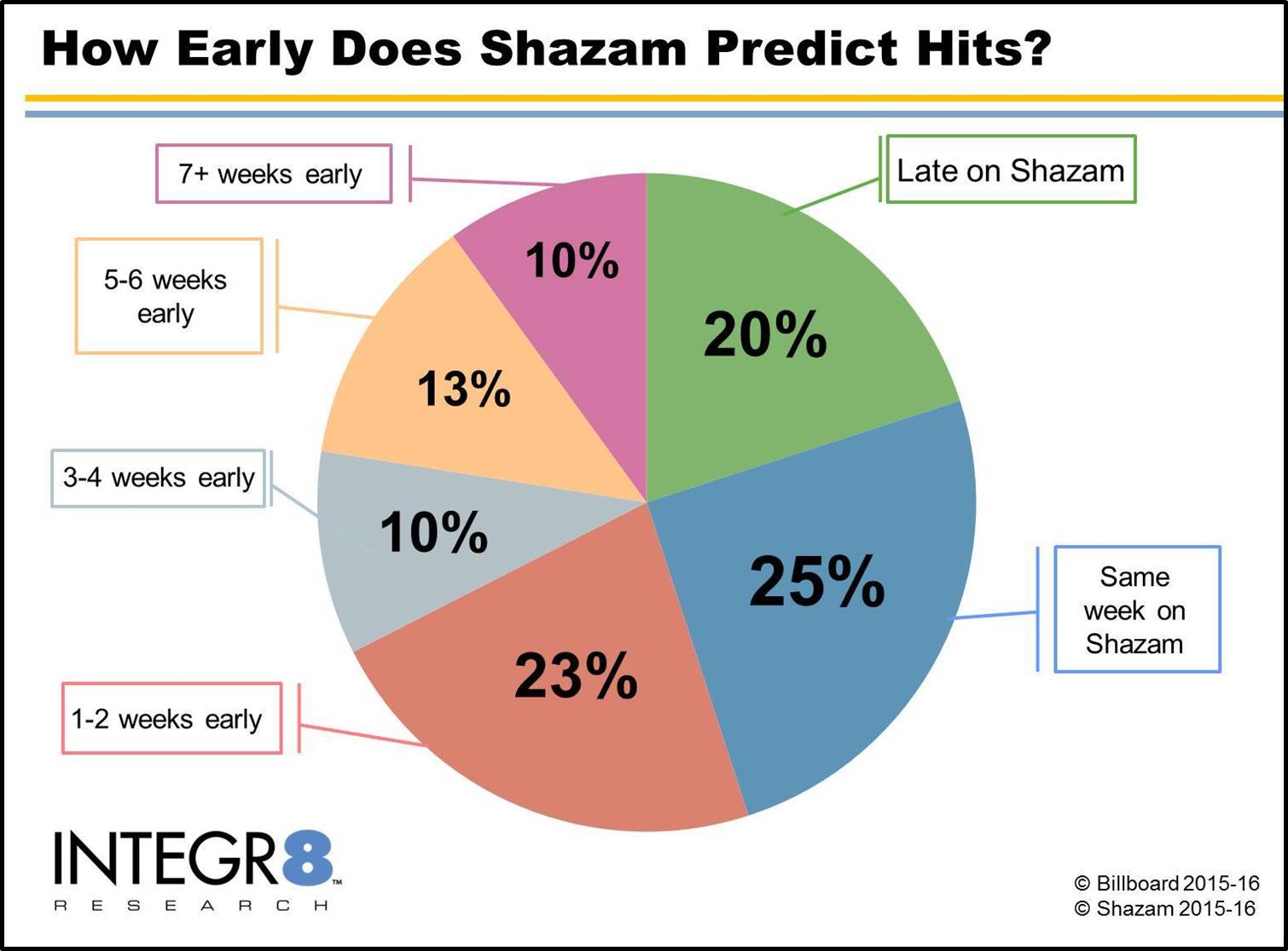
Among the 73% of songs that reach Shazam’s Top 10 and also become Billboard Hot 100 Top 10 hits, Shazam’s lead time at spotting those hits early varies widely. For 45% of songs, Shazam mirrors or even lags behind the Billboard Top 100.  In fact, 20% of songs reach the Hot 100’s Top 10 before they reach Shazam’s Top 10.

Integr8 graph 2 blog 1

For the remaining 55% of songs, however, Shazam is early:

  • Shazam’s claim that they can sometimes spot a hit, “months before most people have even heard of it,” is true for 10% of songs which become Top 10 on Shazam seven or more weeks before they become Top 10 hits on Billboard.
  • Twenty-three percent (23%) are three to six weeks ahead on Shazam.
  • Another 23% of Top 10 hits rise to Shazam’s Top 10 only one to two weeks early.

So on average, songs emerge as Top 10 hits on Shazam two weeks earlier than they do on Billboard’s Hot 100.

Clearly, the numbers show Shazam has potential to spot a significant percentage of hit songs early.  The real question is, however, is there a pattern to the styles or genres of songs that Shazam can help you spot early?  We’ll tackle that analysis with specific artist and titles in our next blog.


New Study Analyzes Shazam’s Track Record of Predicting Hits for Radio

Release of study marks the public debut of new company

Research Triangle Park, NC, May 19, 2016—Integr8 Research, the only company focused exclusively on providing custom new music research for the radio industry, announced its official public launch today with the release of its first industry study, “How Shazam Can Help You Predict Hits.”

The study examines which songs being “Shazamed” most ultimately became big hits for radio. A series of blogs will be published over the next few weeks to review the results, with part one now available at http://bit.ly/1TjHXxW. Among the study’s findings:

  • 73% of the songs that become Top 10 hits on Shazam ultimately become Top 10 chart hits.
  • On average, Shazam is two weeks early at predicting Top 10 hits.

“Programmers today have access to more information than ever about what new music is popular, but that hasn’t made picking the right new music any easier.” said Integr8 Research President Matt Bailey. “The goal with our Shazam study is the same goal we have for all the work we do:  Give radio programmers confidence that they’re picking the right new music for their stations.”

Integr8 Research provides customized in-depth insights to help clients pick the right new music, using multi-methodological recruitment and advanced survey techniques to find a station’s most relevant listeners. It is the successor to Core Call Out Research, which began providing callout research based upon highly focused samples of strategically relevant listeners in the 1980s.

About Integr8 Research:
Integr8 Research is headquartered in Research Triangle Park, NC and focuses exclusively on customized new music research for the radio industry. As the successor to Core Call Out Research, its clients include leading radio stations owned by CBS Radio, Emmis Communications, SummitMedia, Newcap Radio and The E.W. Scripps Company. For more information, visit www.integr8research.com.

Press Contact: 
Katie Dombrowski
Integr8 Research
919-917-8855
katie@integr8research.com

###