
Tag Archives: radio

Do Your Ads Fit Your Brand?

Tuesdays With Coleman

As we at Coleman Insights have learned from years of radio research, a station’s brand is vital to its success. Coleman Insights’ Brand Content MatrixSM illustrates our belief that the success of great radio stations is the result of two dimensions. First, the station’s brand strength—its top of mind awareness and perception. Second, its in-the-moment content strength—a function of how compelling the content is. The Brand Content Matrix shows the most successful radio stations marry high-quality content with a well-established brand.
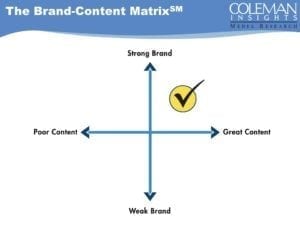
Brand Content Matrix

The content we program should fit with the brand we’ve established or are trying to establish. For example, a Classic Rock station with a harder edge should consider whether playing Fleetwood Mac, even if it tests, fits the brand. The development of a station’s brand—and making sure the brand is considered in decisions from programming to marketing—plays a very important role in a station’s continued success.

The cable TV world, where I spent a good chunk of my career, understands this. However, a cable network, especially one with a carefully and well established brand, also concerns itself with the ads it airs. That is, if it wants to maintain its brand integrity with its audience, the brand’s objectives must be woven through advertising as well as content. Commercials have to make sense in a viewers’ experience or a viewer might, literally or figuratively, walk away. With the advent of minute-by-minute Nielsen measurement and new platforms for measuring viewer engagement, ad content fit has become part of the network brand equation. This is especially true for custom ad content, like sponsorships and integrations. Networks want to be sure that ad content flows with carefully selected programming content and doesn’t provide a misguided “jolt” that disrupts the viewing experience. Yet in radio, we don’t always take that approach.

In the radio world, we also talk about “fit”, but that addresses programming elements like music and personalities. It is rarely viewed in the context of whether advertising makes sense on a station. We don’t often concern ourselves with how well an ad integrates into the listener experience. After all, an ad is an ad, and stations need ads to survive, and people are used to hearing ads, so why make any changes?

PPM tells us that “in the moment” listenership diminishes during ad breaks (though, as we found in our 2011 and 2006 studies, not as much as the industry believes). When stations strive to provide their listeners with a seamless content-to-ad experience, they can cut down on this disengagement even further. Listeners shouldn’t get the aforementioned jolt when an ad break starts, cueing them to tune out either literally or figuratively. An advertisement won’t always sound exactly like a station’s regular programming, but if an ad makes sense within the framework of the station, it will likely maintain audience engagement while it plays. More engaged listening can lead to both a more engaged audience and better advertiser ROI.

The question, then, is how best to provide a listener with an experience that is as seamless as possible. One suggested method is through localization.

When a station’s hosts, who are already known quantities to their listeners, read ad copy that is customized for the station and its metro area, listeners connect it directly to the station’s content. The voices they hear are familiar, and listeners think of a station’s host as local. Therefore, the ads make geographic sense. Using a station’s talent is also great for business. Recent studies, like one from the USC Annenberg School of Communications and another commissioned by Cumulus Media, tell us that using familiar personalities in radio ads increases purchase consideration or purchase itself, and that familiar personalities influence listeners’ opinions.

Another method would be making sure the products advertised—and the style in which they’re advertised—make sense for a station’s brand. For example, a car dealership commercial featuring a country song might feel jarringly out of place on an Urban AC. You might not want a Motley Crue music bed under a spot on a Mainstream AC station, just as hearing John Legend could be confusing on an Active Rock outlet.  If your station is perceived as “family-friendly”, are there clients with edgy spot content you need to turn away or spots you should at least daypart? Is the production quality to the station’s standards or will it reflect poorly on the product?

Not every solution will work for every station. Programmers who are fortunate to have the advantage of research—especially perceptual research—can glean a better understanding of what their brand stands for. Understanding what your brand means to your audience and the broader marketplace can empower you to view the product from every angle. This level of strategic knowledge allows savvy programmers to consider every song and piece of content. Sharing these brand insights and working collaboratively with the sales leadership at the radio station can help ensure that your station’s listening experience continues to engage your audience even when your programming is on a break.


 

5 “Stranger Things” You Didn’t Know About Radio

In honor of the release of Stranger Things 2  on Netflix today, here are 5 “stranger things” you didn’t know about radio:

  1. Radio saved the Eiffel Tower from destruction. The Parisian government planned to disassemble the tower for scrap metal. To prove it could be used as a strategic utility, designer Alexandre-Gustave Eiffel built an antenna stop the tower and funded experiments with wireless telegraphy in 1898. Today, more than 100 antennae on the tower broadcast radio and TV signals around the world. *History.com (3/31/14) 
  2. More Americans 6+ listen to radio (93%) each week than watch TV (89%), use a smartphone (83%), PC (50%) or tablet (37%). *2017 Nielsen Audio Today (6/22/17)
  3. Nikola Tesla, not Marconi, invented the radio. As early as 1892, Nikola Tesla created a basic design for radio. However, Marconi claimed all the first patents. The U.S. Supreme Court declared Marconi’s patents invalid and awarded them to Tesla in 1943, six months after Tesla’s death. Marconi generally still gets the credit. *Radiobroadcaster.org (2/24/14)
  4. Marconi was the great-grandson of John Jameson, founder of Jameson Irish Whiskey. *Clifdenheritage.org (12/1/10)
  5. Officially, from 1922-1971 you could not listen to radio in the UK without having a license. The government wanted citizens to pay ten schillings to get a license. *Radiolicence.org.uk

Why Successful Radio Stations Need Research

This week, we continue with part 2 of a blog series that revisits a column I wrote for Radio & Records in 1999 found while digging through the Coleman Insights archives.

Radio and Records

Despite significant changes in the industry over the past 18 years, I’ve been struck by how little some things have changed. I discussed four scenarios in which radio managers fail to get the full benefit of conducting research on their stations. This week, we’ll put the spotlight on:

Scenario 2 – We Have Great Numbers: A program director dismisses any need for conducting research on her station by citing its performance in the latest Nielsen book.

There is no question that Nielsen represents “the bottom line.” I worked for Arbitron, which was acquired by Nielsen in 2013, for six years and experienced how significantly the company’s data impacted radio stations first hand. This experience—and my contact with the company since I left there in 1993—taught me a great deal about the quality of the information they provide, even if there is always room to improve it.

Using Nielsen to assess how your station is doing, however, is not a very good use of their data. In fact, it is downright dangerous. Listener appetites and the competitive landscape can change so quickly that what Nielsen reported in the fall book might have little bearing on the winter results. It’s also been my experience that ratings performance and the strength of your position are not perfectly correlated.

Let’s play out a hypothetical situation. Let’s say you’re in charge of an Adult Contemporary station, currently number one in your target demo. When it comes to music, you’ve got a lot of room to play with and your playlist covers various segments of the format spanning four decades. Your morning show gets decent numbers, but at-work listening is where your station really shines. With things going so well, it would be easy to say, “Why do research”?

There are a couple of things that tend to remain constant in radio. First, you probably won’t stay on top forever. Second, if you are at or near the top, a competitor will likely try to slice into your success. What if you knew, with a great deal of clarity, where your own strengths and weaknesses lie? What if you knew the strengths and weaknesses of other stations in the market? What if you knew if the musical tastes of the market were changing? What if you knew that the awareness level and appeal of your morning show wasn’t as high as you expected? What if you discovered the broad nature of your playlist made you vulnerable to a more focused attack?

Would you rather have answers to these questions before your radio station is attacked?

A perceptual study—at Coleman Insights, it’s called a Plan DeveloperSM—can  help shore up your fort before it is too late to discover your vulnerabilities. Perceptual research can also discover what your brand stands for in the marketplace.  Stations with strong brands are far more equipped to withstand ratings wobbles than those without. Focusing on the next ratings book is a short-term strategy.  Focusing on research that builds your brand is a long-term approach built for long-term success.

What kind of research should you do and is it giving you the results you need? Furthermore, are the results being interpreted properly as part of a larger brand strategy? Next week, we’ll focus on Scenario 3 – Confusing Tactical and Strategic Research.    


The Research Methodology Trap

I was recently cleaning out the Coleman Insights archives and came across a column I wrote for Radio & Records in 1999. (Step in the DeLorean and check it out on Page 96 here.)

Radio and Records

In that article, I described four problematic scenarios my colleagues and I often encountered when radio station personnel discussed research with us. What struck me as I read the column—beyond how much younger I looked in the photo that accompanied it!—is the frequency with which we still encounter many of these scenarios. Sure, the ways listeners consume audio and the dynamics of the radio industry have changed dramatically over the past 18 years, but the fact that the points raised in my column still resonated really caught my attention.

Thus, in this four-part blog series, I’ll revisit those scenarios with some updates.  This week, we’ll focus on Scenario 1 – The Methodology Focus.

There is absolutely nothing wrong with questions about research methodology.  In fact, any manager who does not understand the methodology his or her research company is using—including the benefits and drawbacks of each element of that methodology—is selling his or her station short.

The problem with this scenario stems from where it starts. If you are dealing with a credible firm, they will propose a research program that is customized to your specific issues, rather than force a “boilerplate” 400-person perceptual study down your throat. While many firms (including ours) will have their own methodological approaches, the good ones will adapt their ways of doing things to what you need to accomplish with your research.

Instead of focusing on the technical merits or drawbacks of a potential research partner’s methodology, you should be trying to answer more important questions about them, such as:

  • “Have they demonstrated a clear understanding of what I am trying to accomplish through research?”
  • “How is their track record with helping stations in similar situations?”
  • “Do they have an agenda or will they be straight with me about what the findings say?”
  • “Will they provide me with data or will they go further and help me interpret the numbers and make recommendations on how I should proceed?”
  • “To what degree will they help me implement changes based on the research?”

Believe me, methodology is important. There is enough research out there based on poor design, dubious samples and weak quality control worthy of multiple columns dedicated to that subject on its own. However, if the relationship with the research company is built on your feelings about their methodology and not on whether they truly understand your situation and have the knowledge to help you, the odds of both parties ending up disappointed are very high.

Why invest in research when ratings already look great? Next week, we’ll focus on Scenario 2 – We Have Great Numbers.