
Tag Archives: marketing

Three Takeaways from Internet Summit

Tuesdays With Coleman

I’m a big believer that radio can benefit from conferences that are not completely radio-centric but feature beneficial and actionable sessions. One example of this is Digital Summit, which is held in 23 locations across the United States.

Coleman Insights HQ is in the Raleigh, North Carolina area, where Digital Summit’s sister event, Internet Summit is held. In the past two years, this event featured marketing icon Seth Godin as the keynote speaker, and I wrote blog posts on both occasions. There was Seth Godin’s Brand Lessons for Radio in November 2017 and last December’s Direct Marketing is Easy. Brand Marketing is Hard, one of our most read and talked about Tuesdays With Coleman entries.

One session I attended (and hadn’t originally intended to attend) was called “It’s More Than Data: We’ve Been Doing Content Strategy Wrong,” presented by Paxton Gray. Gray is the Executive Vice President of Operations at a digital marketing agency called 97th Floor. While the content of the session itself was useful and interesting, there were two other things that really caught my attention and made the visit to this room memorable.

Upon introducing himself, Gray offered the chance to win a copy of Seth Godin’s latest book, “This is Marketing” (somehow it always comes back to Seth Godin) and a $100 gift card to an attendee who comments on his most recent LinkedIn post. The post was this:

97th Floor hosts a marketing book club

There are a number of clever things about this strategy. Of course, I took the bait and went to his LinkedIn page, and before seeing the post I sent a connection request. Then I read the post, which tells you about a Book Club he started at his company. They buy a book for everyone at 97th Floor that wants one and sometimes discuss it over dinner. By asking for recommendations of books, podcasts or blogs, he’s created post engagement and increased the chances of it going viral. So of course I plugged Tuesdays With Coleman, he engaged back right away, and then I didn’t think about it for the next week.

That was until I opened my LinkedIn page to take a peek at my news feed, and guess what came up—a post from 97th Floor.

97th Floor hosts an Alumni Night

This one shared a picture of the company’s recent Alumni Night at Topgolf. The post explains how 97th Floor alumni have access to an alumni network that includes a dedicated Slack channel that allows them to stay connected and share job opportunities. Once again, it’s a post with a pretty good idea that promotes company culture without having to say, “Our culture is awesome!” (Sidebar: if that’s how you promote company culture you might not have a great company culture.)

There are ideas and inspiration to be found outside the lines of where you’ve always expected them to be. So this year’s takeaways for the radio industry are:

  1. Attend a non-radio conference.

We love radio conferences, including the always great Worldwide Radio Summit. Radio is embracing Podcast Movement, a very wise move. But do you think radio could benefit from a conference like Digital Summit, which is loaded with sessions on items like website optimization, social media, SEO and email marketing?

I do.

  1. Start a book club.

In our fragmented world (see last week’s blog, Disney+, Decision Paralysis and Your Brand for more on fragmentation), we’re all consuming different content. The thought of having programming and sales reading the same book, listening to the same podcast, subscribing to the same blog and then comparing notes feels like a good way to improve communication and learn some new things together in the process.

  1. Embrace alumni.

While the idea of an alumni network may not be transferable, we do know radio loves a good reunion and that listeners build connections with personalities. Often their favorite personalities go away, never to be heard from again. By periodically embracing its past, radio can find another outlet to maintain the bond between listener and station.

Thanks to Paxton Gray for the inspiration for today’s post. Keep those ideas flowing!
4 Lessons From the Last Blockbuster Video

Tuesdays With Coleman

There is no reason why a Blockbuster Video should still be in business.

But in fact, there are quite a few reasons it is.

And when you’re the last one standing in a business segment that many might perceive is from the Mesozoic era, it’s probably a good exercise to ask the obvious question…

How is the last Blockbuster still in business, and what can I learn from it?

The last Blockbuster Video on Earth is in Bend, Oregon—population 94,520.

No kidding, if you go to Blockbuster.com, there is a link that says, “Blockbuster Store Location” that pops up with only the Bend store.

Just 15 years ago, there were 9,000 Blockbusters on Earth, and generally speaking, we all know what went wrong.

Blockbuster missed the move to DVD-by-mail (it even passed up the chance to buy Netflix for $50 million in 2000. Oops). Blockbuster missed the move to DVD in a box (Redbox). It missed the move to streaming. And, perhaps the biggest self-inflicted wound was the dreaded customer-service killing late fee.

So, we know why Blockbuster closed. What’s the last one doing open?

Is it because Bend is such a small town? Doesn’t hold water. Bend is a Nielsen rated market (#196), and what about all the smaller areas that had Blockbusters?

Is it because Bend doesn’t have high speed internet? No. It does.

Well, what? What is it then??

LESSON 1: Promote what differentiates you

When you walk into the last Blockbuster on Earth, the employees wear gear and they sell t-shirts that scream, “Last Blockbuster in America!”. You can buy a “Last Blockbuster” sticker for $2.

It could very easily just be the last Blockbuster on the planet and not tell anyone about it. But what’s the fun in that?

Media brands make subtle changes to their strategies and hope the audience notices. Or, the positioning doesn’t cut through. That’s not how you build an image.

A great exercise for any brand is to think about what truly makes it different. Why consumers choose it over other brands. You may find it’s not what you’re promoting now.

Once you determine what that differentiator is, you hammer it like you’re the last Blockbuster on Earth.

LESSON 2: Use memories and nostalgia

A man drove 1,000 miles to the last Blockbuster because, he said, he “just wanted to relive [his] childhood”.

Its social media is littered with photos of customers taking pictures of themselves at the last Blockbuster on Earth.

Blockbuster brings back memories.

You know what else brings back memories? Music. Funny, radio can be pretty good at capitalizing on emotion too when it remembers to tap into it.

LESSON 3: Make your brand easy to use

We’ve covered the paradox of choice too many times to count in this blog. Today’s consumers are overwhelmed with choices and “subscription fatigue”. A customer at the last Blockbuster on Earth compares Netflix to a dating app. “You’re on it for hours, it’s almost overwhelming.”

No, it is overwhelming.

Customers appreciate the incredible customer service and recommendations provided by the staff at the last Blockbuster on Earth.

Radio is free and already curated. Make the listening experience as easy, painless and personal as possible.

LESSON 4: Make it a fun place to work

When I was a radio program director, you could always tell which station in the cluster was mine. The studio of the last station I programmed was the one with the inflatable couch and the autographs of the station’s celebrity guests on the orange wall that the air staff painted on a Saturday while listening to the new Kings of Leon on repeat.

Just as listeners can tell if your team is having fun, so can customers of every business.

The employees at the last Blockbuster on Earth clearly love working there.

There are pictures of them through the years in the owner’s office.

They write handwritten notes, have been known to offer home delivery, and host movie trivia nights and movie dance parties.

If the last Blockbuster on Earth can thrive, your radio station can too.

Just run it like it’s the last Blockbuster on Earth, and you’ll be just fine.

Be True To Your Base Position

Tuesdays With Coleman

Does your brand have a base position? No matter what industry, whatever the size of the company…you must have a clearly understood base position.

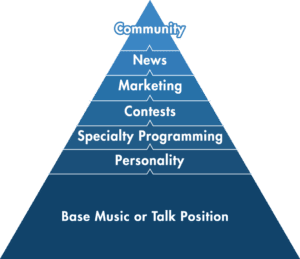
When we work with radio stations, we often refer to the foundation of our Image PyramidSM—the base music or talk position. For the other components of the pyramid (personality, specialty programming, contests, marketing, news and community) to enhance the performance of your station, listeners must instantly understand the basics of your brand.

Coleman Insights Image Pyramid

Is it the rock station? The sports station? The hit music station?

It’s not only essential for listeners to understand your base position in a simplistic way—you have to understand it as well. It has to be in the fabric of everything you do.

My wife Sharon and I are “foodies” who love to explore the burgeoning restaurant scene where we live in Raleigh, North Carolina.  One of our favorite restaurants clearly has a base position.

Royale is a French-American bistro that opened in November 2016 and at the time, the only way to make reservations was via Instagram. The menu was limited, with no more than five or six entrees choices available. Still, the food was delicious, the service was outstanding and the atmosphere was hopping. After one or two visits, you couldn’t help but have a strong and clear perception of what Royale was all about.

Royale is a hip, downtown Raleigh hotspot with high quality French-American food.

That’s their base position.

Over five or six dining experiences since, we have observed changes to Royale.

You can now make reservations online—albeit only on Resy, not on OpenTable—or even by phone. The menu includes more choice while retaining its distinct French-American flavor. Heck, they now even have a nightly special.

These changes allowed Royale to broaden and become more mass appeal without compromising their base position.

By evolving and staying true to their base position, Royale added brand depth—similar to how a radio station adds brand depth with personalities and contests. Just as radio stations need to establish a clear understanding of their base position before focusing on other elements, Royale set a defined expectation of what the brand stands for.

Restaurants have a wide range of strategic options at their disposal, just like radio stations.

Royale could have looked to expand their customer base by, for example, lowering prices. That would have compromised the quality promise in their base position. They could have started accepting coupons or expanded their menu options outside of French-American cuisine.

These moves may offer short-term gain but in the long run would be severely detrimental to the brand.

Just like restaurants, radio stations evolve and add brand depth. That brand depth, however, has to be in concert with the base position or it will erode the brand.

It’s as true in the restaurant business as it is in radio. When you add depth while remaining true to your brand, the sky is the limit.

Reducing Friction On Your Radio Station – Part 1

Tuesdays With Coleman

Friction is a hot buzzword in marketing these days. It refers to obstacles in the customer experience.

Can’t find the “submit” button on a form? Friction.

Pop-ups getting in the way on a website? Friction.

Getting charged unexpected fees? Very irritating friction.

Are you adding friction to your radio station?

How much has changed in the ways radio station personnel deal with listeners?

Still asking for caller 9 to win a pair of tickets to the home show, only for the listeners to get a busy signal?

When a listener wins from a town an hour away from your studios, do you tell them you’ll mail the prize or do you tell them they have to pick it up because “that’s the policy”?

Do you make fun of “prize pigs” and tell them they can only win every 60 days, essentially inviting them to listen to another station? Or, do you celebrate people who are actively engaged with your content?

When a listener makes a request, do you tell them, “I’ll see what I can do”, or “I’ll get that right on for you” or “It’s coming up” (even though it isn’t coming up for 15 hours)?

Does your website make it easy to connect with the team, from the General Manager to the jocks? Is there an easy way for them to provide feedback?

Are you engaging with your audience on social media or using it as an advertisement, leaving their comments hanging?

Are you only allowing people within your metro to stream the station (and is that worth it)?

Are you paying attention to the spots and promos on the stream? Is it playing the same PSA over and over again, making it unlistenable?

What do Amazon, Southwest Airlines, Nordstrom, and your radio station have in common?

They are all brands.

What if you treated your listeners the way those brands treat their customers?

Strong brands research, develop a plan from the findings and execute the plan.

Friction is the enemy of plan execution.

Next week in Part 2 of “Reducing Friction on Your Radio Station”, we’ll discuss how radio stations can reduce friction by utilizing research to present a more cohesive product.


Jay Nachlis Adds Marketing Director Duties at Coleman Insights

RESEARCH TRIANGLE PARK, NC, January 26, 2018 –

Coleman Insights announced today that Jay Nachlis has added the title of Marketing Director at the media research firm. Nachlis was hired as an Associate Consultant in July, 2017. The announcement was made by Warren Kurtzman, president at Coleman Insights.

“Companies succeed when they identify needs and then put people who have the talents and desire to fulfill those needs in place,” said Kurtzman. “Very shortly after Jay joined us last year it became very clear than in addition to the great work he was doing for our clients, his marketing orientation could also be put to great use by our company. That we are placing him in this unique dual role is a testament to what he brings to the table.”

“I’m thrilled to take on heading up marketing initiatives for Coleman Insights, you can visit their homepage and learn about our approach ” said Nachlis. “It’s such a unique opportunity. On the one hand, I get to work with clients and help maximize their success. At the same time, I get to tell the Coleman story and introduce our work to potential clients. That’s pretty special.”

Nachlis will have the newly created title of Associate Consultant/Marketing Director. He has more than two decades of programming and marketing experience, including on-air, music director and program director positions in San Francisco, Buffalo, Detroit, Syracuse, and Raleigh-Durham.

About Coleman Insights

Coleman Insights, headquartered in Research Triangle Park, NC, with offices in Philadelphia and Hamburg, Germany, is a firm that has helped media properties build strong brands and develop great content since 1978. Its clients include hundreds of media properties in North America, South America, Europe and Asia, including those owned by Emmis Communications, iHeartMedia, Entercom Communications Corporation, Univision, Bonneville International Corporation, Hubbard Radio, Newcap Radio, SummitMedia, Bauer Media, Salem Communications, Connoisseur Media, Corporación Radial del Perú, Neuhoff Media, Delmarva Broadcasting Company and Townsquare Media. Additional information about Coleman Insights is available at www.ColemanInsights.com.


Click here to download press release