Tag Archives: apple podcasts

Apple Podcasts Is in on Video. Will Users Notice?

Apple announced this past week that it will introduce advanced video capabilities in its Apple Podcasts app this spring, including seamless switching between watching and listening and dynamic video ad support, and that is indeed a very big deal. But video podcasting isn’t new for Apple.

Apple brought podcasts into iTunes in 2005 and supported video podcasts via RSS from the very beginning, offering both audio and video shows side by side. While there were technical limitations in that early RSS-based video implementation, including playback and monetization challenges, Apple effectively led the way in mainstream audio and video podcasting. Apple never stopped supporting video via RSS; it effectively stopped highlighting it. Those video feeds were siloed, the UI de-emphasized them, and search behavior generally pushed you to audio unless you specifically searched for terms like ‘video.’

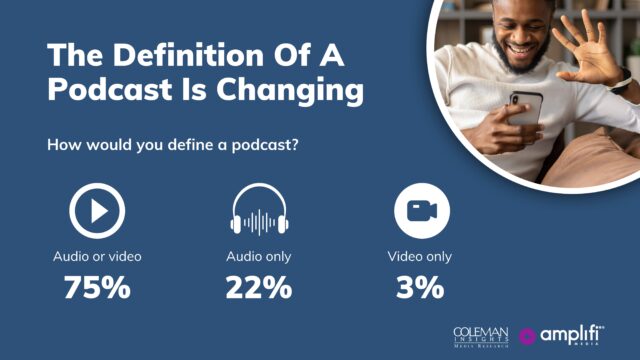
Meanwhile, a behavioral sea change took hold of the podcasting world, with a grip that isn’t going away any time soon. Amplifi Media’s Steve Goldstein and I, in our first video podcasting research study of U.S. podcast consumers 15-64 in July 2023, noted that consumers were reporting YouTube as their #1 podcasting platform. Even more interesting to us was something bubbling under the surface — the way consumers described podcasts was changing. In that study, 75% of podcast consumers defined podcasts as audio or video, while only 22% described podcasts as audio-only, despite the industry anecdotally seeing itself as an audio medium. The results of our March 2025 follow-up, “The State of Video Podcasting,” were striking in how fast this was moving. It showed that 85% defined podcasts as audio or video, compared to just 13% that said audio-only.
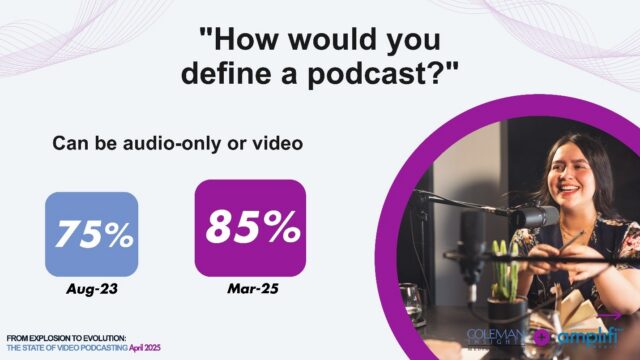
Reported podcast usage shifted in tandem with this shift in usage and definition, with a massive 77% of podcast consumers reporting they alternate between audio and video in the 2025 study.

YouTube was (and is) the biggest beneficiary of this, as it increased its lead in reported platform usage. To say this consumer shift has been a disrupter would be selling it short. Spotify pushed its chips in on video. Netflix recently announced its new initiative. The New York Times embraced video. Networks, creators, and agencies are all attempting to navigate the new world order.

A deeper look at Apple reveals bigger issues.

Transistor’s Justin Jackson, looking at our 2025 data, pointed out that Apple Podcasts has an aging problem: among younger listeners, especially 18–24, Apple’s usage drops into single digits while YouTube and Spotify enjoy dominant leads.
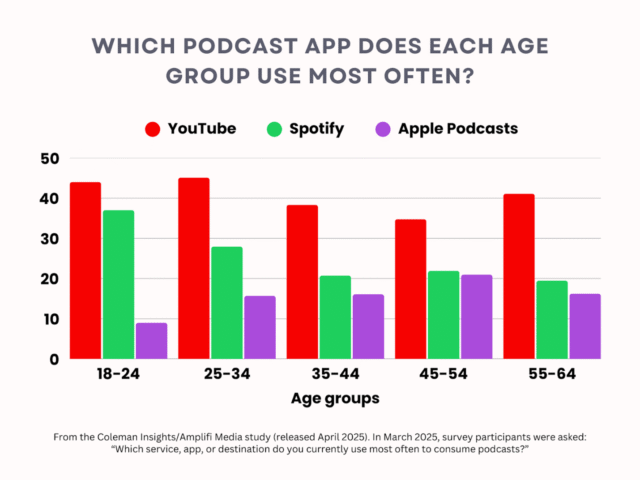
Apple Podcasts video gen z

That’s not a problem video alone is going to fix.

Most pieces on Apple’s news seem to focus on the technical side of things. Instead of leaning on the old RSS‑based video feeds, Apple will now ingest video via its HLS streaming tech, enabling adaptive quality and seamless audio/video switching for users. On the monetization side, HLS also allows dynamic insertion of video ads. The industry does (and should) care about Apple’s move.

But this all begs a very (I would argue most) important question…

Will consumers care?

This isn’t to say this isn’t the right move by Apple. It absolutely is. As Tom Webster pointed out last week in referencing Sounds Profitable research, “About 42% of Apple’s video podcast consumers are spending more than half their podcast time watching video. These aren’t reluctant video viewers. They aren’t people who need convincing. They already want video — they’ve just been going somewhere else to get it.”

Although plenty of Apple engineers would surely disagree with me, the technical build was the easy part. The hard part is connecting the brand perceptual dots and tracking progress.

Consumers use YouTube for video because they think of it for video. Their satisfaction with the platform keeps them there. That massive image presents the biggest challenge for any other podcast platform to effectively compete in video, and that includes Spotify and Netflix, despite all their resources.

The long-term success of video on Apple Podcasts will be determined by Apple’s ability to first build awareness of the native app on the iPhone, particularly with younger consumers who may have no idea it’s there. In conjunction with and after this, the experience must not only be perceptually strong but should offer at least one important point of differentiation. In other words, if I’m already using YouTube to watch videos and Spotify to stream my music, why shouldn’t I stay there for my podcasts? What’s special about Apple that pushes me to open the Apple Podcasts app?

Kudos to Apple for getting (back) in the game. The focus they put on technical capabilities now needs to be matched by an equal focus on perception and positioning, because that’s ultimately how this move will be judged.
Why Podcasters Must Urgently Adopt A Video Strategy

Good morning from the world’s largest podcasting conference, Podcast Movement in Washington, DC! From the first time I attended this great event in Philadelphia six years ago, I felt an energy that always excites me about returning.

No one should debate podcasting’s strength as an audio medium. Like radio, there is power in the spoken word, in the ability to paint mental pictures and tell stories. It is magically portable. Easy to listen to on the go, whether in the car, while taking a walk, or riding the subway.

If you think about the ways early podcast consumers listened to podcasts, you might visualize this:

Apple Podcasts

Photo credit: Mojahid Mottakin / Shutterstock.com

The Apple Podcast logo was essentially the de facto logo for the medium, a true indication of the power of branding. Apple was the right platform for podcasting because the app was native to Apple devices—no need to go to the App Store and download it.

But consumer habits change.

While iOS is still the leading operating system over Android in the United States, it’s not by a ton (about 60%-40% according to TechRepublic), and globally Android dominates iOS (about 70%-30%).

So, it’s no longer just about the convenience of the native app on your phone. It’s what brands win the mind of the consumer. And it’s important to note some crucial changes that have taken place.

While Apple is a favorite of many creators, a remarkable thing happened to two other platforms on the consumer side.

  • Spotify went from 30 million active users in 2013 to 626 million in 2024.
  • YouTube went from 532 million active users in 2019 to 868 million in 2023.

Consumers made a behavioral shift to Spotify and YouTube because their brands grew, and they offered content their audiences found appealing. If you’re not putting extra energy into these platforms, you’re not fishing where the fish are.

One year ago, I presented the landmark “New Rules of Podcasting on YouTube” study at Podcast Movement in Denver with Steve Goldstein of Amplifi Media. This benchmark research project explored the perceptions and usage of video among American podcast consumers. Here are three key takeaways.

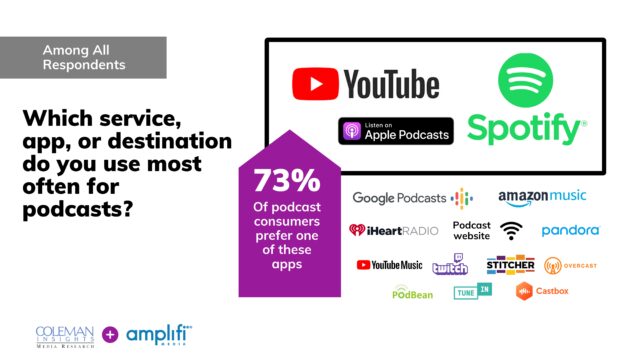
  1. 73% of podcast consumption is dominated by three platforms…YouTube, Spotify, and Apple.

One of these platforms is all video. One has publicly stated in recent months that it is going all-in on video. On my personal Spotify account, I’m now getting video podcast recommendations on my home page before audio versions.

  1. Consumers don’t see podcasting as an audio-only medium.

We were intentional in our study to not use the word “listen” when referring to a podcast because we felt it was important to understand whether consumers see podcasting as an audio-only medium. They used to, but they don’t anymore.

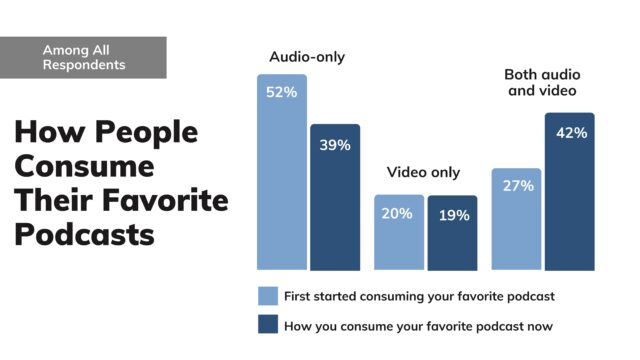
  1. More podcast consumers now say they consume their favorite podcast via audio and video than just audio.

If a fan of your podcast searches for a video version and it’s not there, do you think YouTube or Spotify’s algorithms will suggest other shows that will take your audience away from yours?

Of course they will.

After I presented this study, many subsequent conversations followed with creators and networks. We acknowledged that there is no “one size fits all” video solution for every podcast. Not every podcast needs to, or even should, offer complete episodes on video. Even if starting with the usage of video as a marketing tool, using trailers and clips, it is a great place to begin the journey.

And yet, there were two words I knew I could count on hearing from all of them.

“Yes, but”.

“Yes, but the views are miniscule relative to the time we spend”.

“Yes, but YouTube’s advertising restrictions are horrible”.

“Yes, but no RSS feed”.

“Yes, but we can’t sell it”.

“Yes, but I don’t have the staff”.

“Yes, but it’s a trend”.

As my therapist might say, your feelings are valid. But they miss the big picture.

Most of the research I conduct for podcasters at Coleman Insights is perceptual research. We may take a deep dive, for example, into the behavior of fans of Kids & Family podcasts or fiction podcasts. Maybe we’re digging into perceptions of sports podcast users.

This type of research is very different than top-line usage analytics, which don’t dig into brand images that influence behavior. Perceptions in podcasting are changing, and that is changing behavior.

In a couple of hours at 10:15 AM EDT, I’ll join a panel for a session called “Stop Leaving Impressions On The Table: Vodcasting Is Podcasting” moderated by Carl Weinstein, COO of Locked On Podcast Network. Locked On features a local podcast for every team in every major sport. Weinstein’s network jumped into vodcasting (video podcasting) years ago, and fully resisted “yes, but”. I asked him a few questions about their experience.

Q: When did Locked On embrace video? Why was it important for Locked On to embrace it early, when most podcasters are only now considering it as an integral part of their strategy?

A: We began adding the video simulcast of all our podcasts to our entire lineup in 2021. It was less about embracing it early than it was about meeting the audience where they were. The signs were already there in 2021, actually before then, that the audience was already defining a podcast differently than the industry was at that time. To reach the total potential audience, we needed to move towards them and could not expect them to move back towards us. We jumped in with both feet and never looked back.

Locked On Podcast Network Chief Operating Officer Carl Weinstein

Q: How has it performed compared to audio and what are some of the key differences? Why do you think it’s been so successful for you and not as successful for others?

A: Performance has been amazing. I think largely because we tapped into a totally new audience and also because discovery on the primary video platform, YouTube, is so much better than discovery on the traditional audio podcast apps. Hard for me to speak to what others are experiencing, but I think for us, we are tailor-made for the video platforms and experience. Our podcasts are daily, our podcasts are shorter than most others in the market (30 minutes or less), and we cover sports, targeting one of the most passionate, widest-reaching affinity groups in media.

Q: Seems many creators are concerned about tracking and attribution with YouTube. How have you handled that?

A: We have an amazing advertising ops team. We have developed our own systems and processes for tracking and reporting and have worked with our advertising partners to optimize each for their needs. We are also on OTT, both VOD (Video On Demand) and FAST TV (Free Advertising-Supported Streaming Television), so with each platform we must address a unique set of requirements and needs. Not necessarily easy, and certainly time and resource-consuming, but totally doable and worth the effort.